The article examines how South India emerged as India’s aviation leader through strong economic activity, connectivity, industrialization, business travel, and sustainable regional aviation growth.
Syllabus Areas:
GS III - Economy
The South - AP, Telengana, TN, Karnataka, Kerala - dominates aviation.
In the year ’25-26, Southern airports carried one crore more passengers than the north, and 1.44 crore more than the west.
Interestingly, a decade ago, the race was much tighter.
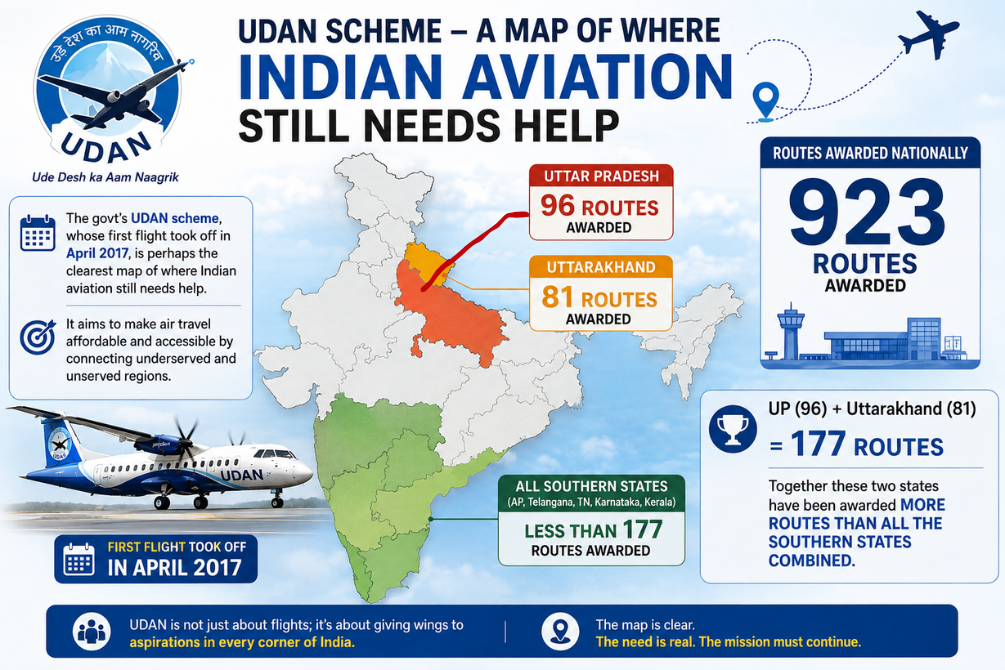
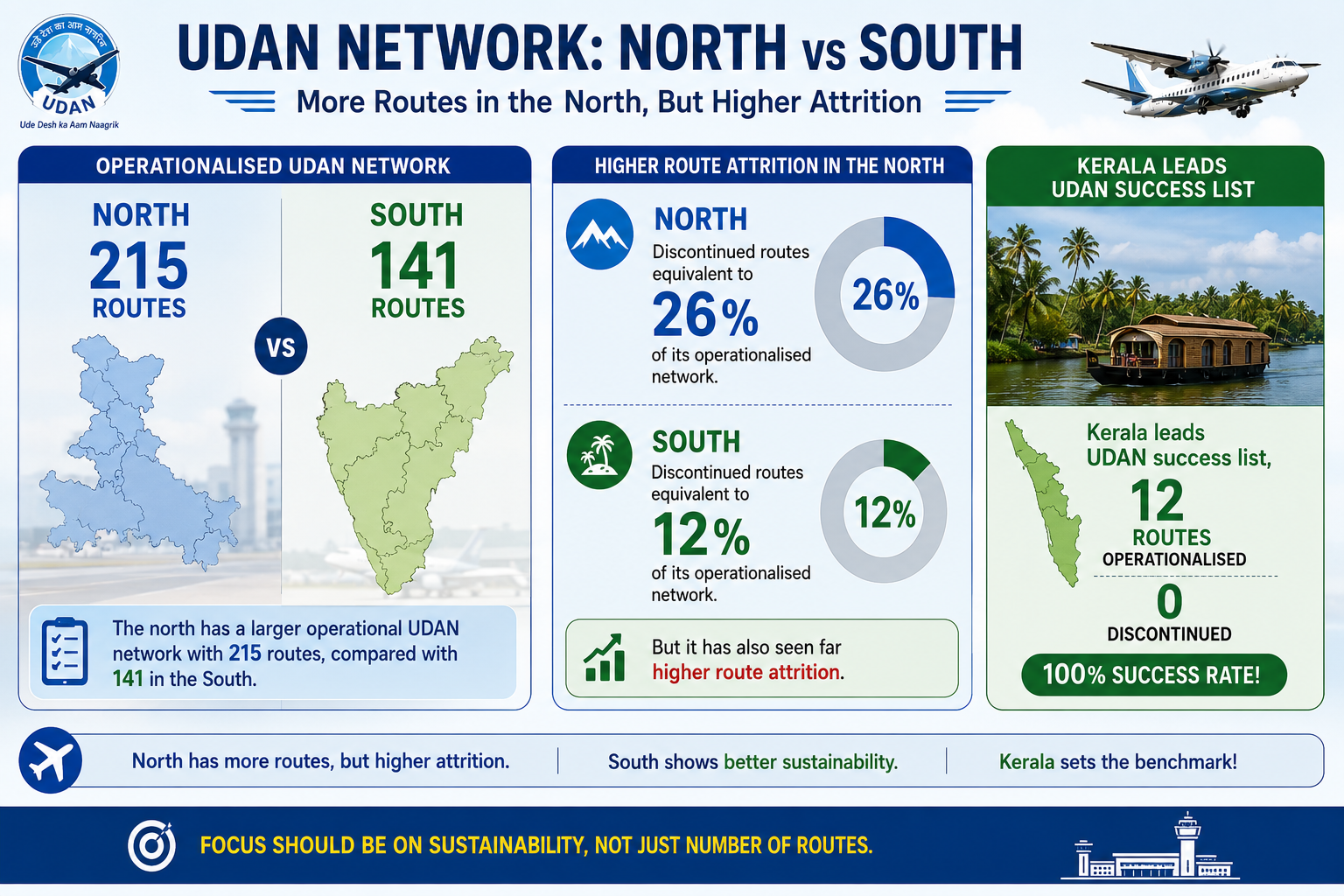
But awarding routes is one thing. Survival is another.
In UP, UDAN flights commenced on 56 routes, but 30 were shut within 3 years, the highest discontinuation for any state. Uttarakhand followed with 16 discontinued routes. Assam with 12.
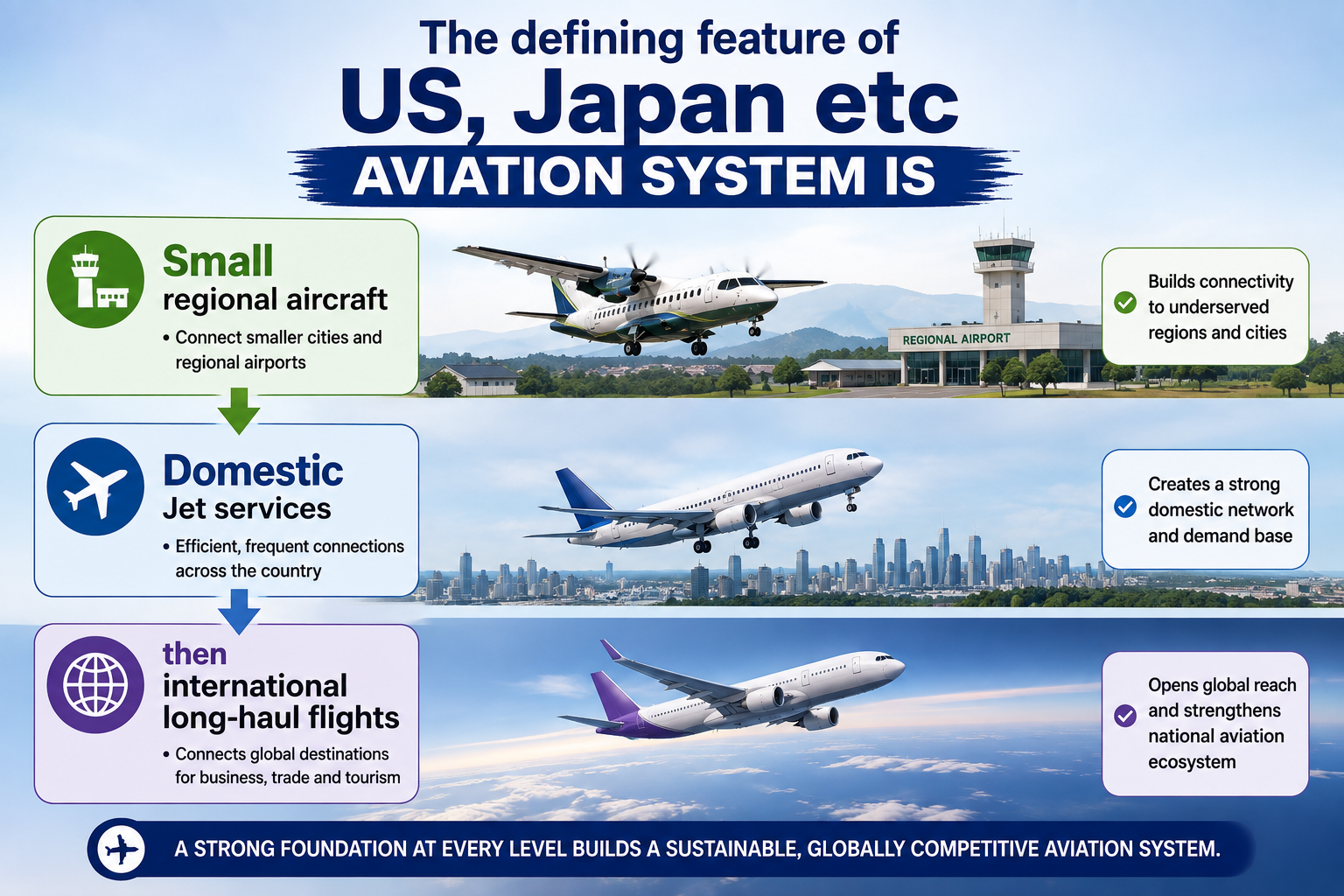
This structure is now increasingly visible in South India.
Rajahmundry as an Emerging Aviation Hub
-
Rajahmundry (RJY) is a major textile hub, often called the “Bombay of the South.”
-
IndiGo and Fly91 together operate around 10 daily flights between Hyderabad (HYD) and Rajahmundry (RJY).
-
Rajahmundry is also connected by non-stop flights to major cities such as:
-
Delhi
-
Mumbai
-
Bengaluru
-
Chennai
-
This connectivity shows how Tier-2 cities like Rajahmundry are becoming important aviation centres in South India.
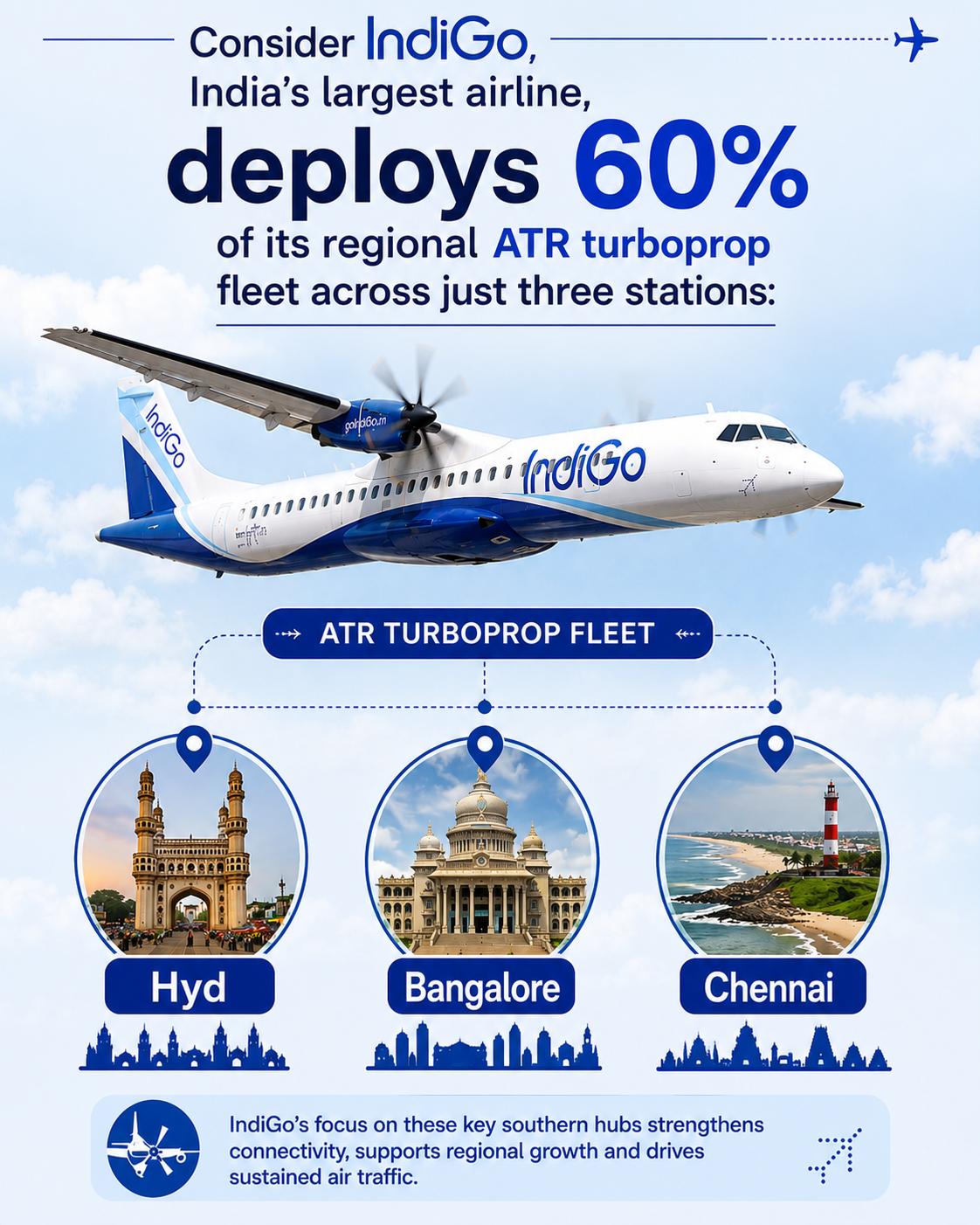
ATR turboprop = a small aircraft with propellers, mainly used for short-distance flights.
-
Connects small cities and towns
-
Suitable for short routes
-
Uses less fuel than large jets on short flights
-
Helps connect Tier-2 and Tier-3 cities to major cities
What makes South Leader?
-
Demand in the south is not just reliant on one or two metros, but distributed across a network of economically active cities.
-
They have strong interlinkages across technology, manufacturing, healthcare, education, exports.
-
This creates more diversified traffic base, for ex:
-
Tamilnadu has Chennai, Coimbatore, Madurai, Salem, Tiruchunapalli, Tutikudi
-
Karnataka has Bengaluru, Mysuru, Hubli, Belagavi
-
Andhra Pradesh has Vizag, Tirupathi, Rajamandry, Kaddap, Kurnool.
-
South’s passenger strength is rooted in its economic structure, airport infrastructure network, presence of key cities, which generate frequent business travel to both domestic and international destinations
-
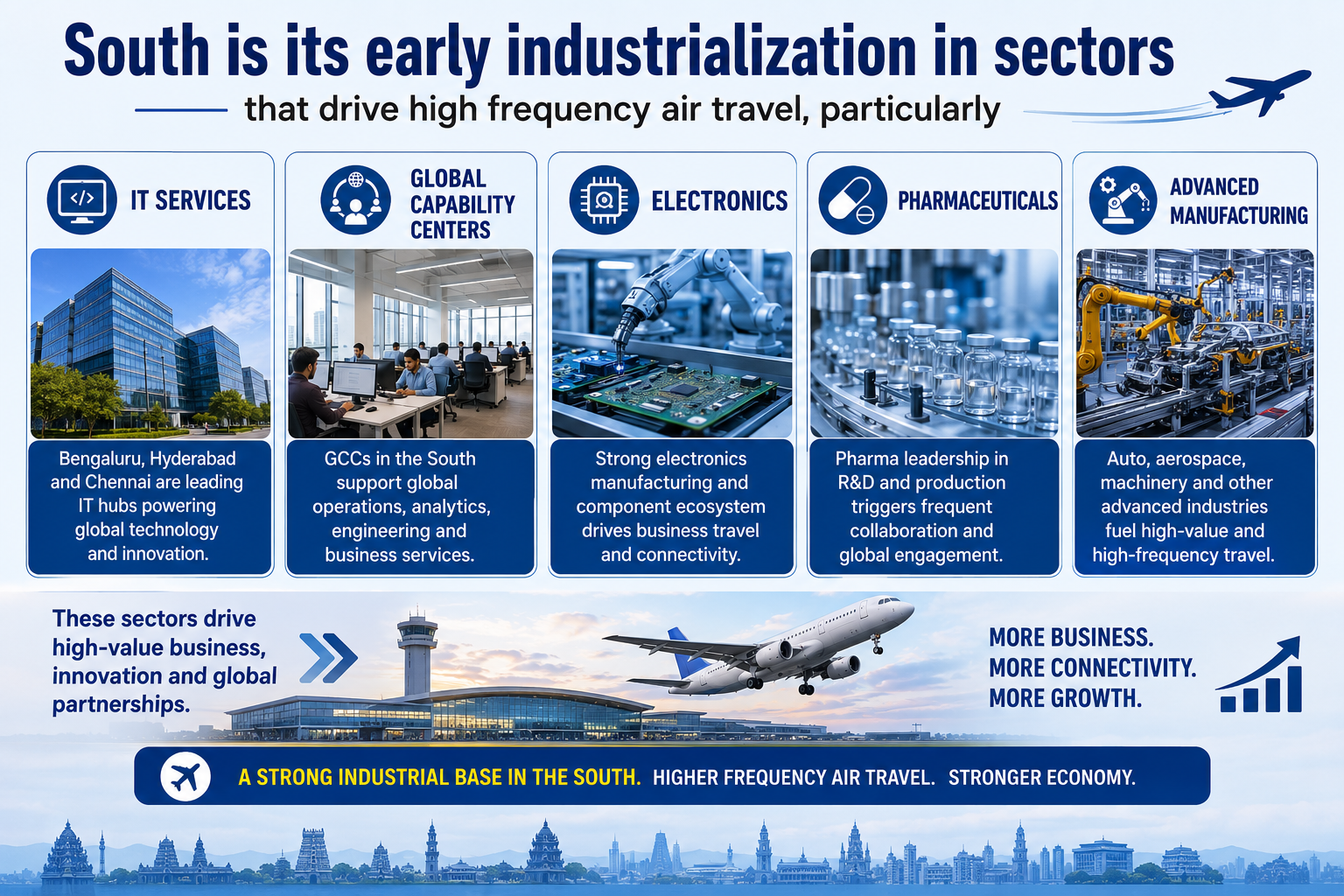
The growth of IT services in Bengaluru and Hyderabad, along with startups and venture capital, creates more business travel. As a result, short-haul domestic travel increases, and international air traffic also grows.
-
These attract talent from across country creating sustained air traffic
-
Then cities function as national business gateways with deep domestic and international connectivity needs.
-
At the same time, Tier-2 markets are more integrated into the formal economy, sustaining demand beyond metro-to-metro routes
-
As GCC multiplies across regions and data centre investments pour-in, that demand base keeps compounding.
-
Economically anchored routes tend to deliver more stable, recurring passenger flows over time.
Kerala Success story
Heavy International traffic
-
At Kozhikode, 76% of all passengers are international travellers.
-
At most Indian airports including Delhi and Mumbai, the typical split is 30% international and 70% domestic.
-
Kerala’s overseas traffic is driven largely by Gulf links and the migration economy.
Infrastructure has also played decisive role in South’s aviation success story
-
Delhi and Mumbai operating beyond comfortable capacity for decades.
By contrast, South entered the modern airport era with newer runways and cleaner blue print. -
Today 4 of Indian ten business airports by passenger traffic are in south
Bengaluru, Hyd, Chennai, Kochi. No other region matches that concentration.
Inverting Aviation History
-
Indian Aviation began its commercial journey in West in 1932, JRD Tata flew his historic airmail service from Karachi to Mumbai via Ahmedabad.
-
For decades thereafter, Mumbai had India’s business airport and the western corridor remained the gravitation centre of Indian flying: the busiest routes, the thicker traffic of national carriers, Headquarters of national carriers.
-
But Mumbai’s congested airport could not keep pace with demand. Later Delhi became the busiest airport.
-
Indian Aviation once moved along the west to north axis, from Mumbai to Delhi.
The next chapter is with South:
-
Business cities
-
Temple Towns
-
Gulf gateway
-
Textile hubs
-
Technology centres
-
new airport