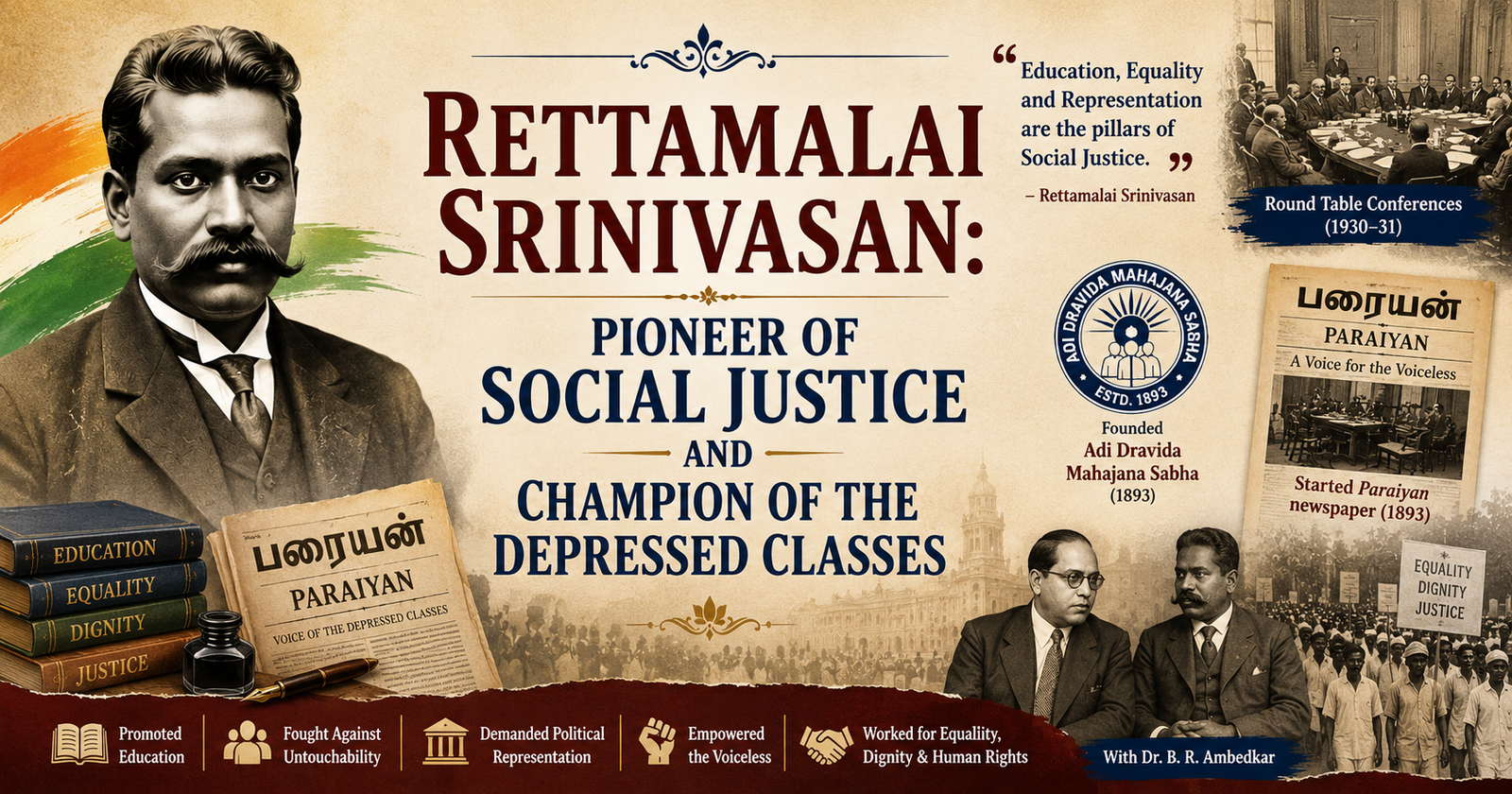
Explore Rettamalai Srinivasan's inspiring journey as a pioneering social reformer who championed equality, dignity, education, and justice for marginalized communities.
Syllabus Areas:
GS I - History
On the occasion of the birth anniversary of Rettamalai Srinivasan (7 July), the Vice President of India paid floral tributes to the eminent social reformer, recognizing his immense contribution to the struggle against untouchability and the advancement of social justice.
A pioneering leader of the Depressed Classes, Rettamalai Srinivasan dedicated his life to securing equality, dignity, and political representation for marginalized communities. His efforts laid the foundation for India's social justice movement and continue to inspire the constitutional values of equality, fraternity, and human dignity.
Who was Rettamalai Srinivasan?
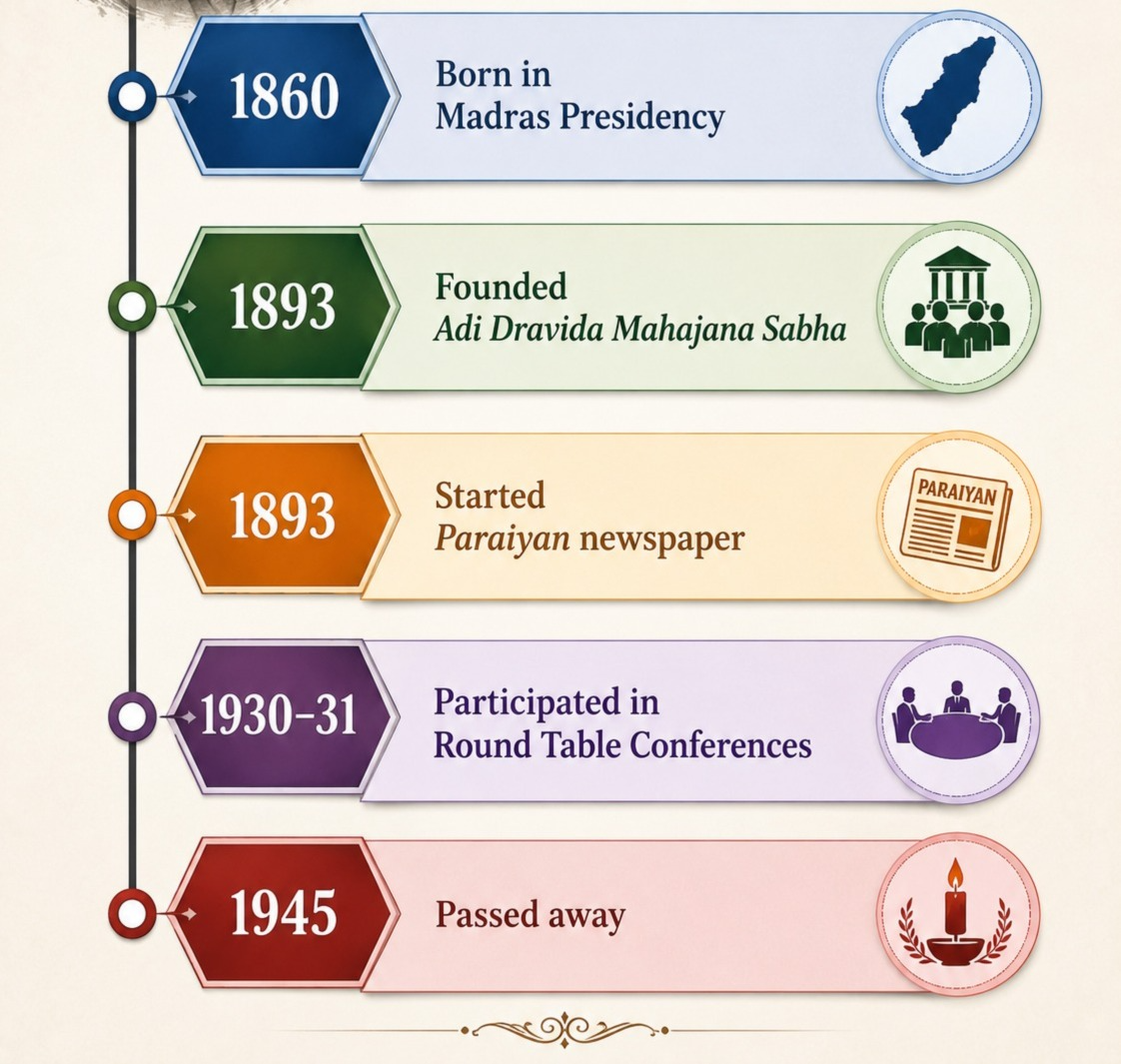
Rettamalai Srinivasan (7 July 1860 – 18 September 1945) was an eminent social reformer, political activist, journalist, and one of the foremost leaders of the Depressed Classes in colonial India. Popularly known as Diwan Bahadur Rettamalai Srinivasan, he devoted his life to eliminating untouchability and securing equal rights for marginalized communities.
He belonged to the Paraiyar community in the Madras Presidency and personally experienced caste discrimination from an early age. These experiences inspired him to dedicate his life to social reform.
Founder of the Adi Dravida Mahajana Sabha
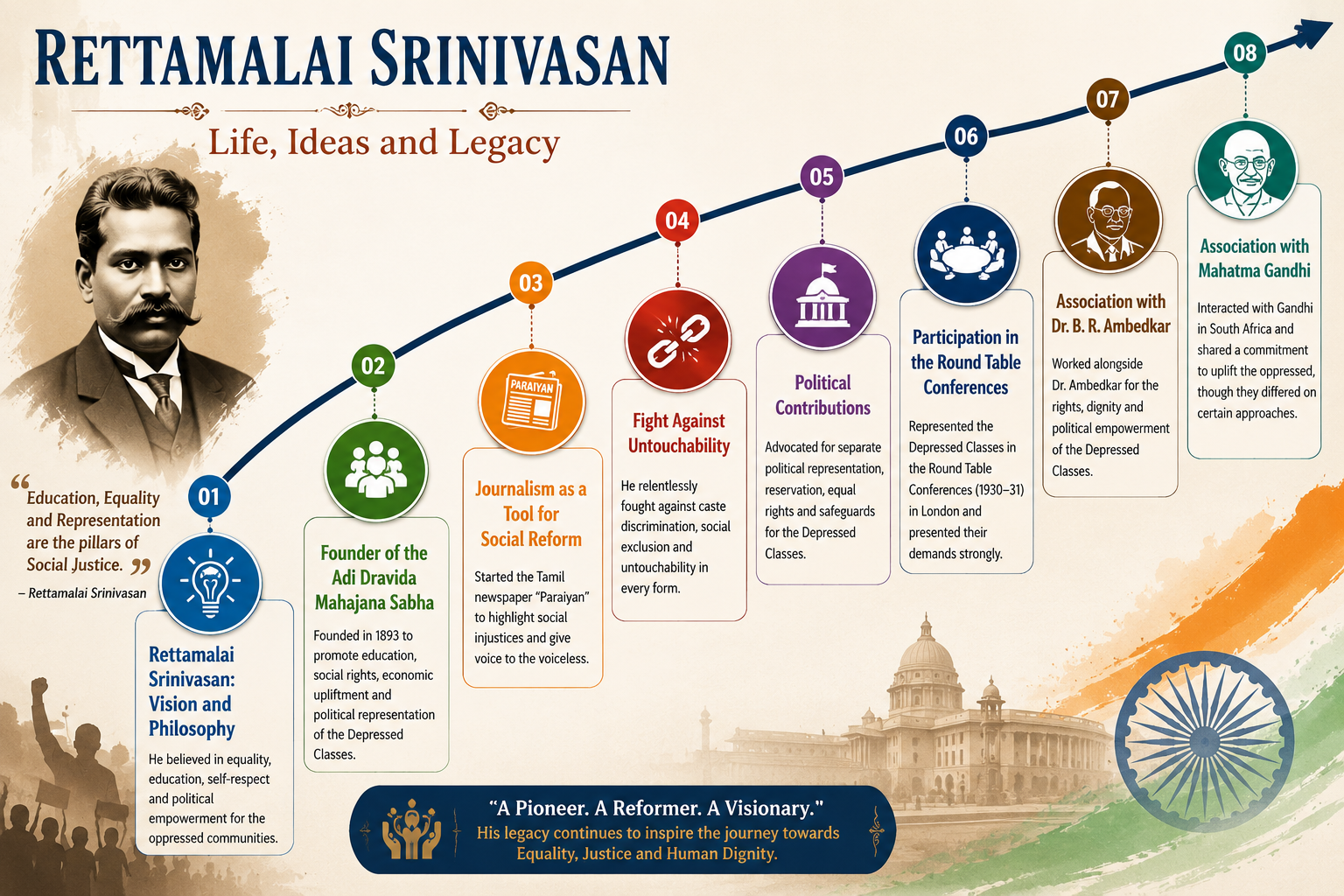
One of his greatest contributions was establishing the Adi Dravida Mahajana Sabha in 1893.
Objectives
-
Promote education among Scheduled Castes
-
Demand equal employment opportunities
-
Fight social discrimination
-
Secure political representation
-
Improve economic conditions
The organization became one of the earliest institutional movements for Dalit rights in South India.
Journalism as a Tool for Social Reform
Recognizing the importance of public opinion, Srinivasan started the Tamil newspaper Paraiyan in 1893.
The newspaper highlighted:
-
Caste discrimination
-
Denial of education
-
Social exclusion
-
Government policies
-
Rights of marginalized communities
Through journalism, he gave voice to communities that had long been excluded from mainstream political discourse.
Fight Against Untouchability
Long before the Indian Constitution outlawed untouchability, Rettamalai Srinivasan campaigned against:
-
Social segregation
-
Temple entry restrictions
-
Denial of education
-
Employment discrimination
-
Public exclusion
-
Caste-based humiliation
He believed every human being deserved equal dignity and respect regardless of caste.
Participation in the Round Table Conferences
-
Srinivasan represented the Depressed Classes at the First and Second Round Table Conferences (1930–1931) held in London.
-
These conferences discussed India's constitutional future.
-
Along with Dr. B. R. Ambedkar, he argued that historically marginalized communities required independent political safeguards and adequate representation in legislative bodies.
-
His participation ensured that the concerns of Dalits became part of constitutional discussions during British rule.
Association with Dr. B. R. Ambedkar
Rettamalai Srinivasan shared a common objective with Dr. B. R. Ambedkar:
-
Social equality
-
Political representation
-
Educational empowerment
-
Abolition of untouchability
Both leaders believed that constitutional rights and political participation were essential for achieving social justice.
Association with Mahatma Gandhi
-
During Mahatma Gandhi's stay in South Africa, Rettamalai Srinivasan had professional interactions with him and reportedly served as a translator in legal proceedings.
-
Although both opposed untouchability, they differed on certain approaches to achieving social reform and political representation for the Depressed Classes.
-
These debates later became significant in shaping India's discourse on caste reforms.
Rettamalai Srinivasan occupies a distinguished place in India's social reform movement. At a time when caste discrimination was deeply entrenched, he courageously advocated for equality, education, political empowerment, and human dignity for the oppressed. His vision anticipated many of the principles later enshrined in the Constitution of India. More than eight decades after his passing, his legacy continues to inspire efforts toward building an inclusive, just, and equitable society. His life exemplifies the transformative power of leadership rooted in courage, constitutional values, and an unwavering commitment to social justice.