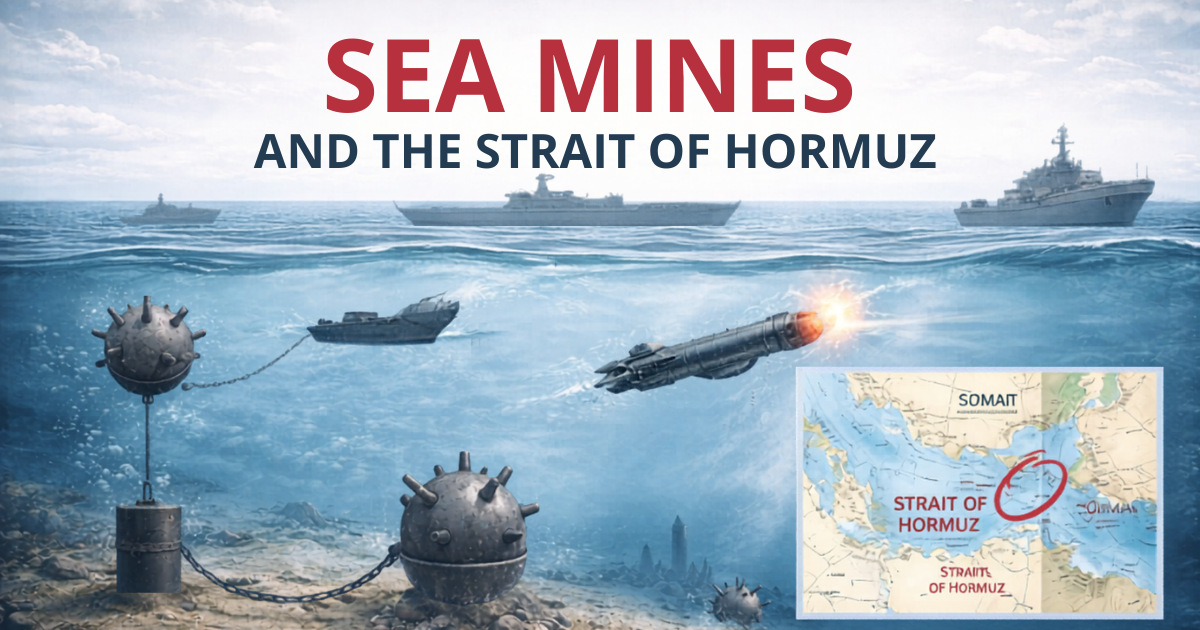
Explore sea mines and their strategic role in the Strait of Hormuz, including types, deployment methods, and global implications for maritime security, trade disruption, and geopolitical tensions in this vital chokepoint.
Syllabus Areas:
GS II - International Relations
GS III - Science and Technology
The Strait of Hormuz is one of the world’s most critical maritime chokepoints, connecting the Persian Gulf to the Arabian Sea. Nearly one-fifth of global oil trade passes through this narrow stretch, making it a lifeline for global energy security. Any disruption here has immediate geopolitical and economic consequences.
Among the most effective tools for disrupting maritime traffic in this region are sea mines—relatively low-cost yet highly disruptive naval weapons. Recent concerns over Iran’s naval capabilities have once again brought attention to how sea mines could potentially paralyse shipping through the Strait.
What Are Sea Mines?
A sea mine is a self-contained explosive device placed in water to damage or destroy ships and submarines. Unlike torpedoes, which actively chase targets, sea mines remain dormant until triggered.
They can be activated by:
-
Contact (physical touch)
-
Magnetic signatures
-
Acoustic signals (sound of engines)
-
Pressure changes in water
Sea mines serve both offensive and defensive purposes:
-
Blocking enemy naval movement
-
Protecting coastlines
-
Disrupting trade routes
Types of Sea Mines
Sea mines come in several forms, each designed for specific operational environments and tactical objectives.
1. Drifting Mines
These float on or just below the surface and move with ocean currents.
-
Advantage: Easy deployment
-
Limitation: Less control over target selection
2. Bottom (Influence) Mines
Placed on the seabed, these mines are triggered by:
-
Magnetic signatures
-
Acoustic signals
-
Pressure variations
They are harder to detect and highly effective in shallow waters.
3. Contact Mines
Anchored to the seabed but floating below the surface, these explode when physically struck by a vessel.
-
One of the oldest and most widely used types
4. Remote-Controlled Mines
These are detonated manually from a control station, often for coastal defense.
-
Advantage: Precision targeting
-
Use case: Strategic choke points
5. Limpet Mines
Attached directly to ships by divers or small boats.
-
Common in covert operations
-
Often used for sabotage
6. Smart / Rocket Mines
Advanced systems capable of launching a torpedo or rocket when a target is detected.
-
Represent modern evolution in naval warfare
-
Combine detection + attack capability
Iran’s Sea Mine Capabilities
Iran has developed a diverse inventory of naval mines, posing a serious challenge in the Strait of Hormuz.
1. Mahan-3
-
Moored mine deployable up to ~100 meters depth
-
Rises along a cable to strike ships
-
Triggered by acoustic signals
-
Carries significant explosive charge
2. Mahan-1 Series
-
Traditional moored mines
-
Less sophisticated but still effective
3. Mahan-2
-
Bottom mine
-
Harder to detect than moored variants
-
Requires shallow waters for maximum impact
4. Mahan-6
-
Reportedly similar to Italian Manta bottom mines
-
Designed for stealth and precision
5. EM-52 Rocket Mine
-
Believed to be of Chinese origin
-
Launches a rocket toward the target upon detection
-
Range: ~10–20 km
6. Self-Propelled Mines
-
Equipped with propulsion systems
-
Can move toward targets rather than waiting passively
Why the Strait of Hormuz Is Vulnerable
Several geographical and strategic factors make the Strait particularly susceptible:
-
Narrow Width: At its narrowest, only about 33 km wide
-
Shallow Waters: Ideal for bottom mines
-
Heavy Traffic: Dense commercial shipping increases likelihood of mine strikes
-
Limited Alternate Routes: Few viable bypass options
Even a limited deployment of mines could:
-
Delay shipping
-
Increase insurance costs
-
Trigger global oil price spikes
Challenges in Mine Countermeasures
Detecting and neutralizing sea mines is a complex and time-consuming process.
Key Challenges:
-
Mines are often small and camouflaged
-
Can remain inactive for long periods
-
Require specialized vessels and divers for removal
Countermeasures Include:
-
Mine-sweeping ships
-
Underwater drones
-
Sonar detection systems
Despite technological advances, clearing mines from a strategic chokepoint like Hormuz could take weeks or months.
Strategic Implications
The use of sea mines in the Strait of Hormuz would have far-reaching consequences:
1. Global Energy Crisis
-
Disruption in oil supply
-
Sharp increase in global oil prices
2. Military Escalation
-
Likely involvement of major naval powers
-
Increased risk of regional conflict
3. Economic Shockwaves
-
Higher shipping and insurance costs
-
Impact on global trade and inflation
Sea mines represent a classic example of asymmetric warfare—low-cost tools capable of creating high-impact disruptions. In the context of the Strait of Hormuz, they serve as a powerful strategic lever, especially for a country like Iran.
For policymakers and aspirants preparing for competitive exams, the key takeaway is this:
Control over maritime chokepoints is not just about naval power—it is about the ability to disrupt, deter, and dominate critical global supply chains.