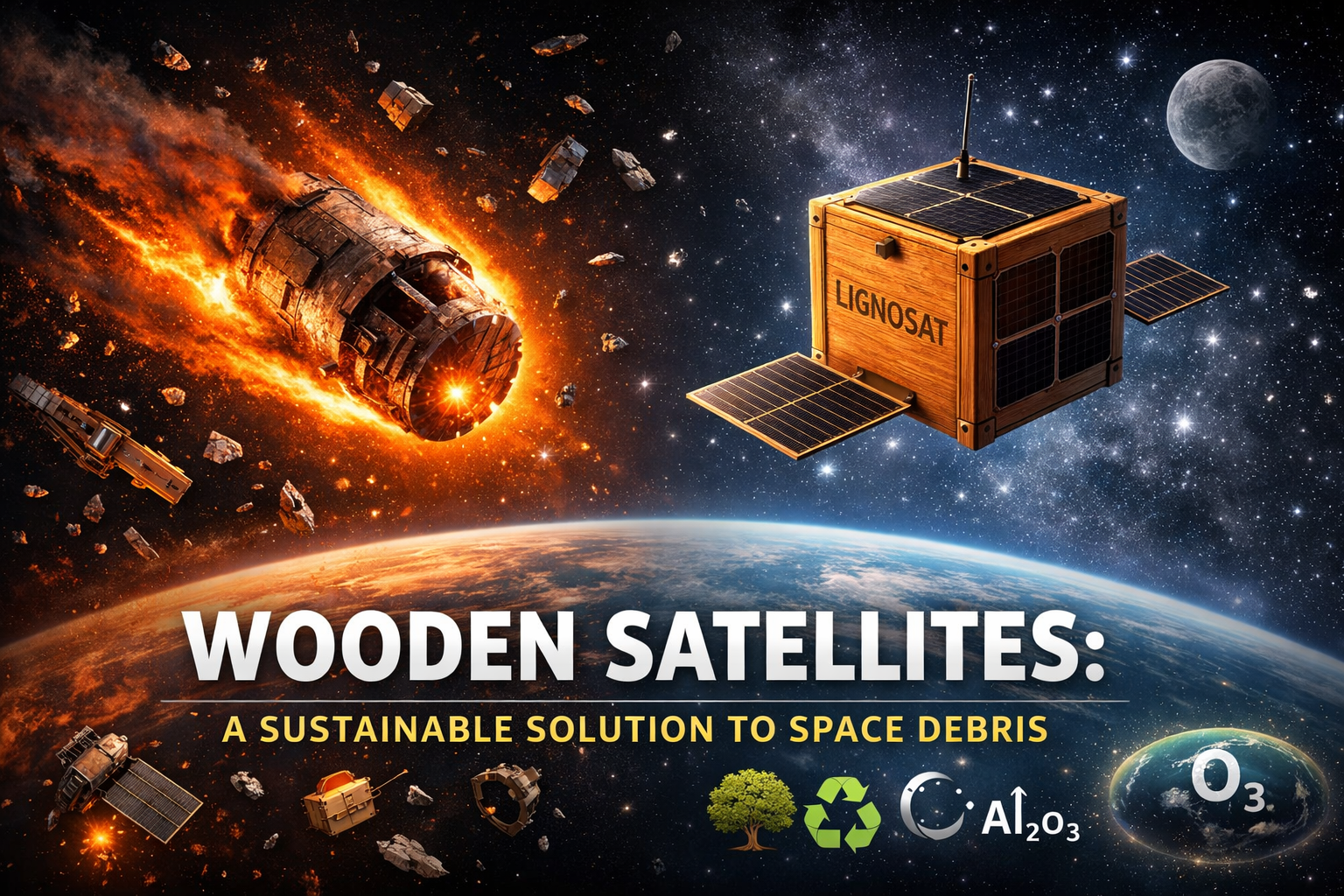
A contrasting depiction of space pollution and sustainability, showing a burning metallic satellite versus an eco-friendly wooden satellite, highlighting environmental risks of re-entry and innovative solutions for sustainable space exploration.
Syllabus Areas:GS III - Science and Technology, Environment |
On March 12, 2026, a defunct NASA satellite weighing nearly 600 kg re-entered Earth’s atmosphere and burned up over the Pacific Ocean. While such events are not uncommon, they highlight a growing concern—the environmental impact of satellite re-entries.
With estimates suggesting that at least three old satellites fall back to Earth every day, and projections indicating that this number could rise significantly in the near future, scientists are now questioning the long-term consequences of this trend.
The Growing Problem of Space Debris
Space is increasingly becoming congested:
-
Around 14,000 satellites are currently in orbit.
-
Since the 1960s, nearly 25,000 satellites have been launched.
-
There are an estimated 100 trillion fragments of space debris.
-
Total mass of objects in orbit is about 15,000 tonnes.
-
Launch rates are accelerating, with ~2,000 launches annually expected till 2031.
Future projections are even more alarming:
-
Mega-constellation projects could lead to tens of thousands of additional satellites.
-
A 2021 estimate suggests that “1 in every 15 lights in the night sky could be a satellite.”
This signals a transition from space exploration to space congestion.
Re-entry Pollution: The Invisible Threat
When satellites re-enter the atmosphere, they burn up due to friction. This process releases fine metal particles into the upper atmosphere.
Key Pollutants Released:
-
Aluminium
-
Lithium
-
Other metallic residues
Why is Aluminium a Concern?
-
Aluminium reacts with oxygen to form aluminium oxide (alumina).
-
Alumina:
-
Contributes to ozone layer depletion
-
Persists in the atmosphere for decades
-
Alters atmospheric chemistry
Current Situation:
-
Aluminium already constitutes about 10% of stratospheric particles.
-
This could rise to 50% with increasing satellite activity.
This represents a slow, invisible form of pollution, often overlooked in environmental discourse.
Impact on Climate and Atmosphere
The long-term consequences of satellite burn-up are not fully understood, but early research indicates serious risks:
-
Ozone layer depletion
-
Changes in polar temperatures (projected by 2040)
-
Disturbance in radiative balance of the atmosphere
-
Potential implications for global climate systems
This adds a new dimension to environmental concerns—pollution originating from outer space.
Wooden Satellites: A Promising Alternative
To address this emerging challenge, scientists are exploring wood as an alternative material for satellites.
Why Wood?
-
Burns cleanly upon re-entry → minimal toxic residue
-
Does not produce harmful metal oxides like alumina
Key Advantages:
Radio Transparency
-
Wood allows radio waves to pass through
-
Enables internal placement of antennas → compact design
Thermal Insulation
-
Protects onboard electronics from extreme temperature variations
Lightweight and Sustainable
-
Reduces launch weight
-
Environmentally friendly and biodegradable
Scientific Breakthroughs
Japan’s LignoSat Programme
LignoSat-1 (Launched November 2024)
-
First-ever wood-panelled satellite
-
Size: 10 cm cube, Weight: 900 grams
-
Orbited at 400 km altitude
-
Survived extreme temperatures:
-
+121°C to -157°C
-
Despite communication loss, it proved:
-
Wood can withstand harsh space conditions
LignoSat-2 (Expected 2026)
-
Aims to improve:
-
Communication systems
-
Structural performance
Other Global Efforts
-
WISA Woodsat (Finland):
-
Designed to study the durability of wood in space
-
Equipped with cameras to monitor material behavior
-
Green Propulsion Systems:
-
Developed by startups like Manastu Space (India)
-
Aim to eliminate toxic propellants
These innovations indicate a shift toward sustainable space technology.
Future Risks: A “Ring of Trash” Around Earth
The increasing number of satellites poses multiple risks:
-
Continuous atmospheric contamination
-
Rising space debris collision risks
-
Potential for Kessler Syndrome (chain-reaction collisions)
-
Increased burden on space traffic management
If unchecked, space could become an unsustainable environment, much like Earth’s polluted ecosystems.
The Way Forward
1. Sustainable Design
-
Adoption of eco-friendly materials like wood
-
Reduction in metal usage
2. Green Propulsion
-
Development of non-toxic fuel systems
3. Regulatory Frameworks
-
Stronger global norms for:
-
Satellite launches
-
End-of-life disposal
4. International Cooperation
-
Strengthening treaties and coordination mechanisms
-
Ensuring responsible use of outer space
Conclusion
The rapid expansion of space technology has brought immense benefits—communication, navigation, and global connectivity. However, it also introduces new environmental challenges that extend beyond Earth.
The issue of satellite re-entry pollution highlights a critical truth:
Technological progress without sustainability can create long-term global risks.
Exploring alternatives like wooden satellites represents a forward-thinking approach, but it must be complemented by robust governance and responsible innovation.
The future of space exploration will depend not just on how far we go, but how responsibly we operate beyond Earth.