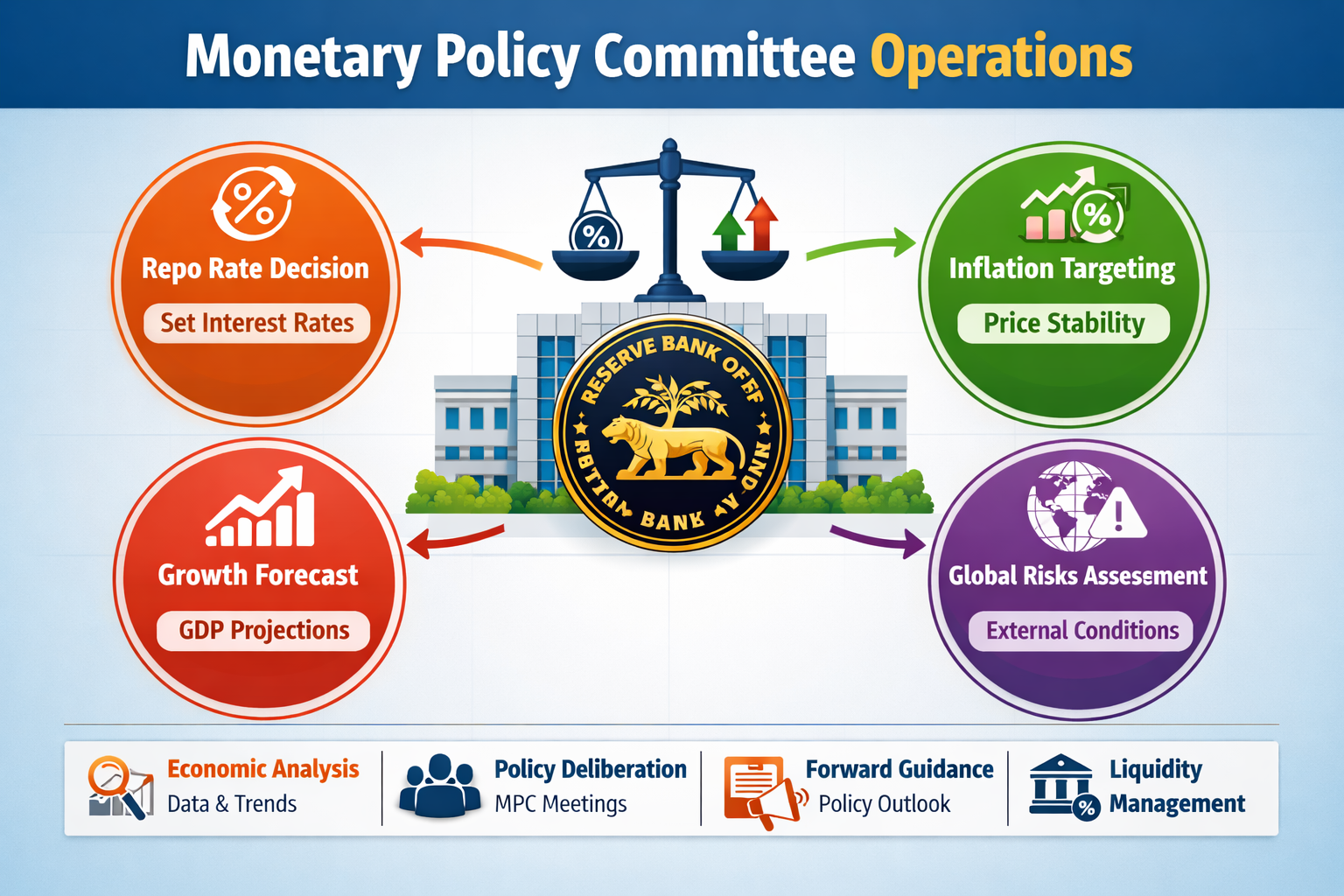
A clear visual guide to Monetary Policy Committee operations, including repo rate decisions, inflation targeting, growth forecasts, and liquidity management by RBI.
Syllabus Areas:GS III - Economy |
The Monetary Policy Committee (MPC) of Reserve Bank of India, in its April 2026 meeting, decided to keep the repo rate unchanged at 5.25% while continuing with a neutral policy stance.
This decision has attracted attention because it comes at a time when:
-
Inflation is well within the target range,
-
Economic growth remains robust, and
-
Global uncertainties continue to pose risks to stability.
The move signals a strategic pause by the RBI, making it a crucial development for policymakers, investors, and UPSC aspirants alike.
Repo Rate Unchanged – A Deliberate Pause
-
The MPC decided to retain the repo rate at 5.25%, continuing the pause observed in previous meetings.
-
The repo rate is the rate at which the Reserve Bank of India lends money to commercial banks, making it a key tool to control liquidity and inflation.
-
This decision reflects a calibrated approach—the RBI is allowing earlier rate cuts to fully transmit into the economy rather than rushing into fresh policy changes.
Policy Stance – Neutral and Data-Driven
The MPC maintained a neutral stance, indicating flexibility in future actions.
What does “neutral” mean?
-
No commitment to either rate hikes or cuts
-
Decisions will depend on incoming economic data
-
Focus on balancing inflation control and growth support
This marks a shift toward pragmatic and adaptive policymaking, rather than a fixed directional bias.
Inflation Outlook
Retail inflation is projected to remain within the RBI’s target band (2%–6%), with expectations closer to the lower end.
Key Drivers
-
Stable food prices
-
Moderation in global commodity prices
-
Effective monetary management
With inflation under control, the RBI has greater policy flexibility, reducing the urgency for rate hikes.
Growth Outlook – Strong Momentum
India’s GDP growth is projected at around 7.4%, making it one of the fastest-growing major economies.
Growth Drivers
-
Strong domestic consumption
-
Increased government capital expenditure
-
Recovery in investment activity
The RBI’s decision supports continued growth without risking overheating.
Global Uncertainties – A Key Concern
The MPC highlighted several external risks:
-
Ongoing geopolitical tensions
-
Volatility in global financial markets
-
Uncertain trade environment
These risks justify a cautious and flexible policy stance, as external shocks could quickly alter domestic conditions.
Liquidity Management – Ensuring Stability
The Reserve Bank of India reiterated its commitment to maintaining adequate liquidity in the banking system.
Focus Areas
-
Smooth transmission of monetary policy
-
Supporting credit growth
-
Ensuring financial stability
Overall Policy Approach – Balanced and Forward-Looking
The April 2026 MPC decision reflects a balanced strategy:
-
Inflation is under control → No urgency for tightening
-
Growth is strong → No need for aggressive easing
-
Global risks persist → Maintain caution
Key Takeaway
The RBI has adopted a “wait and watch” approach, ensuring that policy decisions remain flexible, data-driven, and responsive.
The April 2026 monetary policy decision of the Reserve Bank of India represents a carefully calibrated pause in India’s monetary cycle. By keeping the repo rate unchanged and maintaining a neutral stance, the RBI aims to strike a fine balance between price stability and economic growth, while remaining vigilant to global uncertainties.
This approach highlights the evolution of India’s monetary policy towards a more measured, evidence-based, and forward-looking framework.
Prelims Questions:1. Consider the following statements regarding the Monetary Policy Committee (MPC):
Answer: (a) Explanation: 2. With reference to repo rate and reverse repo rate, consider the following statements:
(a) 1 and 2 only Answer: (b) Explanation: 3. Consider the following statements about inflation targeting in India:
Answer: (a) Explanation: 4. Consider the following actions by the Reserve Bank of India:
Which of the above would increase liquidity in the economy? (a) 1 and 2 only Answer: (a) Explanation: 5. Consider the composition of the Monetary Policy Committee:
Answer: (a) Explanation: 6. If inflation rises sharply due to supply-side shocks, what is the most appropriate response of the MPC? (a) Ignore inflation Answer: (b) Explanation: |