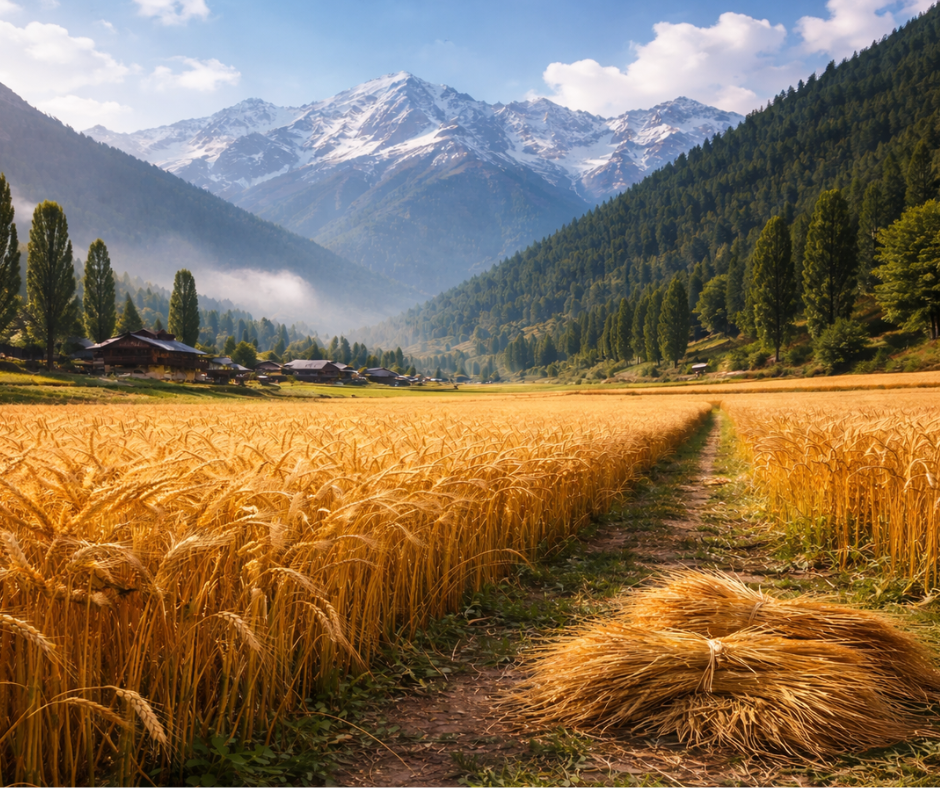
Scientists at Sher-e-Kashmir University of Agricultural Sciences and Technology of Kashmir (SKUAST-K) have developed two early-maturing wheat varieties (SW-3 and SW-4) tailored to Kashmir’s unique agro-climatic conditions.
Syllabus Areas:GS III - Food Security, Cropping Patterns |
Scientists at Sher-e-Kashmir University of Agricultural Sciences and Technology of Kashmir (SKUAST-K) have developed two early-maturing wheat varieties (SW-3 and SW-4) tailored to Kashmir’s unique agro-climatic conditions. These varieties address a long-standing problem of delayed wheat harvest disrupting the rice–wheat cropping cycle, a backbone of food security and rural livelihoods in the region. Their recent field-level introduction in Gurez valley (2025) has brought this scientific breakthrough into focus.
Background: The Core Agricultural Challenge in Kashmir
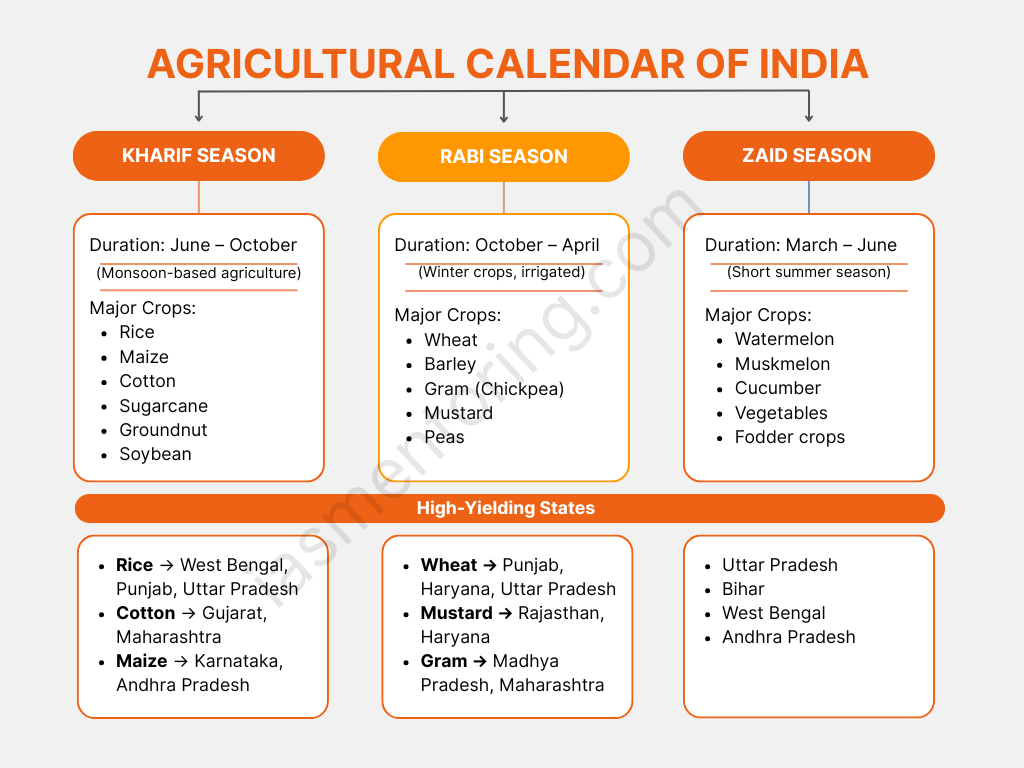
Wheat is a rabi crop, sown in October and ideally harvested by May.
However, in Kashmir:
-
Rice dominates the kharif season, requiring field preparation by May–June.
-
Earlier wheat varieties, mostly sourced from sub-tropical regions like Haryana and Delhi, matured late (June–July) under Kashmir’s cooler conditions.
-
This delayed harvest disrupted the rice–wheat rotation, forcing farmers to compromise either wheat harvest or timely paddy transplantation.
Despite being high-yielding, these varieties were ill-suited to Kashmir’s cropping calendar, making early maturity a strategic priority for local plant breeders.
The Scientific Breakthrough: Shalimar Wheat-3 (SW-3) and Shalimar Wheat-4 (SW-4)
After nearly a decade of research, SKUAST-K scientists developed:
Shalimar Wheat-4 (SW-4)
-
Maturity: Last week of May
-
Significance: Enables complete vacation of fields before paddy transplantation
Shalimar Wheat-3 (SW-3)
-
Maturity: First week of June
-
Special features:
-
Bio-fortified with iron and zinc (>40 ppm)
-
Protein content: ~12%
-
Potential yield: Up to 38 quintals/hectare
-
Suitable for grain + fodder dual use
Both varieties are:
-
Comparable to older varieties in cold tolerance and agronomic traits
-
Specially adapted to mid-altitude regions up to 1,850 metres
Why Early Maturity Matters More Than Maximum Yield
Plant breeders acknowledge a key trade-off:
-
Early maturity often comes with slightly lower yield potential
-
However, in Kashmir:
-
Timely harvest is more critical than marginal yield gains
-
It safeguards the entire cropping system, not just one crop
By maturing earlier, SW-3 and SW-4:
-
Preserve the rice–wheat rotation
-
Reduce climate-related risks
-
Improve farm-level planning and labour efficiency
Breeding Methodology: A Decade-Long Scientific Process
The varieties were developed using conventional plant breeding techniques, not GM methods:
-
Cross-breeding of diverse wheat lines
-
Pedigree selection – identifying superior plants across generations
-
Multi-location trials (2–3 years) at university research stations
-
On-farm trials (about 2 years) with farmers, supported by the Agriculture Department
Total time: ~9–10 years from initial cross to farmer-ready variety
This highlights the time-intensive nature of crop innovation and the importance of sustained public research institutions.
Disease Resistance: Tackling Yellow Rust
A major achievement of the new varieties is resistance to yellow rust, a fungal disease common in Kashmir:
-
Causes stunted growth and yield loss
-
Thrives in cool, moist conditions
-
Has repeatedly damaged local wheat crops in the past
Built-in resistance:
-
Reduces dependence on fungicides
-
Lowers production risk
-
Enhances yield stability, especially in adverse years
Fodder Security: A Hidden but Critical Benefit
In many parts of Kashmir and Gurez:
-
Wheat is grown primarily for fodder, with grain as a secondary benefit
-
Wheat straw (stalks) is dried and stored for harsh winters
Early-maturing, disease-resistant wheat:
-
Ensures reliable fodder availability
-
Allows better winter feed planning
-
Reduces losses due to unexpected weather or disease outbreaks
Field-Level Impact: Gurez Valley (2025 Introduction)
In October 2025, SKUAST-K introduced SW-3 in the Gurez valley near the Line of Control:
-
70 quintals of seed distributed
-
700 farmers covered
-
Farmers also received a scientific package of practices
Why this matters:
-
Gurez is an isolated, high-altitude region
-
Farmers rely on traditional seed systems
-
Access to modern agricultural innovation is limited
This initiative demonstrates last-mile delivery of agricultural science.
Farmers’ Voices: Ground Reality
-
Timely harvest allows proper paddy transplantation
-
Even with similar yields, calendar alignment is a major gain
-
Improved resistance to cold and disease offers greater livelihood security
-
Dual grain-fodder utility meets local farming needs
Farmers emphasise that predictability and timing, not just yield, define success in mountain agriculture.
Key Takeaway
This development shows why location-specific agricultural research is essential. One-size-fits-all crop solutions fail in diverse agro-climatic zones like the Himalayas.
The development of SW-3 and SW-4 wheat varieties by SKUAST-K is a quiet but transformative reform in Kashmir’s agriculture. By prioritising timely maturity, disease resistance, fodder security, and nutritional value, these varieties strengthen the rice–wheat system, enhance farmers’ resilience, and reinforce regional food security.
This is not merely a crop improvement story—it is a lesson in context-driven policy, scientific patience, and sustainable agriculture.
Prelims Questions:
1. Consider the following statements regarding early-maturing wheat varieties developed for Kashmir:
-
They help maintain the rice–wheat cropping cycle.
-
They were developed using genetic modification techniques.
-
They mature earlier than wheat varieties sourced from subtropical regions.
Which of the statements given above are correct?
A. 1 and 2 only
B. 1 and 3 only
C. 2 and 3 only
D. 1, 2 and 3
Correct Answer: B
Explanation:
Conventional breeding was used, not GM. Early maturity helps preserve cropping calendar.
2. With reference to yellow rust disease in wheat, consider the following:
-
It is a fungal disease.
-
It thrives in cool and moist climatic conditions.
-
It increases grain size but reduces protein content.
Which of the statements given above are correct?
A. 1 and 2 only
B. 2 and 3 only
C. 1 and 3 only
D. 1, 2 and 3
Correct Answer: A
Explanation:
Yellow rust causes stunting and yield loss, not grain improvement.
Mains Questions:
1. Explain how early-maturing and disease-resistant crop varieties contribute to climate-resilient agriculture in India. (250 words)
Keywords to use:
-
Yellow rust
-
Risk reduction
-
Mountain agriculture
-
Smallholder farmers