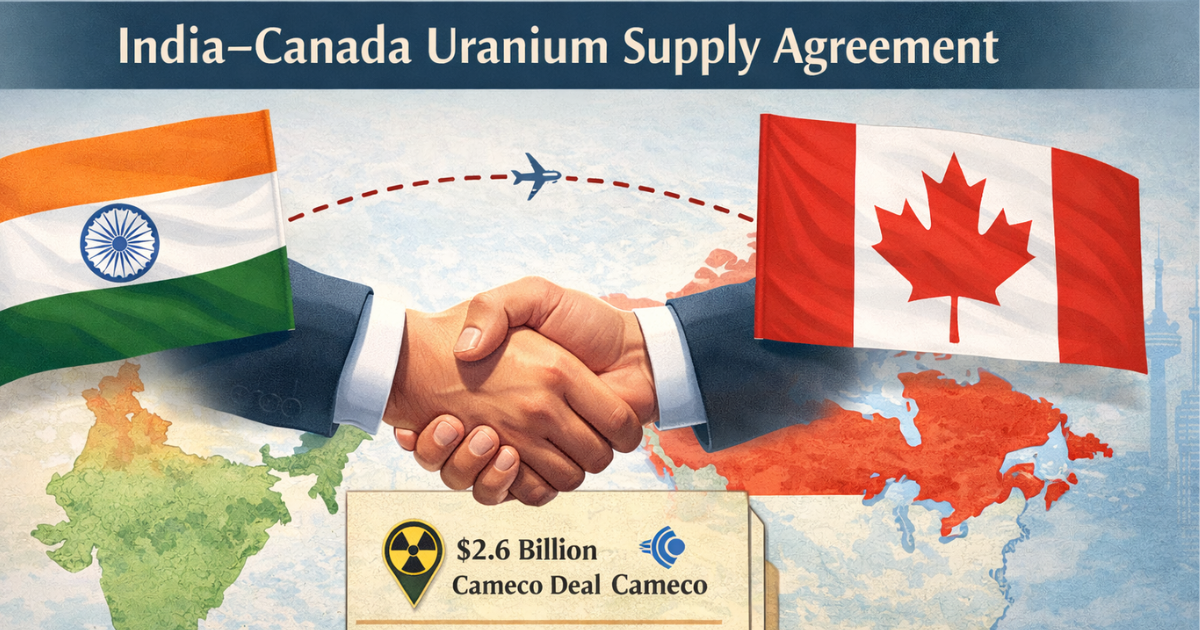
India recently signed a Canadian $2.6-billion uranium supply deal with Cameco on March 2. The agreement will supply 10,000 tonnes of uranium to India between 2027 and 2035.
Syllabus Areas:GS III - Science & Technology, Environment |
The deal strengthens India’s efforts to ensure long-term energy security and nuclear fuel supply for its growing nuclear power programme.
India’s Uranium Reserves and Stockpiles
-
India possesses both domestic uranium reserves and imported stockpiles.
Domestic Uranium Reserves
-
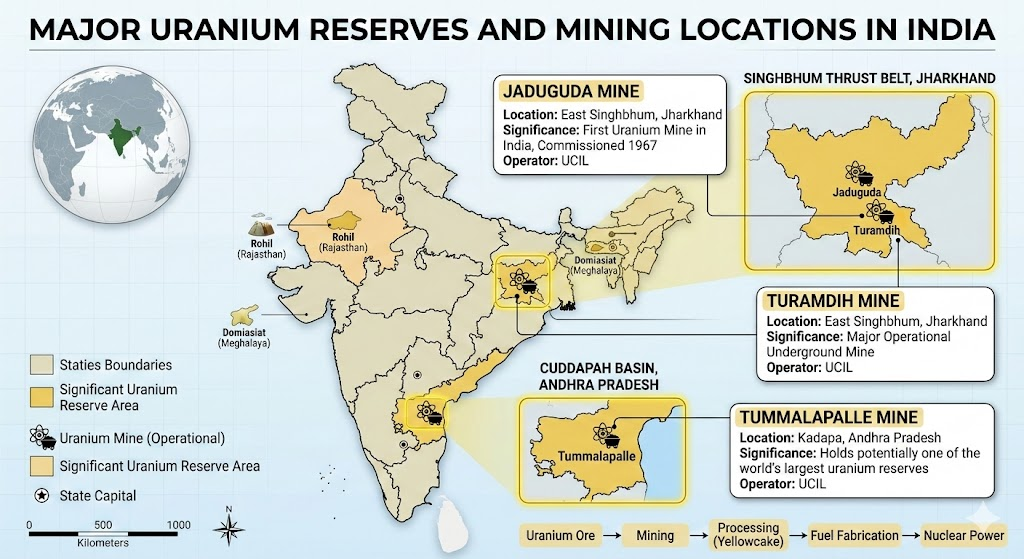
Total uranium ore reserves: 4.2–4.3 lakh tonnes of ore.
-
Major mining locations:
-
Jaduguda Mine
-
Turamdih Mine
-
Tummalapalle Mine
-
Extractable uranium metal: 76,000–92,000 tonnes.
Why extraction is limited
-
Indian uranium ore is low grade (0.02%–0.45%).
-
In contrast, Canadian uranium ore is 10–100 times richer, making mining more economical there.
What is “Uranium Ore Grade”?Ore grade refers to the percentage of uranium present in the rock that is mined.
Higher grade → more uranium per tonne of rock → cheaper extraction. Uranium Grade in IndiaMost Indian deposits (e.g., Jaduguda, Turamdih, Tummalapalle) have:
Example:
So huge volumes of rock must be mined and processed. |
Dependence on Imports
-
Nearly 75% of India’s civilian uranium requirement is met through imports.
-
Kazakhstan (through Kazatomprom)
-
Uzbekistan
-
Russia
-
Canada (through Cameco)
Strategic Fuel Reserve
-
India is building a strategic uranium reserve equivalent to 5 years of nuclear fuel supply to protect against supply disruptions.
Weapons vs Civilian Use
-
Imported uranium is legally restricted to civilian nuclear reactors.
-
Hence domestic uranium mining continues, ensuring material availability for strategic and defence purposes.
India–Canada Civil Nuclear Cooperation
The uranium deal operates under the India-Canada Civil Nuclear Cooperation Agreement (NCA) signed in 2010.
Background
-
The agreement became possible after:
-
The Nuclear Suppliers Group granted India a 2008 waiver.
-
The India–US 123 Agreement enabled civil nuclear trade despite India not signing the Nuclear Non-Proliferation Treaty.
Key Provision
-
India must provide “fissionable material accounts” to Canada to track usage of supplied uranium.
Debate around the agreement
Criticism:
-
Some see this requirement as intrusive to Indian sovereignty.
Supporters argue:
-
Importing uranium for civilian reactors frees domestic uranium, which can be used for strategic nuclear purposes.
How India Uses Uranium
Nuclear Power Generation
-
India currently operates 24 nuclear reactors.
-
Total capacity: ~9 GW.
Most power comes from 700 MW Pressurised Heavy Water Reactors (PHWRs).
Contribution to electricity:
-
Around 6–7 GW
-
Nearly 3% of India’s electricity generation
Future Target
-
Government aims to increase nuclear capacity to 100 GW by 2047.
Challenges:
-
Land acquisition issues
-
Public protests near nuclear sites
-
Long construction timelines
Research and Medical Uses
Uranium is used in research reactors such as:
-
Dhruva Reactor
These produce medical isotopes such as:
-
Technetium-99m (used in medical imaging)
-
Iodine-131 (used in cancer treatment)
Small Modular Reactors (SMRs)
-
Union Budget 2025-26 allocated ₹1.2 lakh crore for SMR development.
-
SMRs generally use 3–5% enriched uranium.
Strategic Uses
Domestic uranium supports:
-
Nuclear weapons (estimated ~170 warheads)
-
Nuclear-powered submarines such as the INS Arihant.
India’s Three-Stage Nuclear Power Programme
India follows a three-stage nuclear programme designed by Homi J. Bhabha.
Stage 1 – Pressurised Heavy Water Reactors (PHWRs)
Fuel:
-
Natural uranium (U-235)
Output:
-
Electricity
-
Byproduct: Plutonium-239
Stage 2 – Fast Breeder Reactors (FBRs)
Fuel:
-
Mixed Oxide (MOX)
-
Uranium-238
-
Plutonium-239
Outputs:
-
Electricity
-
Uranium-233
-
More plutonium-239
Important feature:
-
Breeding: reactors produce more fuel than they consume.
Key project:
-
Prototype Fast Breeder Reactor (PFBR) — currently nearing commissioning.
Stage 3 – Thorium-Based Reactors
Fuel:
-
Thorium-232
-
Plutonium-239
Output:
-
Electricity
-
Uranium-233
Why thorium?
-
India possesses 20–25% of global thorium reserves.
Challenges in India’s Nuclear Programme
-
Delays and Cost Overruns
-
Example: PFBR project cost increased significantly over time.
-
Sanctions and Technology Restrictions: After India’s nuclear tests, international sanctions slowed nuclear development.
-
Long Fuel Breeding Cycles: According to former Atomic Energy Commission chairman Anil Kakodkar:
-
Doubling time of a fast breeder reactor: 15–20 years
-
Time required to produce enough fuel for another reactor.
-
Thus achieving 100 GW nuclear capacity requires several fuel-breeding cycles.
-
Thorium Deployment Timeline: Large-scale thorium energy may only occur 3–4 decades after commercial fast breeder reactors, possibly around the 2060s or later.
Why India is Signing Multiple Uranium Deals
India is securing uranium supplies because:
-
Domestic ore is low grade and insufficient.
-
Nuclear capacity is planned to expand dramatically.
-
Fuel breeding cycles are slow.
-
Strategic reserves are needed to avoid supply disruptions.
-
Imports support civilian reactors, allowing domestic uranium for strategic uses.
India’s low-grade uranium reserves necessitate imports to sustain its expanding nuclear energy programme. Strategic international agreements, alongside domestic mining and the three-stage programme, remain essential for long-term energy security and technological self-reliance.
Mains Questions:
1. Civil nuclear agreements often balance energy cooperation and non-proliferation concerns. Discuss with reference to India’s nuclear partnerships. (250 words)
2. Why does India continue to import uranium despite having domestic reserves? Examine the economic and technological factors involved. (150 words)