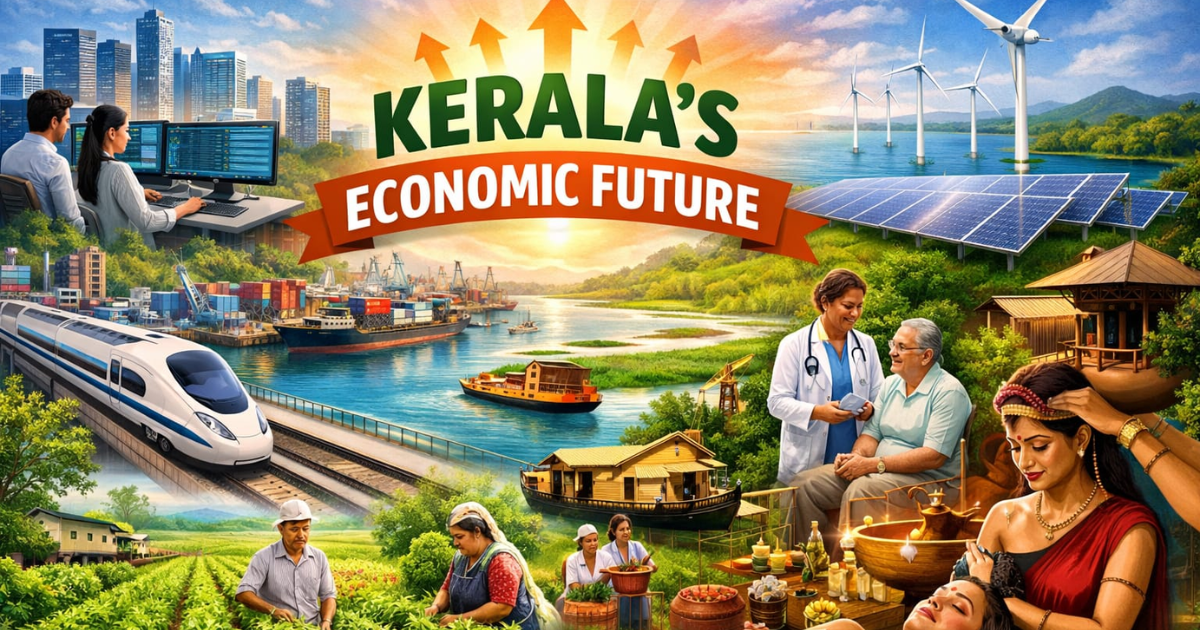
Economic future of Kerala is once again under national focus due to declining remittance growth, rapid ageing of population, ecological constraints, and debates on sustainable development models.
Syllabus Areas:GS III - Economy, Environment and Science |
With Vizhinjam Port nearing operationalisation, the State is rethinking its growth strategy—moving beyond a remittance-led economy towards innovation, knowledge, and high-value global integration.
Kerala’s Historical Advantage: Early Globalisation
-
Kerala practised globalization centuries before the term existed.
-
Muziris symbolised a cosmopolitan trade hub with Romans, Arabs, Jews, Chinese, and Europeans.
-
This created a plural, syncretic civilisation—religious coexistence as an economic by-product.
-
Global integration is not alien to Kerala; it is civilisational.
Remittances:
In economic terms:
In the Indian context:
Limitations:
|
From “Remittance Economy” to “Innovation Economy”
-
Kerala’s remittances (~₹21.3 lakh crore annually) power consumption, not production.
-
The “Global Malayalee” exists, but value creation largely happens outside Kerala.
-
Problem: Over-comparison with Tamil Nadu/Maharashtra’s heavy industrial model.
-
Reality:
-
High population density (Netherlands-level)
-
High literacy (Singapore-level)
-
High ecological fragility (Costa Rica-level)
-
Heavy industry is structurally incompatible with Kerala.
Healthcare as the Core Growth Engine
(a) Precision Medicine & Gene Valley
-
Kerala’s genetic diversity (Dravidian–Aryan–Arab–European mix) is a scientific asset.
-
Ageing population → opportunity for precision medicine and geriatric care.
-
Proposal:
-
A Kerala “Gene Valley” on the lines of Iceland’s population genomics.
-
Disease-risk mapping and personalized drug responses.
(b) Medical Devices & Med-Tech Manufacturing
-
India imports ~80% of medical devices—this is strategic vulnerability.
-
Kerala has:
-
Engineering talent
-
Institutions like SCTIMST
-
Proven capability (blood bags, cardiac devices)
-
Vision: Become a global exporter of high-value med-tech (stents, valves, robotics).
Ageing Population as an Economic Asset
-
Kerala is India’s fastest ageing society.
-
Instead of welfare burden → silver economy.
-
Proposal:
-
Japanese-style assisted living and retirement villages in climate-friendly highlands.
-
Target both domestic and Western “grey nomads”.
-
Ayurveda:
-
Must move from wellness tourism to evidence-based cure systems.
-
Replicate China’s TCM model using scientific validation.
-
Goal: Position Kerala as the “Sanatorium of the East.”
Biodiversity, Agriculture & High-Value Farming
-
Kerala is among the world’s top biodiversity hotspots.
-
Constraint: No land for low-yield agriculture.
-
Solution:
-
Dutch glasshouse farming model.
-
Focus on revenue per inch, not acreage.
-
Examples:
-
Pokkali rice (saline-resistant)
-
High-value spice oleoresins
-
Shift from raw produce → bio-extraction & agri-tech exports.
Blue Economy: From Fishing to Marine Farming
-
Present model: Extractive, low-tech fishing.
-
Proposed shift:
-
Sustainable aquaculture (Norway model)
-
Marine algae-based pharmaceuticals
-
Scientific deep-sea fishing & cold chains
-
Vizhinjam Port:
-
A port without value addition is just a parking lot.
-
Must develop a logistics & processing city (Singapore model).
-
Use solar & wind to fuel future maritime shipping.
-
Kerala as the fuel station of the Indian Ocean.
Weightless Economy: Knowledge Over Land
-
Heavy industry is ecologically unviable.
-
Kerala’s strength lies in high intellect, low footprint sectors.
(a) Space & Defence
-
Thiruvananthapuram already hosts India’s space ecosystem.
-
Proposal:
-
A private “Space Coast” for nano-satellites and propulsion.
-
Defence manufacturing ancillaries leveraging BrahMos presence.
(b) Advanced Materials & Graphene
-
Rare earth minerals (ilmenite, monazite) are strategic assets.
-
Move beyond raw exports → microchips, superconductors.
-
Kochi’s graphene centre should scale from pilot to platform.
FinTech, Arbitration & Global Services
-
Kerala has high financial literacy + remittance flows.
-
Proposal:
-
A Global FinTech Centre with a regulatory sandbox (DIFC model).
-
International commercial arbitration hub (Hague/Singapore model).
-
Peaceful backwaters like Kumarakom offer a cost-effective, neutral venue.
Tourism: From Sightseeing to Value Creation
-
Shift from passive tourism → creative and immersive economy.
-
Cinema & VFX:
-
Post-production hub for global studios (Montreal model).
-
Handicrafts → Heritage Luxury:
-
Aranmula Kannadi, Balaramapuram, Kasavu as global luxury brands.
-
Establish a Kerala Design Institute linked with Milan/Paris.
-
Sell stories, sustainability, and design, not souvenirs.
Climate Vulnerability as Exportable Expertise:
-
Kerala faces floods, landslides, coastal erosion.
-
Turn vulnerability into know-how.
-
Dutch model:
-
Export flood management and resilient infrastructure solutions.
-
Kerala as a global living lab for tropical resilience.
Prelima Questions:
1. With reference to the ancient port of Muziris, consider the following statements:
-
It functioned as a major hub for Roman trade in spices and textiles.
-
Archaeological excavations have revealed Roman coins and amphorae.
-
It was located on the eastern coast of India near the Coromandel Coast.
Which of the statements given above are correct?
A. 1 and 2 only
B. 2 and 3 only
C. 1 and 3 only
D. 1, 2 and 3
Answer: A
Explanation: Muziris was on the Malabar Coast (western coast), not Coromandel.
2. India’s remittance-led regional economies, such as Kerala, face which of the following structural challenges?
-
Consumption-led growth without commensurate capital formation
-
Vulnerability to geopolitical shocks in host countries
-
High female labour force participation
-
Limited domestic innovation ecosystems
Select the correct answer using the code below:
A. 1 and 2 only
B. 1, 2 and 4 only
C. 2, 3 and 4 only
D. 1, 2, 3 and 4
Answer: B
Exp: Statement 3 is incorrect—Kerala’s female LFPR remains low.
3. The Western Ghats are classified as a biodiversity hotspot primarily due to:
-
High species endemism
-
High vulnerability to anthropogenic pressures
-
Presence of mangrove ecosystems
-
High altitude cold deserts
Which of the above are correct?
A. 1 and 2 only
B. 1, 2 and 3 only
C. 2 and 4 only
D. 1 and 4 only
Answer: A
Mains Questions:
1. Explain the concept of the Blue Economy.How can coastal States like Kerala balance marine conservation with economic development? (10 marks)