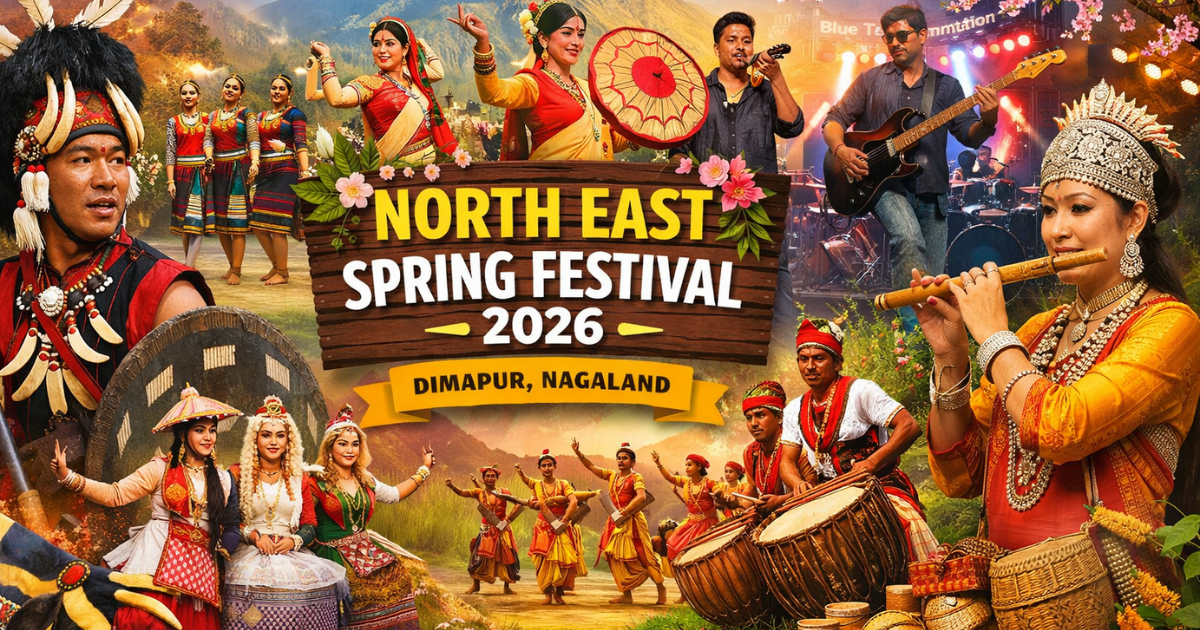
The three-day North East Spring Festival 2026, also known as the Festival of the North East, commenced on 26 February 2026 at the North East Zone Cultural Centre (NEZCC) Complex in Dimapur, Nagaland.
Syllabus Areas:GS I - Indian Society and Culture |
Organized jointly by the North East Zone Cultural Centre (NEZCC), Dimapur, and the South-Central Zone Cultural Centre (SCZCC), Nagpur, this event is being held under the aegis of the Ministry of Culture, Government of India.
Objective and Significance
-
The festival’s primary objective is to celebrate, preserve, and promote the diverse folk and tribal cultural heritage of the eight Northeastern states of India.
-
It aims to provide a national platform for traditional performing artists from the region, showcasing their art forms, music, and cultural expressions to a broader audience.
-
This cultural initiative also serves a deeper purpose — strengthening national integration through cultural exchange.
-
By bringing together artistic traditions from the Northeast and pairing them with cultures from the South-Central region (through the Madhya Dakshini Festival segment), the festival fosters mutual understanding and unity among India’s culturally diverse communities.
Organizers and Collaboration
-
North East Zone Cultural Centre (NEZCC), Dimapur — A nodal cultural institution under the Ministry of Culture responsible for preserving and promoting tribal and folk arts of the Northeast.
-
South-Central Zone Cultural Centre (SCZCC), Nagpur — Partner centre representing the cultural ethos of the South-Central region of India, facilitating cultural exchange.
-
Ministry of Culture, Government of India — The overarching authority supporting the festival as part of its broader mission to preserve India’s cultural heritage.
Cultural Highlights and Performances
The festival features an extensive line-up of performing artists representing the vibrant and diverse cultural landscape of the Northeast:
-
130 folk artists from the eight Northeastern states will present traditional art forms, including tribal dances, folk music, and indigenous performances.
-
Special attention has been given to youth engagement through contemporary but culturally rooted performances by regional bands and choirs, such as:
-
Blue Temptation (Shillong)
-
Coronation Choir (Dimapur)
-
Bhramos (Kohima)
-
6 Strings (Guwahati)
This combination of traditional folk forms and modern celebratory performances helps bridge generational and cultural audiences, amplifying the reach and impact of Northeast arts.
Madhya Dakshini Festival Segment
Alongside the Spring Festival, the Madhya Dakshini Festival 2026 is being conducted in partnership, creating a cultural confluence between Northeast India and the South-Central states. Under this segment:
-
83 artistes from states including Madhya Pradesh, Maharashtra, Telangana, Karnataka, and Chhattisgarh showcase the dance, music, and performing traditions of the South-Central region.
-
This integrated celebration is coordinated with national cultural initiatives such as Bharat Ko Jano (which promotes cultural awareness) and the Border Area Programme (which supports frontier region integration through socio-cultural engagement).
Extended Cultural Outreach
The festival isn’t limited to Dimapur alone — extended programmes are being planned across Northeast India to broaden outreach and participation:
-
Namsai, Arunachal Pradesh – Cultural activities from 2–3 March 2026.
-
Ri-Bhoi, Meghalaya – Events scheduled for 5–6 March 2026.
These extended events are designed to carry the festival’s spirit beyond the main venue and involve wider communities across the region.
Voices from the Festival
Dr. Prasanna Gogoi, Director of NEZCC Dimapur, emphasized that the North East Spring Festival represents a grand celebration of India’s cultural diversity. He reiterated that the initiative reflects the Ministry of Culture’s ongoing commitment to safeguarding India’s rich and varied heritage, strengthening unity through shared artistic and cultural experiences.
The North East Spring Festival 2026 stands as a meaningful initiative to preserve India’s rich tribal heritage while strengthening national integration through cultural exchange. By blending tradition with contemporary expressions, it reinforces the role of culture as a unifying force and aligns with India’s broader vision of inclusive development and cultural diplomacy.
Mains Questions:
1. “Cultural festivals are instruments of national integration rather than mere celebrations.”
Examine this statement in the context of the North East Spring Festival 2026. 250 words