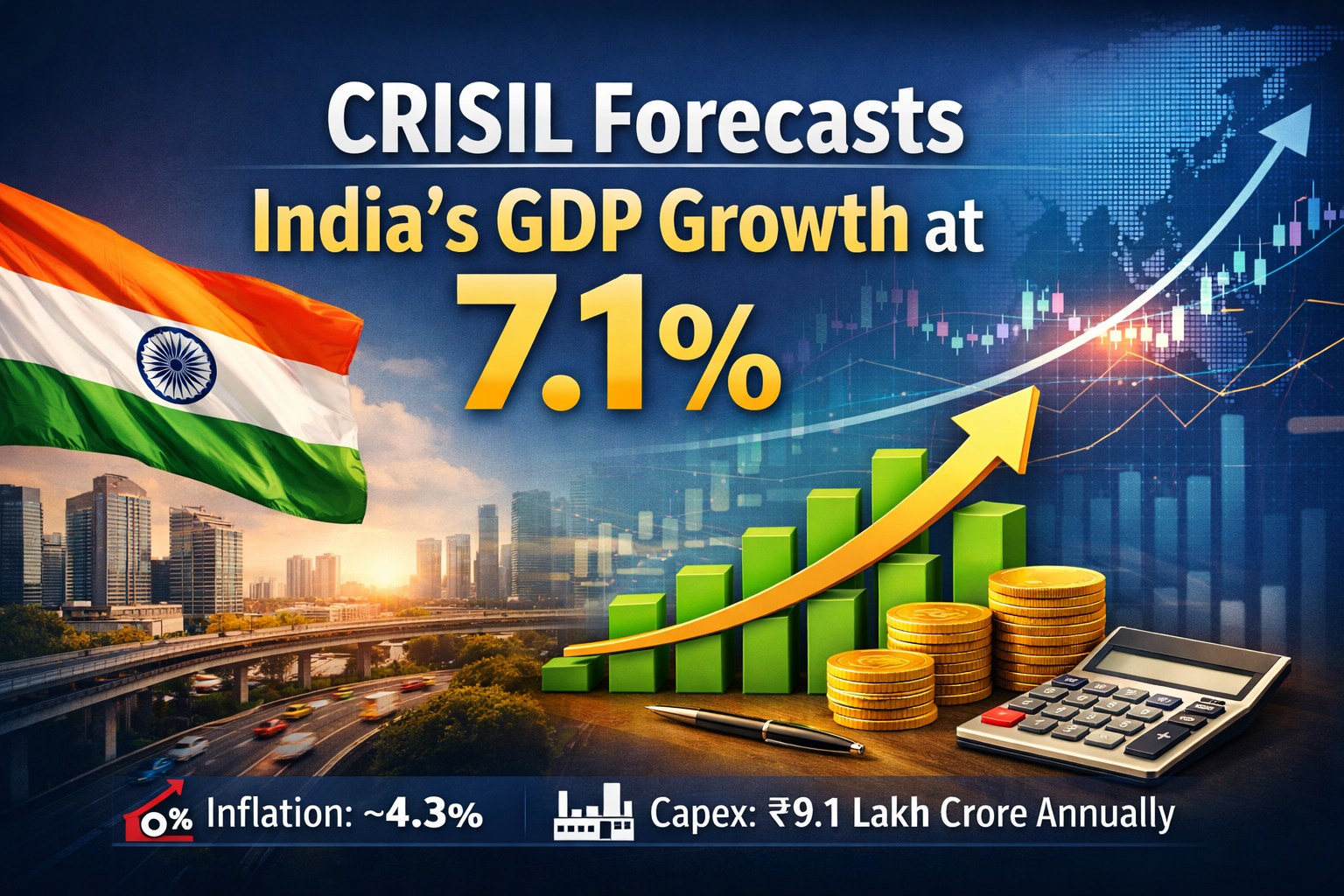
CRISIL projects India’s GDP growth at 7.1% in FY27, signaling strong economic momentum driven by infrastructure investment, rising industrial capex, controlled inflation, and expanding manufacturing, reinforcing India’s position among the fastest-growing
Syllabus Areas:GS III - Economy |
India’s economic growth trajectory continues to attract global attention. In its latest assessment, CRISIL, one of India’s leading credit rating agencies, projected that India’s GDP growth could reach around 7.1% in FY27. The report also estimates that inflation may average about 4.3%, while industrial capital expenditure (capex) could rise significantly to around ₹9.1 lakh crore annually between FY27 and FY31.
These projections signal a strengthening economic cycle driven by infrastructure investment, private sector expansion, and policy stability. For policymakers, investors, and analysts, the forecast provides valuable insights into the direction of India’s medium-term economic outlook.
Understanding CRISIL and Its Economic Forecasts
CRISIL (Credit Rating Information Services of India Limited) is a global analytical company that provides ratings, research, risk assessment, and policy insights. It is a subsidiary of S&P Global and is widely respected for its economic forecasts.
CRISIL’s reports are important because they analyze multiple economic indicators such as:
-
Investment trends
-
Consumption demand
-
Inflation dynamics
-
Fiscal policy and government spending
-
Global economic conditions
Such forecasts help governments and businesses plan future economic strategies.
India’s GDP Growth Outlook
According to CRISIL’s projections, India’s economy is expected to grow at around 7.1% in FY27, maintaining its position as one of the fastest-growing major economies in the world.
Key Drivers of Growth
1. Strong Infrastructure Investment
The Government of India has significantly increased capital expenditure on infrastructure. Programs like PM Gati Shakti National Master Plan aim to improve logistics, connectivity, and industrial efficiency. Better infrastructure reduces transportation costs and boosts productivity across sectors.
2. Manufacturing Expansion
Government initiatives such as the Production Linked Incentive Scheme are encouraging domestic manufacturing. The scheme supports sectors like electronics, pharmaceuticals, automobiles, and renewable energy, helping India strengthen its manufacturing base.
3. Rising Domestic Consumption
India’s growing middle class and expanding digital economy are expected to support consumption-driven growth. Increased spending on housing, consumer goods, and services will further strengthen economic momentum.
4. Digital and Technological Transformation
Rapid adoption of digital payments, fintech innovations, and the expansion of the startup ecosystem continue to enhance productivity and economic efficiency.
Inflation Outlook: Stability Around 4.3%
CRISIL estimates that inflation may average around 4.3% in the coming years, which lies close to the target range set by the Reserve Bank of India.
India’s inflation management framework is guided by a flexible inflation targeting regime, where the RBI aims to maintain inflation at 4% with a tolerance band of ±2%.
Factors Supporting Inflation Control
-
Stable agricultural production
-
Improved supply chain management
-
Monetary policy measures by RBI
-
Controlled global commodity prices (if geopolitical tensions remain moderate)
Maintaining moderate inflation is crucial because it ensures stable purchasing power and encourages investment.
Industrial Capex Cycle: A Major Growth Engine
One of the most significant highlights of CRISIL’s report is the expected surge in industrial capital expenditure (capex).
What is Capex?
Capital expenditure refers to investments made by companies to acquire or upgrade physical assets such as:
-
Factories
-
Machinery
-
Infrastructure
-
Technology
These investments increase production capacity and generate employment.
Capex Outlook
CRISIL estimates that industrial capex could reach around ₹9.1 lakh crore annually between FY27 and FY31.
This surge in investment indicates the beginning of a new private investment cycle, which is essential for long-term economic growth.
Key Sectors Driving Capex
Several sectors are expected to lead the investment cycle:
1. Renewable Energy: India’s ambitious climate goals are driving investments in solar, wind, and green hydrogen projects.
2. Semiconductor and Electronics Manufacturing: The government’s push for semiconductor fabrication units aims to reduce dependence on imports and strengthen domestic supply chains.
3. Steel and Cement: Infrastructure development and urbanization are increasing demand for construction materials.
4. Transportation and Logistics: Expansion of highways, railways, ports, and airports will require massive investments.
Importance of the Investment Cycle
Economic growth becomes sustainable when private investment complements public spending.
The investment cycle typically follows this sequence:
-
Government increases infrastructure spending
-
Demand for industrial goods rises
-
Private companies invest in new production capacity
-
Employment increases
-
Consumption rises further
India appears to be entering this virtuous cycle again after a slowdown in private investment during the previous decade.
Challenges to the Growth Outlook
Despite optimistic projections, several challenges could influence India’s economic trajectory.
-
Global Economic Uncertainty: Geopolitical tensions, trade conflicts, or energy price shocks can affect global supply chains and growth prospects.
-
Inflation Risks: Unexpected spikes in food or fuel prices may increase inflationary pressure.
-
Financial Sector Risks: High corporate debt levels or banking sector stress could slow investment growth.
-
Climate and Environmental Risks: Extreme weather events and climate disruptions can affect agriculture and economic stability.
Policy Measures Needed
To sustain strong economic growth, policymakers must focus on several key areas:
1. Strengthening Infrastructure: Continued investment in transportation, energy, and urban infrastructure will enhance productivity.
2. Boosting Manufacturing: India must deepen industrial ecosystems and improve supply chains to compete globally.
3. Financial Sector Reforms: Efficient credit flow to industries is essential for sustaining the investment cycle.
4. Skill Development: A skilled workforce is necessary to support high-technology industries and modern manufacturing.
CRISIL’s forecast of 7.1% GDP growth for FY27 reflects strong confidence in India’s economic fundamentals. With controlled inflation and a rising industrial investment cycle, India is positioned to sustain long-term economic expansion.
However, sustaining this momentum requires consistent policy support, continued infrastructure development, and resilience against global economic shocks.
If the projected ₹9.1 lakh crore annual industrial capex materializes, India could enter a new phase of investment-led growth, strengthening its position as one of the world’s leading emerging economies.
Prelims Questions:
1. Consider the following statements regarding CRISIL:
-
It is a global analytics company providing ratings and research services.
-
It is a subsidiary of S&P Global.
-
It operates under the Ministry of Finance of the Government of India.
Which of the statements given above is/are correct?
A. 1 only
B. 1 and 2 only
C. 2 and 3 only
D. 1, 2 and 3
Answer: B
2. With reference to Capital Expenditure (Capex), consider the following statements:
-
It refers to expenditure incurred for acquiring or upgrading physical assets.
-
It generally increases productive capacity in the economy.
-
It includes salaries and pensions paid by the government.
Which of the statements given above are correct?
A. 1 and 2 only
B. 2 and 3 only
C. 1 and 3 only
D. 1, 2 and 3
Answer: A
Mains Question:
1. India is expected to enter a new private investment cycle in the coming years. Discuss the drivers and challenges of industrial capital expenditure in India.(150 Words)