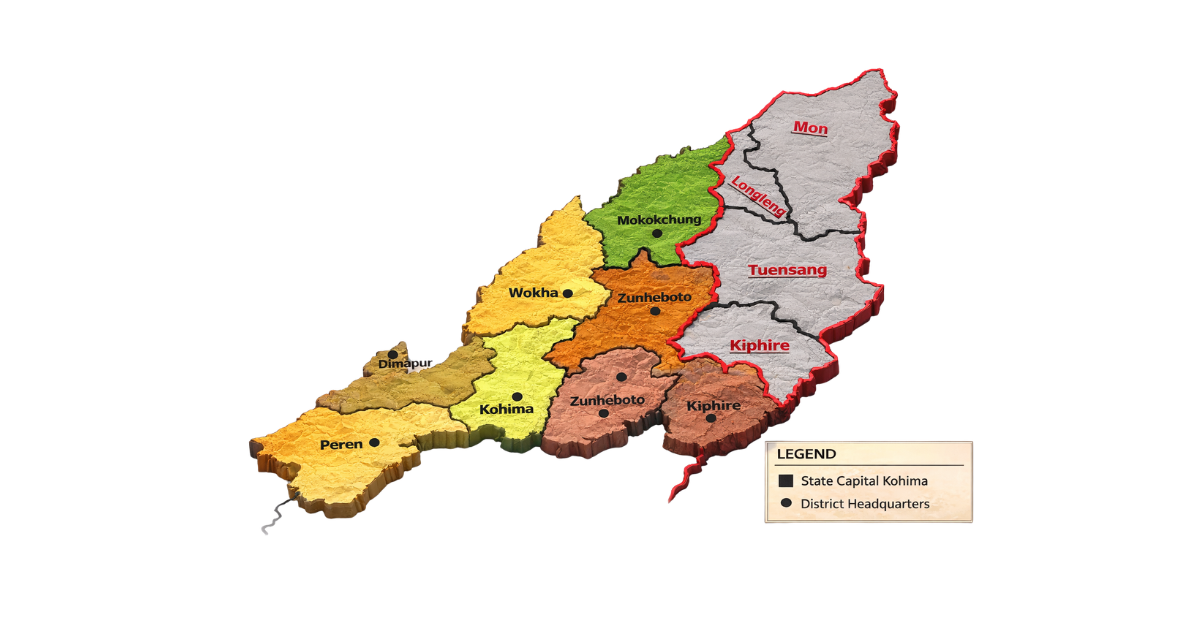
The FNTA agreement addresses Eastern Nagaland’s long-standing autonomy demand, explains ENPO’s movement, Article 371A safeguards, strategic border concerns, and evaluates whether this federal model can resolve similar ethnic and governance conflicts.
Syllabus Areas:GS II - Polity , Governance GS III - Internal Security |
On February 5, the Union Government signed a tripartite agreement with the Nagaland Government and the Eastern Nagaland People’s Organisation (ENPO) to establish the Frontier Nagaland Territorial Authority (FNTA)—a landmark arrangement granting enhanced autonomy to eastern Nagaland without creating a new State.
Background: Who is ENPO and what was its demand?
-
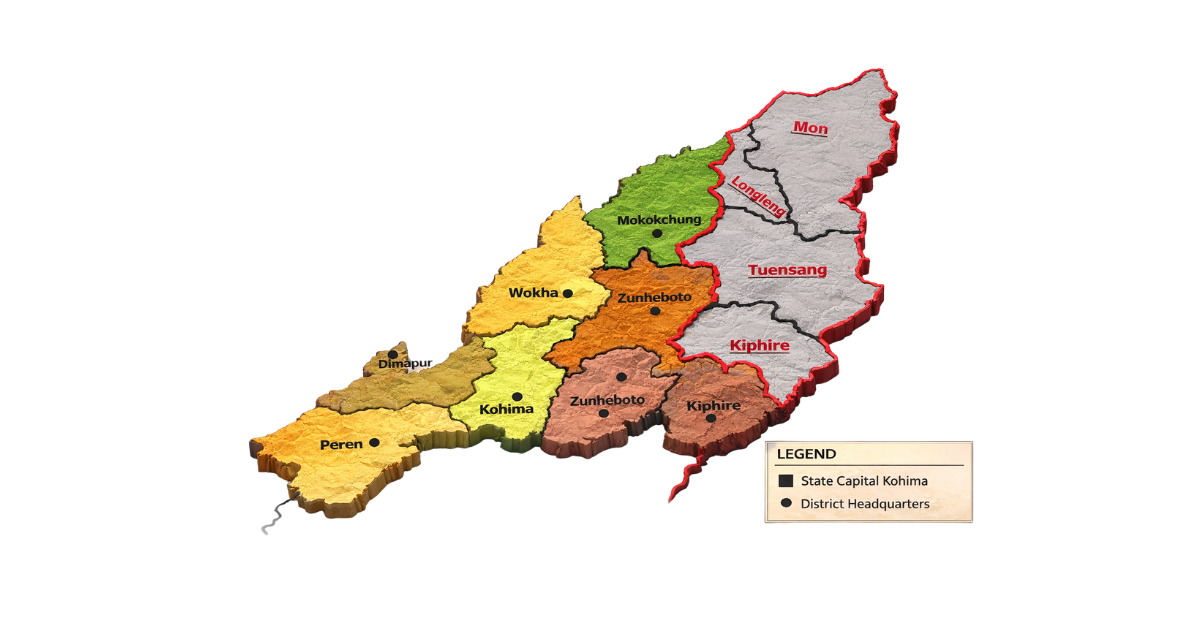
The Eastern Nagaland People’s Organisation (ENPO) represents eight Naga tribes living in six eastern districts of Nagaland.
-
Core demand: Creation of a separate State called “Frontier Nagaland.”
-
The demand was formally conveyed to the Centre in 2010 through a memorandum.

Historical roots of the demand
-
Under British rule (pre-1947), eastern Naga hills were treated as an “unadministered frontier.”
-
This resulted in chronic governance neglect and a long-term developmental deficit.
-
After Nagaland became a State in 1963, eastern districts felt politically and economically marginalised.
-
Resentment grew due to:
-
Administrative concentration in Kohima
-
Perceived dominance of western Naga tribes
-
Over time, this marginalisation crystallised into a strong sub-regional political movement.
Why did the Centre find merit in ENPO’s demand?
The Centre’s intervention was driven by three converging factors:
1. Political Compulsion
-
Earlier attempts—Standard Operating Procedures (SOPs) and a ₹1,500-crore package—failed to satisfy political aspirations.
-
In 2024, ENPO called for a total boycott of Lok Sabha elections, showing its mass leverage and ability to disrupt democratic processes.
2. Strategic & Security Concerns
-
Eastern Nagaland borders Myanmar, making it a critical buffer zone.
-
Presence of armed extremist groups across the porous border heightened security risks.
-
Prolonged alienation of the population in such a frontier region was seen as strategically dangerous.
3. Federal Responsibility
-
The Centre recognised that purely economic solutions cannot resolve political grievances.
-
FNTA was conceived as a middle path—addressing aspirations without redrawing State boundaries.
What does the FNTA offer? (Core Features)
The Frontier Nagaland Territorial Authority (FNTA) provides substantial autonomy within Nagaland.
Key provisions
-
Covers six eastern Nagaland districts.
-
Establishment of a Mini-Secretariat in the region:
-
Headed by a senior-ranking officer
-
Brings administration closer to the people
-
Reduces dependence on Kohima
-
Legislative & executive powers over 46 subjects, including:
-
Land and resource use
-
Agriculture and allied activities
-
Rural development
-
Local infrastructure
Financial & administrative structure
-
Development funds to be shared proportionally based on:
-
Population
-
Area
-
Ministry of Home Affairs to fund initial establishment costs.
Constitutional safeguard
-
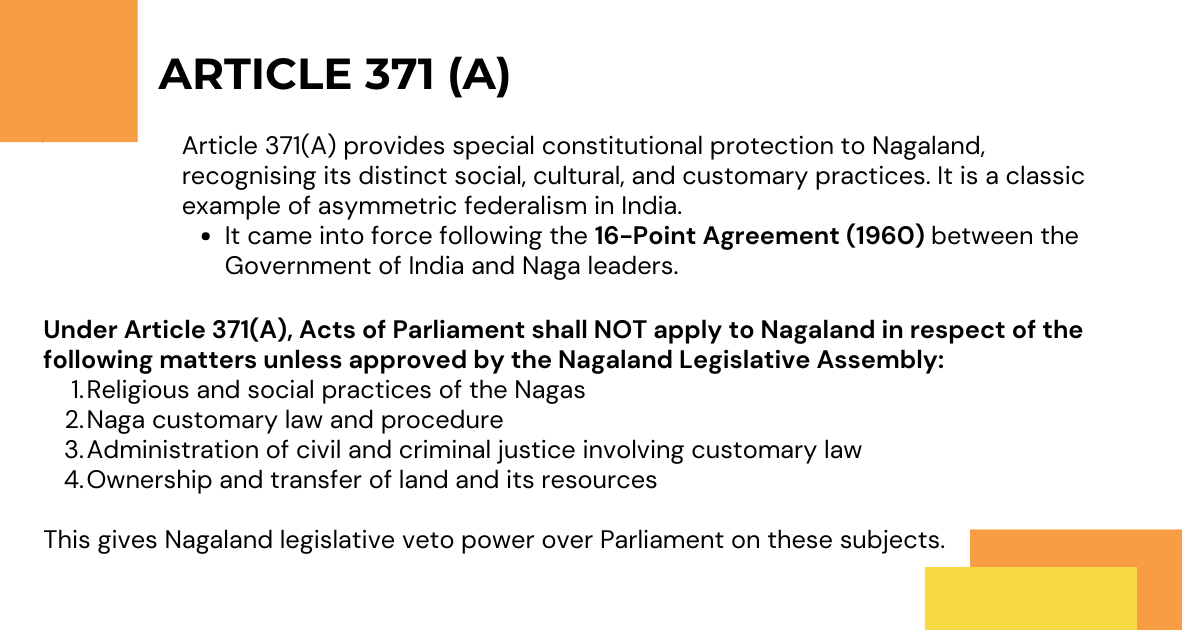
The agreement does not alter or dilute Article 371(A).
-
This ensures continued protection of:
-
Naga customary laws
-
Social and religious practices
-
Traditional land ownership systems
FNTA grants autonomy without Statehood, preserving Nagaland’s constitutional uniqueness.
Can the FNTA model be applied to the Kuki-Zo demand in Manipur?
The FNTA has triggered debate on whether a similar model can address the Kuki-Zo demand for a separate administration in Manipur.
Why FNTA looks promising as a model
-
FNTA resembles territorial autonomy mechanisms, similar in spirit to:
-
Hill Areas Committee under Article 371(C) in Manipur
-
Signals that the Centre is open to constitutional innovation:
-
Autonomy without State bifurcation
-
Middle ground between full Statehood and district-level governance
Why replication is difficult
-
Political consensus missing:
-
Nagaland CM Neiphiu Rio supported negotiations
-
In Manipur, the Meitei-dominated Imphal Valley leadership strongly opposes separation
-
Active ethnic violence in Manipur, unlike Nagaland
-
Zero inter-community trust at present
-
Competing territorial claims by groups like:
-
NSCN (Tangkhul Naga faction) over hill districts
-
Any administrative carve-out risks overlapping claims and escalation.
FNTA offers a conceptual template, but Manipur’s conflict dynamics make direct replication extremely challenging.
Mains Questions:
1. Discuss how the FNTA arrangement balances tribal autonomy with constitutional integrity, without diluting the special provisions under Article 371(A). (150 Words)
2. Eastern Nagaland’s strategic location along the India–Myanmar border influenced the Centre’s decision to accommodate ENPO’s demands. Analyse the link between internal security and sub-regional governance. (250 Words)