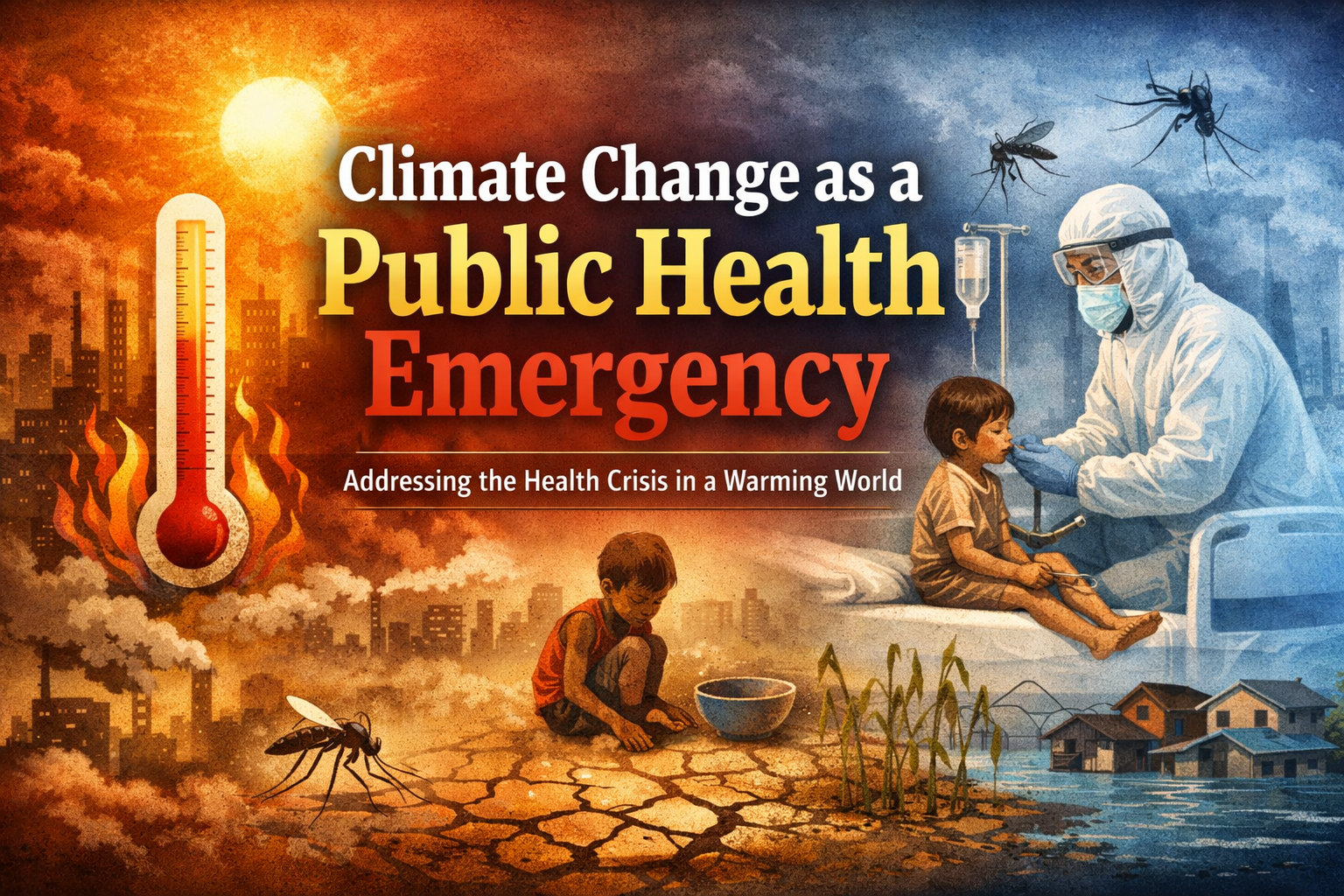
A comprehensive analysis of climate change as a public health emergency in India, covering health impacts, policy gaps, and actionable solutions for integrated governance.
|
Syllabus Areas: GS II - Governance GS III - Environment |
Climate change is no longer a distant environmental concern—it has evolved into an immediate and profound public health emergency. Rising global temperatures, erratic weather patterns, and ecological disruptions are directly impacting human health in ways that are both visible and insidious.
In India, the discourse around climate change remains largely confined to environmental sustainability and economic costs. However, recent developments—such as recurring heatwaves, increasing disease outbreaks, and food insecurity—highlight a critical shift: climate change is fundamentally a health crisis. Recognizing and responding to this transformation is essential for effective governance and long-term resilience.
Understanding the Climate–Health Nexus
Climate change affects health through multiple, interconnected pathways:
1. Direct Health Impacts
-
Heatwaves are becoming more frequent and intense, leading to:
-
Heat strokes
-
Dehydration
-
Increased mortality, especially among vulnerable populations
-
Extreme weather events such as floods and cyclones cause:
-
Injuries and deaths
-
Displacement and mental health issues
2. Indirect Health Impacts
-
Changes in temperature and rainfall patterns influence:
-
Spread of vector-borne diseases like malaria and dengue
-
Contamination of water sources, leading to diarrheal diseases
-
Agricultural disruption leads to:
-
Reduced crop yields
-
Nutritional deficiencies
3. Long-Term Systemic Impacts
-
Air pollution exacerbated by climate factors contributes to:
-
Respiratory diseases
-
Cardiovascular disorders
-
Food insecurity results in:
-
Malnutrition, particularly among children and women
Emerging Public Health Risks in India
India is particularly vulnerable due to its geography, population density, and socio-economic conditions.
1. Heatwaves and Urban Vulnerability
Cities are experiencing the urban heat island effect, where concrete structures trap heat. This disproportionately affects:
-
Urban poor
-
Daily wage workers
-
Elderly populations
2. Expansion of Vector-Borne Diseases
Warmer temperatures are expanding the geographical range of disease vectors:
-
Malaria is appearing in previously unaffected regions
-
Dengue outbreaks are becoming more frequent and severe
3. Food and Nutrition Crisis
Climate variability impacts agriculture through:
-
Irregular monsoons
-
Soil degradation
-
Reduced nutritional value of crops
This leads to a hidden hunger crisis, where caloric intake may be sufficient but nutritional quality is compromised.
Why India’s Current Approach is Inadequate
A critical gap in India’s policy framework is the compartmentalization of climate change and public health.
1. Policy Silos
-
Climate policies focus on:
-
Emission reduction
-
Renewable energy
-
Health policies focus on:
-
Disease treatment
-
Healthcare infrastructure
There is minimal integration between the two.
2. Reactive Rather Than Preventive Approach
-
Government responses are often post-disaster:
-
Relief measures after floods
-
Emergency responses during heatwaves
-
There is insufficient emphasis on:
-
Early warning systems
-
Preventive healthcare planning
3. Lack of Data Integration
-
Absence of real-time data linking climate variables with health outcomes
-
Weak surveillance systems for climate-sensitive diseases
Global Best Practices: What India Can Learn
Several countries and international organizations have begun integrating climate and health policies:
-
Heat Action Plans (e.g., Ahmedabad model)
-
Climate-resilient healthcare systems
-
Integration of climate indicators into public health surveillance
These examples demonstrate that proactive planning significantly reduces mortality and economic losses.
The Way Forward: A Multi-Dimensional Strategy
To address climate change as a public health emergency, India must adopt a holistic and integrated approach.
1. Mainstream Climate into Health Policy
-
Recognize climate change as a core determinant of health
-
Integrate climate risks into:
-
National Health Policy
-
State-level health planning
2. Strengthen Preventive Healthcare Systems
-
Develop:
-
Heat action plans across all states
-
Early warning systems for disease outbreaks
-
Promote community-level awareness and resilience
3. Build Climate-Resilient Infrastructure
-
Climate-proof hospitals and healthcare facilities
-
Ensure uninterrupted access to essential services during disasters
4. Enhance Data and Research Capacity
-
Invest in:
-
Climate-health data systems
-
Interdisciplinary research
-
Use data for predictive modelling and policy design
5. Focus on Vulnerable Populations
-
Target interventions for:
-
Children
-
Elderly
-
Marginalized communities
-
Ensure equitable access to healthcare and nutrition
Ethical and Governance Dimensions
This issue also raises deeper questions:
-
Intergenerational equity: Are current policies compromising future health?
-
Climate justice: Are the most vulnerable bearing the highest burden?
-
State responsibility: Should governments treat climate change as a health emergency similar to pandemics?
A failure to address these questions risks widening inequalities and undermining social stability.
Climate change is not just an environmental or economic issue—it is a human survival issue. Treating it as a public health emergency shifts the focus from abstract global targets to immediate human well-being.
India stands at a critical juncture. Continuing with fragmented policies will only deepen vulnerabilities. Instead, a forward-looking, integrated, and preventive approach can transform this challenge into an opportunity for building a resilient and healthier society.
The real question is not whether climate change affects health—it clearly does. The question is whether policy frameworks will evolve quickly enough to respond to this reality.