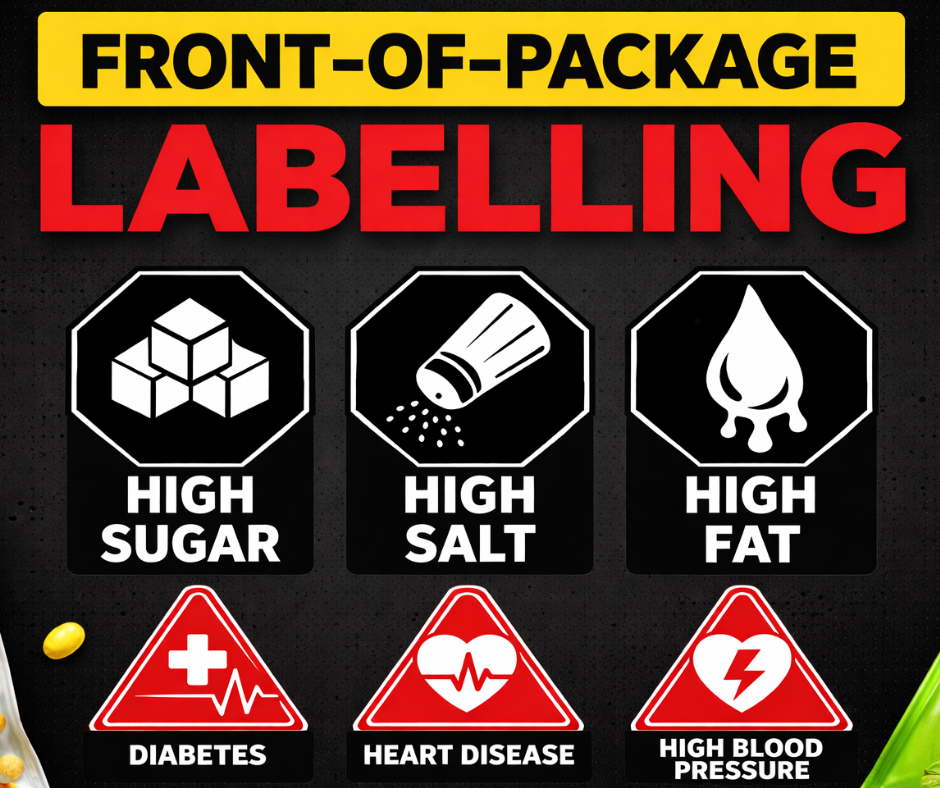
The Supreme Court of India has directed the Food Safety and Standards Authority of India (FSSAI) to consider introducing mandatory front-of-package warning labels on packaged foods high in sugar, salt, and saturated fat.
Syllabus Areas:GS II - Governance GS III - Public Health, Food Processing Industry |
The Court has asked FSSAI to submit its response within four weeks, reiterating citizens’ right to health amid the rising burden of non-communicable diseases (NCDs) in India.
Background and Judicial Context
-
The case was brought by the NGO “35 and Our Health Society”, arguing that clear nutritional warnings are essential for informed consumer choice.
-
In 2025, the Supreme Court had already directed an expert committee under FSSAI to recommend amendments to the Food Safety and Standards (Labelling and Display) Regulations, 2020 to enable front-of-package labelling (FoPL).
-
FSSAI sought extensions citing stakeholder consultations, but in February 2026, the Court expressed dissatisfaction, noting that the process had not produced any “positive or good result.”
-
A major point of disagreement was FSSAI’s proposal for an Indian Nutrition Rating (INR) system, which the petitioner opposed for not aligning with globally accepted warning-label standards.
What Is Front-of-Package Labelling (FoPL)?
Front-of-package labelling refers to simple, visible warning symbols or labels placed on the front of packaged foods to alert consumers if a product is:
-
High in sugar
-
High in salt
-
High in saturated fat
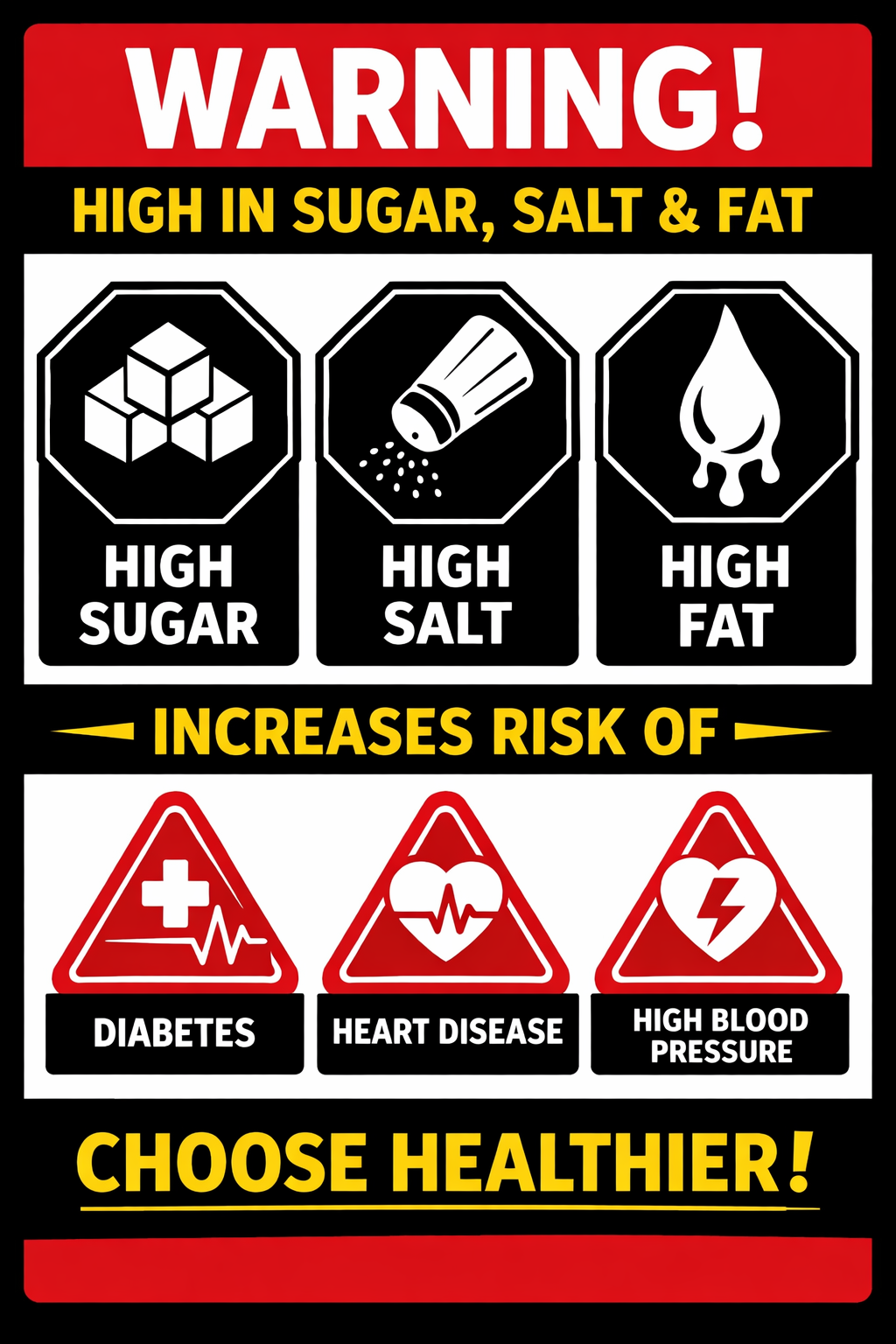
Globally, many countries use clear warning symbols (such as black stop-signs or bold alerts) rather than complex rating systems, as they are easier to understand across literacy levels.
Health Rationale: The NCD Crisis in India
India is facing a silent epidemic of lifestyle-related diseases:
-
The ICMR-INDIAB (2023) study found:
-
101 million Indians (11.4%) suffer from diabetes
-
136 million are pre-diabetic
-
Other alarming indicators:
-
Hypertension: 35.5% (national average)
-
Abdominal obesity: 39.5%
-
High cholesterol: 24%
There is strong scientific evidence linking ultra-processed foods rich in sugar, salt, and saturated fats to:
-
Diabetes
-
Hypertension
-
Cardiovascular diseases
Why Front-of-Package Labelling Matters
1. Enables Informed Consumer Choice
-
Consumers often do not read or understand back-of-pack nutritional tables.
-
Simple warnings help people quickly identify unhealthy products.
2. Preventive Public Health Tool
-
FoPL works at the prevention stage, reducing disease burden before medical intervention is needed.
-
Prevention is far more cost-effective than treatment in a resource-constrained health system.
3. Nudges Industry Reformulation
-
Evidence from other countries shows that mandatory warning labels push food companies to reduce sugar, salt, and fat content.
4. Advances Right to Health
-
The Court’s intervention reinforces that commercial interests cannot override public health.
-
Transparent labelling is part of the State’s duty under Article 21 (Right to Life).
Indian Nutrition Rating vs Global Warning Labels
|
Aspect |
Indian Nutrition Rating (Proposed) |
Global Warning Labels |
|
Complexity |
Composite score, harder to interpret |
Simple, direct warnings |
|
Consumer Understanding |
Requires nutritional awareness |
Easily understood |
|
Global Acceptance |
Limited |
Widely endorsed (WHO, PAHO) |
|
Public Health Impact |
Uncertain |
Proven effectiveness |
The Court appears sceptical of models that may dilute risk communication instead of clearly flagging unhealthy products.
Broader Implications
-
Signals stronger judicial oversight of health regulators.
-
Aligns India’s food regulation with global public-health best practices.
-
Strengthens accountability of FSSAI in balancing industry consultation with citizen welfare.
Way Forward
-
Mandatory, standardised front-of-package warning labels aligned with global evidence-based models.
-
Time-bound implementation with minimal dilution.
-
Complementary public awareness campaigns on nutrition literacy.
-
Continuous monitoring of health outcomes and industry compliance.
Front-of-package labelling is not merely a regulatory reform—it is a public health imperative. With non-communicable diseases already entrenched across India, transparent food labelling can act as a powerful first line of defence. The Supreme Court’s sustained intervention underscores that prevention, informed choice, and the right to health must prevail over commercial convenience.
Prelims Questions:
1. With reference to Front-of-Package Labelling (FoPL) in India, consider the following statements:
-
It aims to warn consumers about high levels of sugar, salt, and saturated fat in packaged foods.
-
It is currently mandatory under the Food Safety and Standards (Labelling and Display) Regulations, 2020.
-
It is supported by global public health bodies as an effective non-communicable disease prevention tool.
Which of the statements given above is/are correct?
A. 1 and 2 only
B. 1 and 3 only
C. 2 and 3 only
D. 1, 2 and 3
Correct Answer: B
Statement 2 is factually incorrect → FoPL not yet mandatory.
Mains Questions:
1. “The right to health cannot be subordinated to commercial interests.”
In this context, examine the role of the Supreme Court of India in advancing front-of-package food labelling as a public health measure. (150 / 250 words)
2. “Informed choice is a moral obligation of the State, not a consumer luxury.”
Examine this statement in the context of public health regulation and food labelling in India.