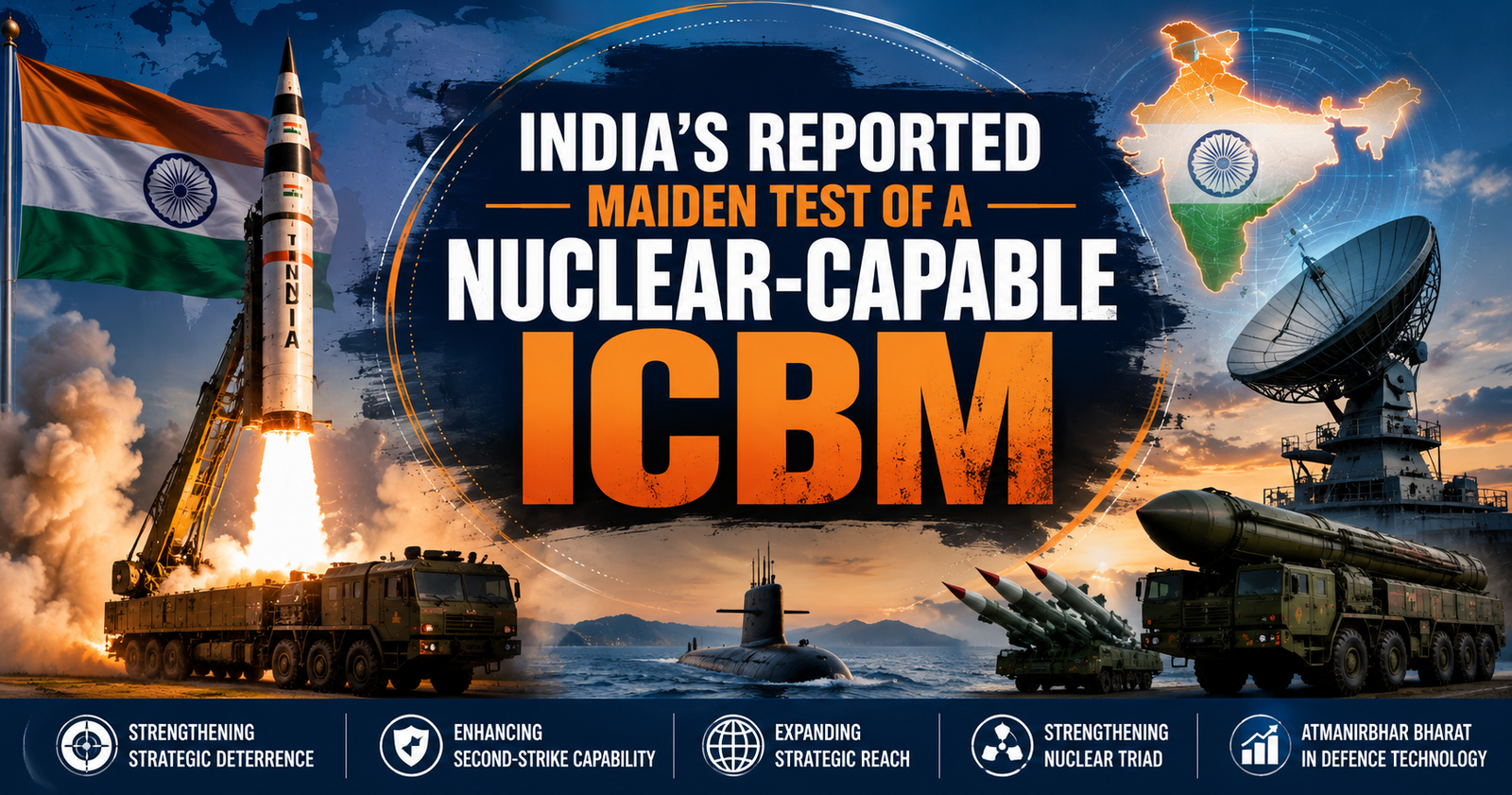
Explore India’s reported maiden nuclear-capable ICBM test, its strategic significance, deterrence capability, nuclear triad, geopolitical implications, defence modernization and impact on regional and global security dynamics.
Syllabus Areas:GS III - Science and Technology, Security |
India reportedly conducted the test of a nuclear-capable Intercontinental Ballistic Missile near the Odisha coast.
The test is significant because:
-
It demonstrates India’s expanding long-range missile capability.
-
It strengthens strategic deterrence.
-
It improves India’s second-strike capability.
-
It contributes to the credibility of India’s nuclear triad.
The development is being closely observed by neighbouring countries and major global powers.
What is an ICBM?
An Intercontinental Ballistic Missile (ICBM) is a long-range missile capable of carrying nuclear warheads across continents.
Key Features of ICBMs
-
Range generally exceeds 5,500 km
-
Can carry nuclear payloads
-
Travels through ballistic trajectory
-
Extremely high speed
-
Difficult to intercept
ICBMs are among the most powerful strategic weapons in the world.
Understanding Ballistic Missiles
Ballistic missiles follow a trajectory similar to a projectile after launch.
Phases of a Ballistic Missile
1. Boost Phase
The missile is launched and powered upward using rocket engines.
2. Midcourse Phase
The missile travels outside Earth’s atmosphere in space.
3. Terminal Phase
The warhead re-enters the atmosphere and moves toward the target.
Because of their speed and altitude, ballistic missiles are extremely difficult to defend against.
India’s Ballistic Missile Programme
India has steadily developed indigenous missile capabilities under the Integrated Guided Missile Development Programme (IGMDP).
Major Missile Categories Developed by India
-
Prithvi Series: Short-range ballistic missiles.
-
Agni Series: Medium to long-range ballistic missiles.
-
BrahMos: Supersonic cruise missile jointly developed with Russia.
-
K-Series: Submarine-launched ballistic missiles.
-
The reported ICBM test is believed to represent the next phase in India’s strategic missile modernization.
Agni Missile Series: Backbone of India’s Strategic Deterrence
India’s strategic missile capability largely revolves around the Agni series.
Agni-I
-
Short-range ballistic missile
-
Primarily Pakistan-focused deterrence
Agni-II
-
Medium-range capability
-
Covers larger regional targets
Agni-III and IV
-
Enhanced range and payload
Agni-V
-
Approximate range above 5,000 km
-
Can potentially target strategic locations deep inside Asia
Many defence experts already consider Agni-V close to ICBM-class capability.
Strategic Significance of the Reported Test
1. Strengthening Strategic Deterrence
The primary purpose of nuclear-capable long-range missiles is deterrence.
Deterrence means:
Preventing adversaries from initiating aggression due to fear of retaliation.
An ICBM capability enhances India’s ability to:
-
Maintain credible retaliation capability
-
Deter nuclear threats
-
Preserve strategic balance
2. Enhancing Second-Strike Capability
India follows a “No First Use” nuclear doctrine.
This means India pledges:
-
Not to use nuclear weapons first
-
But retaliate massively if attacked with nuclear weapons
For this doctrine to remain credible, India requires strong second-strike capability.
ICBMs improve survivability and retaliatory reach.
3. Expanding Strategic Reach
Long-range missiles provide strategic depth.
They allow India to:
-
Reach distant targets
-
Improve geopolitical leverage
-
Enhance global strategic standing
This capability is especially important in the context of China’s expanding missile arsenal.
4. Technological Advancement
An ICBM programme reflects:
-
Advanced propulsion systems
-
Re-entry vehicle technology
-
Guidance systems
-
Precision navigation capability
Such technologies strengthen India’s overall defence-industrial ecosystem.
India’s Nuclear Doctrine
India officially declared its nuclear doctrine after the 1998 nuclear tests.
Main Features
-
Credible Minimum Deterrence: India maintains only the level of nuclear capability necessary for deterrence.
-
No First Use (NFU): India will not initiate nuclear attack.
-
Massive Retaliation: Any nuclear attack on India will invite severe retaliation.
The development of long-range missiles strengthens the credibility of this doctrine.
Nuclear Triad and Its ImportanceA nuclear triad refers to the ability to launch nuclear weapons from:
Why Nuclear Triad MattersIt ensures:
India’s Nuclear Triad Components1. Land-Based Missiles: Agni missile systems. 2. Air-Based Delivery: Fighter aircraft capable of carrying nuclear weapons. 3. Sea-Based Capability: Submarine-launched ballistic missiles (SLBMs) such as K-series missiles. The reported ICBM capability strengthens the land-based leg of the triad. |
Geopolitical Implications
1. China Factor
China possesses:
-
Advanced ICBMs
-
Hypersonic weapons
-
Expanding nuclear arsenal
India’s missile modernization is often viewed within the broader context of maintaining strategic balance with China.
2. Regional Security Dynamics
South Asia remains one of the world’s most sensitive nuclear regions.
India’s advancements may:
-
Influence regional strategic calculations
-
Trigger military modernization elsewhere
-
Increase focus on missile defence systems
3. Global Strategic Recognition
Only a limited number of countries possess operational ICBMs.
An advanced long-range missile capability enhances India’s image as:
-
A major military power
-
An emerging global strategic actor
-
A technologically capable nation
Technological Challenges in Developing ICBMs
Developing ICBMs requires mastery over highly sophisticated technologies.
Major Challenges
-
Precision Guidance Systems: Accuracy over long distances.
-
Heat Shield Technology: Protection during atmospheric re-entry.
-
Multi-Stage Propulsion: Enabling long-range travel.
-
MIRV Capability (Multiple Independently Targetable Reentry Vehicles)
-
Allows multiple warheads on a single missile.
-
India is also reportedly working on advanced MIRV technologies.
Missile Defence and Strategic Stability
As missile capabilities improve globally, countries are also developing missile defence systems.
Examples
-
US missile shield
-
Russia’s S-500 systems
-
Israel’s Arrow system
Missile defence systems can influence strategic stability by:
-
Changing deterrence equations
-
Encouraging technological competition
India itself has been developing indigenous ballistic missile defence systems.
International Concerns and Arms Control
Global powers often monitor missile developments closely because:
-
Long-range missiles affect strategic balance
-
Nuclear proliferation concerns increase
-
Arms races may intensify
India, however, maintains:
-
Responsible nuclear posture
-
Strong export controls
-
Commitment to strategic restraint
India is also a member of:
-
Missile Technology Control Regime (MTCR)
India’s Defence Modernization Vision
The reported test aligns with India’s broader defence modernization goals.
Key Objectives
-
Indigenous defence production
-
Strategic autonomy
-
Technological self-reliance
-
Enhanced deterrence capability
The “Atmanirbhar Bharat” initiative also encourages domestic defence manufacturing and advanced research.
Challenges Before India
Despite progress, India faces several strategic challenges.
1. Balancing Deterrence and Stability: Avoiding unnecessary escalation while maintaining strong defence capability.
2. High Technological Costs: Advanced missile systems require sustained investment.
3. Regional Arms Competition: Missile advancements may intensify strategic competition.
4. Cyber and Space Vulnerabilities: Modern missile systems depend heavily on communication and satellite infrastructure.
The Way Forward
-
Strengthening Indigenous Technology: India must continue investing in:
-
DRDO research
-
Advanced propulsion
-
AI-enabled defence systems
-
Enhancing Strategic Communication: Transparent nuclear doctrine helps reduce misunderstanding and escalation risks.
-
Strengthening Sea-Based Deterrence: Submarine-based systems improve survivability.
-
Diplomatic Balance: India must maintain strategic stability while protecting national security interests.
India’s reported maiden test of a nuclear-capable ICBM marks a potentially significant milestone in the country’s strategic defence evolution. It reflects India’s growing technological capability, expanding deterrence posture and ambition to maintain strategic stability in an increasingly uncertain global environment.
The development also underlines the transformation of India from a regional military power into an emerging global strategic actor capable of operating within a complex nuclear and geopolitical landscape. While such advancements enhance national security and deterrence, they also require responsible strategic management, diplomatic maturity and continued commitment to global stability. India’s future defence trajectory will likely focus on balancing technological advancement, strategic autonomy and responsible nuclear stewardship in the Indo-Pacific and beyond.