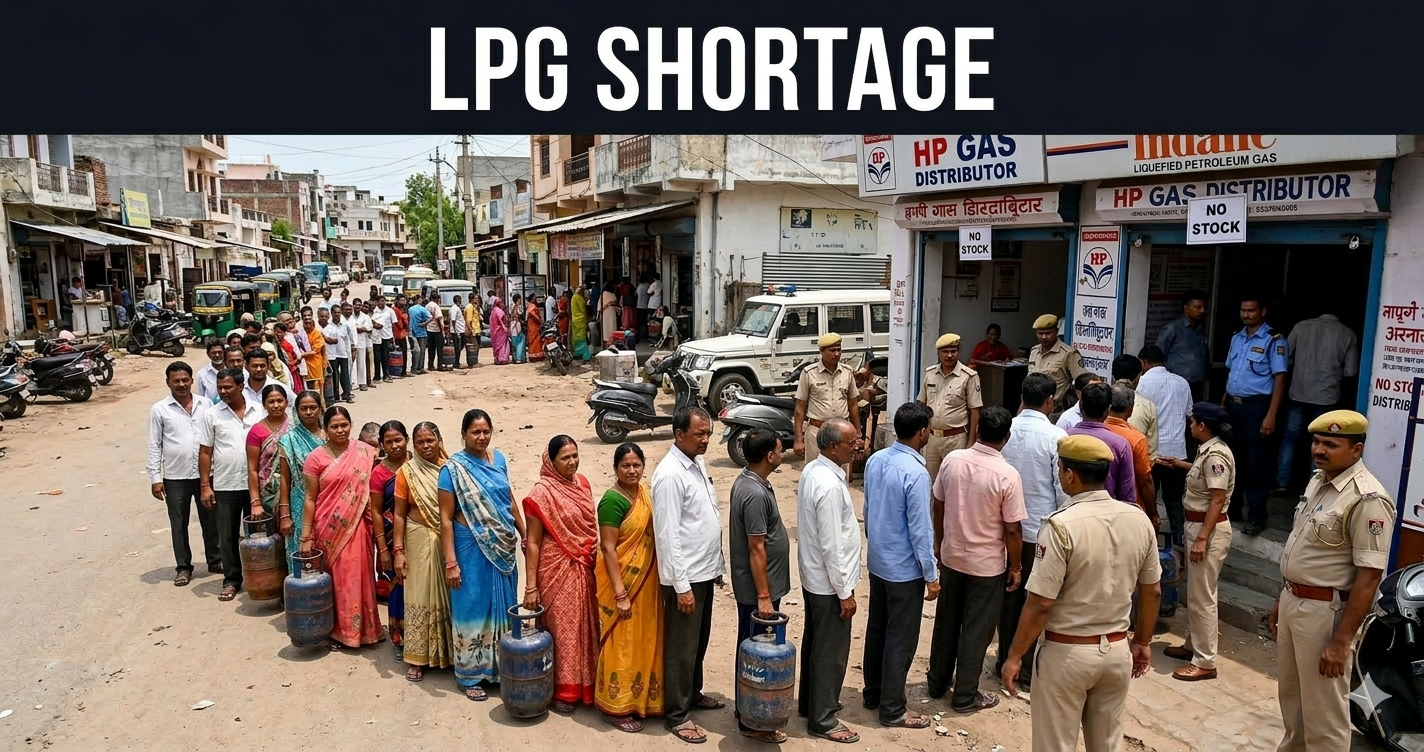
Recent LPG shortages have exposed India’s high import dependence and lack of adequate strategic LPG storage, prompting debate on strengthening energy security infrastructure.
Syllabus Areas:GS III - Economy |
India is facing LPG supply disruptions due to global shipping and geopolitical tensions affecting routes like the Strait of Hormuz. The situation has highlighted India’s inadequate LPG strategic storage, with reserves sufficient for less than two days of consumption, raising concerns about the country’s energy security.
Core Issue: LPG Shortage and Structural Weakness
-
India is facing disruptions in LPG supply, affecting daily household cooking needs.
-
The problem arises because India increased LPG consumption rapidly without building adequate strategic storage.
-
The LPG supply system is designed mainly for continuous operational flow rather than long-term stockpiling.
Key Insight:
India expanded LPG access but did not simultaneously strengthen energy security infrastructure.
Heavy Import Dependence
-
LPG imports have increased dramatically due to rising domestic demand.
Data
-
LPG imports increased threefold between 2011–12 and 2024–25.
-
Current imports: around 20 million tonnes annually.
-
Imports account for ~60% of India’s LPG demand.
-
Import dependency increased from 47% in 2015 to about 60% today.
Implication:
India’s LPG supply is vulnerable to international supply disruptions.
Strategic Vulnerability: Strait of Hormuz
More than 85% of India’s LPG imports pass through the Strait of Hormuz, a critical global energy chokepoint.
If disruptions occur due to:
-
geopolitical tensions
-
war in West Asia
-
shipping blockades
then India’s LPG supply can collapse quickly.
Reason:
India does not maintain large LPG reserves.
Comparison with Oil Strategic Reserves
India has strategic petroleum reserves (SPR) for crude oil and fuels.
Oil reserves
-
Equivalent to around 2 months of consumption.
LPG reserves
-
Only 1–2 days of consumption.
This shows a huge policy gap in energy security planning.
India’s LPG Consumption Pattern
-
India is the second-largest LPG consumer in the world.
-
Monthly LPG consumption: ~3 million tonnes.
-
Daily LPG consumption: ~80,000 tonnes.
Consumption distribution
-
85% of LPG is used by households.
-
Mainly used for cooking.
This means any supply disruption directly affects ordinary citizens, especially women and rural households.
Storage Capacity Crisis
India’s LPG storage infrastructure is extremely limited.
Underground caverns
India has only two LPG underground storage facilities:
-
Visakhapatnam cavern
-
Commissioned: 2007
-
Geological rock: Precambrian gneiss
-
Depth: 162–196 meters
-
Mangaluru cavern
-
Commissioned: 2025
-
Capacity: 80,000 tonnes
-
Geological rock: granitic gneiss
-
Floor: 141 meters below sea level
Total storage capacity
-
1.4 lakh tonnes
Significance
-
Equivalent to less than two days of national LPG consumption.
This is a major energy infrastructure weakness flagged by the International Energy Agency (IEA).
Role of PM Ujjwala Yojana (PMUY)
The surge in LPG demand is closely linked to the government’s social welfare program.
PMUY objectives
-
Provide clean cooking fuel to poor households
-
Reduce use of:
-
firewood
-
cow dung cakes
-
kerosene stoves
Achievements
-
10 crore LPG connections added since 2017
-
Total domestic connections: 33 crore
Impact
Positive:
-
Improved women’s health
-
Reduced indoor air pollution
-
Reduced drudgery for rural women
But it also caused:
-
Sharp rise in LPG demand
-
Increased import dependency
Limited Government Plans for Storage Expansion
According to the Ministry of Petroleum and Natural Gas (MoPNG):
-
There are no concrete plans to build additional LPG caverns.
-
Only the Mangaluru cavern was recently commissioned.
This indicates a policy gap between demand expansion and infrastructure planning.
Alternative Import Sources
India recently signed an LPG import agreement with the United States.
Details
-
Supply: 2.2 million tonnes per year
-
Transport time: ~45 days
Compared to:
-
Persian Gulf shipments, which arrive much faster.
Thus, US imports are not suitable for emergency supply disruptions.
Global Comparison: Europe
Europe provides an interesting comparison.
Gas storage capacity
Europe can store roughly 25% of annual gas consumption.
EU policy after Ukraine war (2022)
-
Mandatory storage filling targets.
-
Countries must reach 90% storage before winter.
Lesson for India:
Strategic storage policies are essential for energy resilience.
Geological Options for LPG Storage in India
Experts identify three major geological zones suitable for underground storage.
1. Peninsular Shield
-
Covers ~60% of peninsular India
-
Rock types:
-
granite
-
gneiss
-
charnockite
This region hosts existing LPG caverns (Visakhapatnam & Mangaluru).
Advantage:
Stable rock formations suitable for storage.
2. Deccan Traps
-
Covers ~5 lakh sq km
-
Basalt rock formation
Challenge:
Engineering complications for cavern construction.
Engineers India Limited (EIL) has faced technical difficulties while designing facilities here.
3. Rajasthan Salt Formations
Located in Bikaner–Barmer belt.
Salt caverns have advantages:
-
cheaper construction
-
faster development
-
naturally impermeable
-
easy gas injection and withdrawal
India is exploring this option.
New Developments in Salt Cavern Technology
-
A refinery is being built in Barmer (Rajasthan).
-
Oil pipelines already exist in the region.
-
Engineers India Limited (EIL) has partnered with Germany’s DEEP company for salt cavern technology.
This could significantly improve future LPG storage capacity.
Other Potential Storage Options
Another option under study is depleted gas reservoirs.
Possible locations:
-
Krishna-Godavari Basin
-
Cambay Basin
-
Mumbai Offshore Basin
These reservoirs can be converted into large-scale gas storage facilities.
Key Structural Problems Identified
The article highlights several structural issues:
-
Rapid LPG demand growth
-
Heavy import dependency
-
Chokepoint risk (Strait of Hormuz)
-
Extremely low strategic reserves
-
Limited storage infrastructure
-
Slow policy response
Policy Implications for India
India needs to:
-
Expand underground LPG storage caverns
-
Diversify import sources
-
Reduce Strait of Hormuz dependence
-
Develop salt cavern storage
-
Convert depleted gas fields into storage
-
Create a strategic LPG reserve policy similar to crude oil reserves.
India’s rising LPG demand, driven by welfare expansion and import dependence, highlights the urgent need to strengthen strategic storage, diversify supply sources, and build resilient energy infrastructure to ensure long-term energy security.