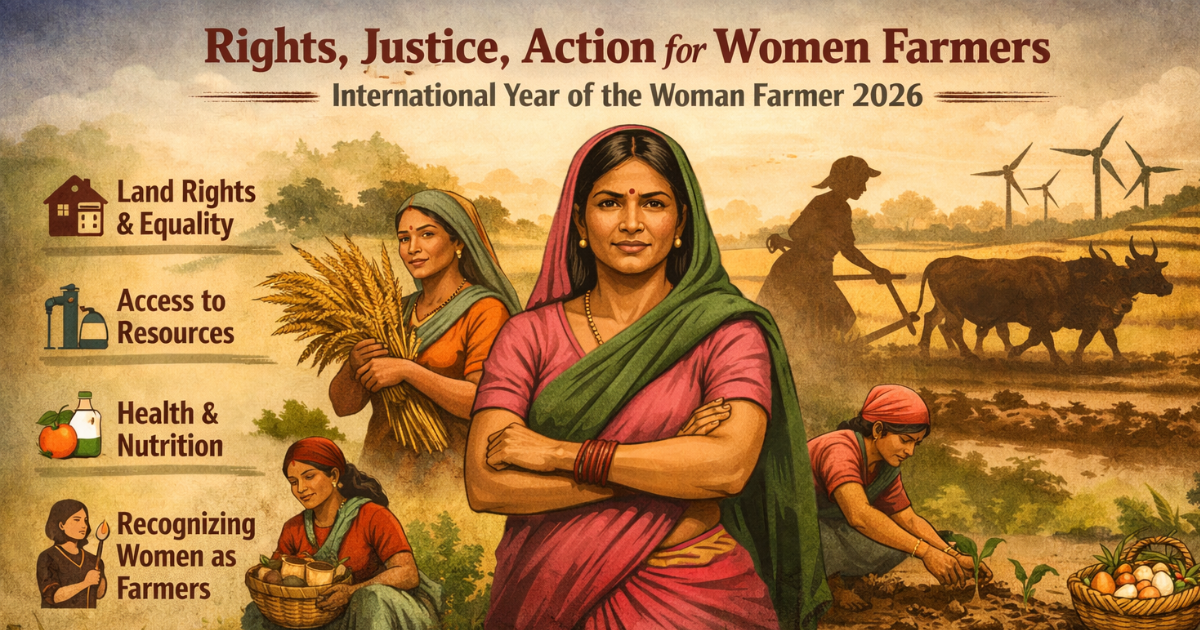
Rural women farmers working in fields symbolize the crucial role of women in agriculture, highlighting issues of land rights, recognition, nutrition, and empowerment in building equitable and resilient food systems in India.
Syllabus Areas:GS I - Society GS III - Agriculture |
International Women's Day 2026 highlights the theme “Rights, Justice, Action for All Women and Girls.” The year also coincides with the International Year of the Woman Farmer, drawing attention to the rights, recognition, and welfare of women in agriculture, particularly in countries like India where women contribute significantly but lack formal recognition.
Women’s Rights in Agriculture Remain Largely Unfulfilled
-
Legal reforms in India have granted equal inheritance rights to daughters, but implementation remains weak.
-
In rural India, land ownership is still predominantly in men's names.
-
Key barriers preventing women from owning land:
-
Patriarchal social norms
-
Patrilineal inheritance traditions
-
Limited legal awareness
-
Administrative hurdles in land registration.
Implication:
Even when women manage farms and agricultural labour, they often lack legal recognition as farmers.
Lack of Land Titles Leads to Institutional Exclusion
Without land ownership documents, women face barriers in accessing:
-
Institutional credit from banks
-
Crop insurance schemes
-
Agricultural subsidies
-
Irrigation schemes
-
Agricultural extension services
-
Climate-resilient technologies
-
Government welfare schemes linked to land ownership.
Structural Problem:
Eligibility criteria of many government programmes are asset-based, which automatically excludes women who do not own land.
Invisible Contribution of Women in Agriculture
Women play a crucial role across the entire agri-food system, including:
-
Cultivation
-
Seed preservation
-
Post-harvest processing
-
Livestock care
-
Food preparation and household nutrition management.
However, their work remains:
-
Undervalued
-
Unpaid or poorly paid
-
Statistically invisible
This creates a disconnect between contribution and recognition.
Feminisation of Agriculture
Migration of men to urban areas has led to increasing feminisation of agriculture.
Meaning:
-
Women increasingly manage:
-
Cultivation
-
Farm finances
-
Risk management
-
Household food security.
However, feminisation does not automatically mean empowerment.
Challenges Women Face
-
Heavy physical labour
-
Lack of mechanisation
-
Limited labour-saving technologies
-
Absence of childcare and social support systems.
This creates a double burden of productive and reproductive responsibilities.
Health and Nutrition Crisis Among Women
Women agricultural workers often face:
-
High work burdens
-
Poor dietary diversity
-
Micronutrient deficiencies
-
Chronic fatigue and health issues
India still has a major burden of:
-
Anaemia among women of reproductive age
-
Micronutrient deficiency
-
Malnutrition among women and girls.
This is described as a “silent emergency.”
Intergenerational Impact of Women’s Malnutrition
Poor maternal nutrition leads to:
-
Low birth weight babies
-
Childhood stunting
-
Cognitive and physical developmental delays.
This creates a cycle of malnutrition across generations.
Dietary Pattern Issue
Typical rural diets are:
-
Heavy in cereals
-
Low in pulses, fruits, vegetables, and animal protein.
Women who help feed the nation cannot secure nutritious diets for themselves.
India’s Right-to-Food Framework
India has established a major food security system through the
National Food Security Act.
Key provisions include:
-
Subsidised cereals through the Public Distribution System (PDS)
-
Supplementary nutrition for:
-
Pregnant women
-
Lactating mothers
-
Children
-
Maternity entitlements.
Some states have expanded this by including:
-
Millets
-
Local foods
-
Fortified staples.
However, improvements in women's nutrition remain uneven, and anaemia rates remain high.
Gap Between Legal Entitlements and Reality
Several systemic issues reduce the effectiveness of welfare programmes:
-
PDS remains cereal-centric
-
Limited inclusion of nutrient-rich foods
-
Overburdened frontline workers
-
Weak community awareness
-
Digitalisation excluding those with:
-
poor connectivity
-
lack of documents
-
limited digital literacy.
Thus, many women cannot fully access their legal rights to food and welfare benefits.
Key Policy Recommendations
1. Recognise Women as Farmers
Agricultural policies should adopt the definition from the
National Policy for Farmers.
This definition recognises farmers beyond landowners, including:
-
Landless cultivators
-
Tenants
-
Agricultural labourers
-
Sharecroppers
-
Tribal gatherers
-
Women engaged in agricultural activities.
Need:
Collection of gender-disaggregated agricultural data.
2. Strengthen Women’s Land and Resource Rights
Key steps suggested:
-
Enforce equal inheritance laws
-
Promote joint land titles for spouses
-
Simplify land registration for women
-
Increase women’s participation in:
-
water resource management
-
common land governance.
Women's collectives can also enhance collective bargaining power.
3. Align Food Systems with Nutrition Goals
Food security programmes should promote:
-
Nutri-cereals (millets)
-
Pulses
-
Fruits and vegetables.
These foods should be integrated into:
-
PDS
-
Anganwadi nutrition programmes
-
Mid-day meal schemes.
Community initiatives like:
-
Kitchen gardens
-
Women seed banks
-
Local food planning
can improve both nutrition and agricultural diversity.
4. Improve Access to Technology and Extension Services
Women farmers must receive:
-
Training
-
Agricultural extension services
-
Climate-smart farming information
-
Market insights.
Access to labour-saving technologies can:
-
Reduce drudgery
-
Save time
-
Improve women’s health.
Empowered women farmers can improve:
-
Productivity
-
Climate resilience
-
Household nutrition outcomes.
5. Role of Research and International Organisations
Institutions like the
M. S. Swaminathan Research Foundation and the
World Food Programme highlight that when women receive:
-
knowledge
-
rights
-
institutional support
they become leaders in climate-resilient and nutrition-sensitive agriculture.
Achieving gender equality in agriculture requires:
-
Recognition of women as farmers
-
Secure land rights
-
Access to resources and technologies
-
Nutrition-focused food systems
Empowering women farmers is not merely a gender issue; it is central to food security, sustainable agriculture, and national development.