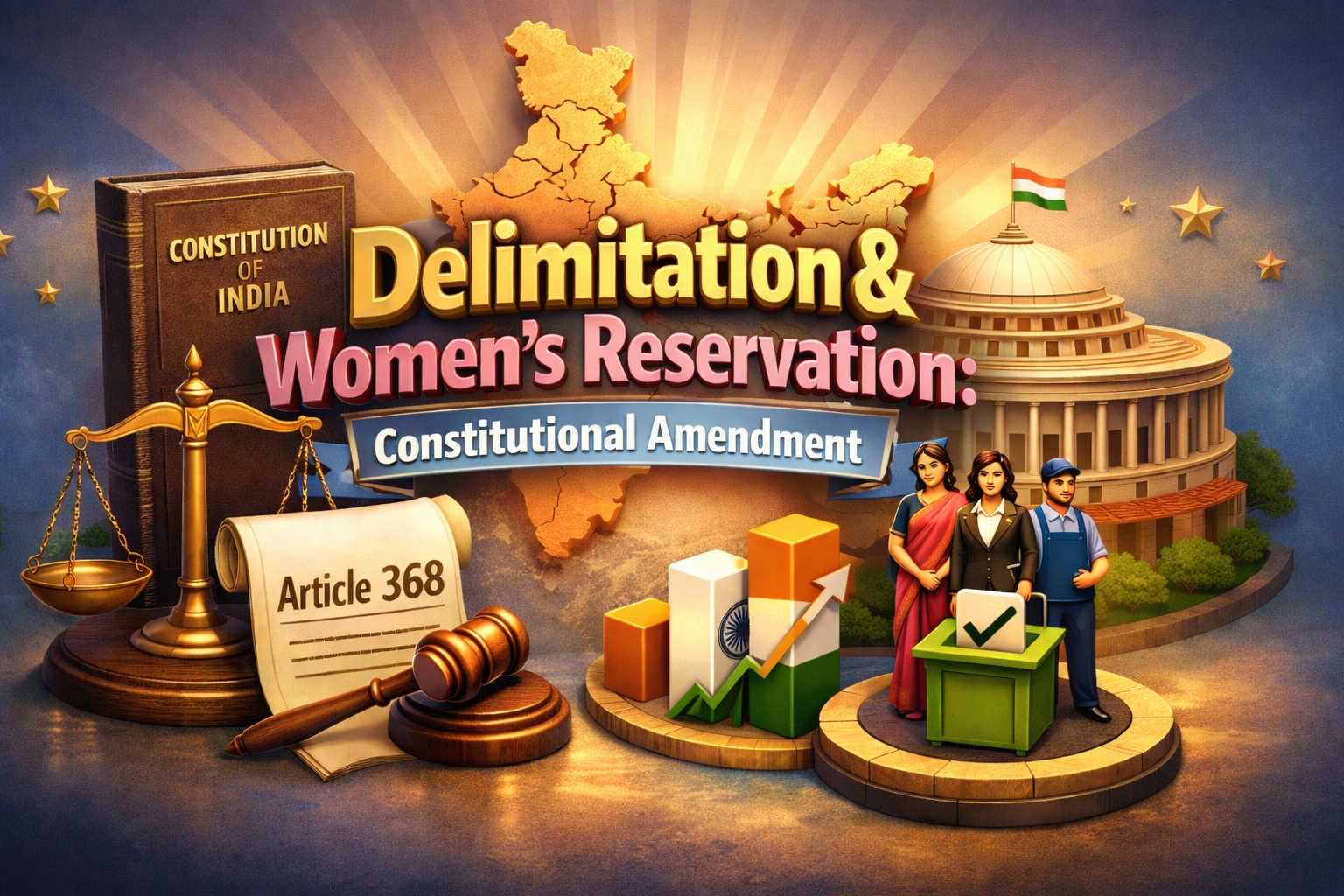
A comprehensive analysis of Delimitation and Women’s Reservation, focusing on constitutional amendments, Article 368, types of majorities, and existing provisions under the 73rd and 74th Amendments for UPSC preparation.
Syllabus Areas:GS II - Polity and Governance |
The issue has come into focus after a recent Bill in the Lok Sabha related to women’s reservation and delimitation lapsed, due to lack of required constitutional support. This has highlighted the complexity of amending the Constitution, especially when issues involve representation, federal balance, and institutional procedures.
Read Delimitation and Women’s Reservation has already been discussed in the previous article.
What is a Constitutional Amendment?
A Constitutional Amendment means formally changing, adding, or removing provisions of the Constitution through a legally defined procedure.
Why is it needed?
-
The Constitution must adapt to changing social needs (e.g., women’s representation)
-
It must also protect core values like democracy and federalism
-
Hence, amendments are neither too easy nor too rigid
Article 368 – Explained Simply
What does it say in practical terms?
-
Only Parliament can amend the Constitution
-
State legislatures cannot initiate constitutional amendments
-
Amendment must be passed as a Bill
-
Introduced in either Lok Sabha or Rajya Sabha
-
Different provisions require different levels of approval
-
Some need only Parliament
-
Some need both Parliament + States
-
President’s assent is mandatory
-
After passage, it becomes law only after approval
Types of Majorities
|
Type |
Meaning (Clear) |
When Used |
Why Important |
|
Simple Majority |
More than half of members present and voting |
Ordinary laws, some constitutional provisions |
Easy decision-making |
|
Absolute Majority |
More than 50% of total membership |
Internal matters of Parliament |
Ensures stability |
|
Effective Majority |
More than 50% of effective strength (excluding vacancies) |
Removal of Vice-President |
Adjusts for vacancies |
|
Special Majority |
Total majority + 2/3rd present and voting |
Most constitutional amendments |
Ensures broad consensus |
|
Special + State Ratification |
Special majority + half of states approve |
Federal provisions |
Protects federalism |
Existing Women’s Representation:
1. Panchayati Raj System
73rd Constitutional Amendment Act
What exactly was introduced?
-
Constitutional status to Panchayats (Part IX)
-
Mandatory reservation of at least 1/3rd seats for women
-
Applies to:
-
Members
-
Chairpersons
Why is it significant?
-
Brought women into grassroots decision-making
-
Increased participation in:
-
Rural governance
-
Welfare schemes
-
Many states expanded it to 50% reservation
2. Urban Local Bodies
74th Constitutional Amendment Act
Key Provisions:
-
Constitutional status to municipalities (Part IX-A)
-
Minimum 1/3rd reservation for women
-
Reservation in leadership roles (Mayor/Chairperson)
Why is it important?
-
Ensures women’s role in:
-
Urban planning
-
Service delivery
-
Local governance
Key Analytical Insight
Local-level success shows:
-
Reservation can improve participation and leadership
But: -
Scaling to Parliament involves:
-
Electoral competition
-
Larger constituencies
-
Complex political dynamics
The debate around delimitation and women’s reservation is fundamentally a question of how to implement reform within constitutional boundaries.
The Constitution provides a carefully balanced amendment mechanism through Article 368, ensuring that:
-
Important changes are not rushed
-
Federal interests are protected
-
Democratic legitimacy is maintained
At the same time, existing provisions under the 73rd and 74th Amendments demonstrate that institutional support can significantly enhance women’s participation.