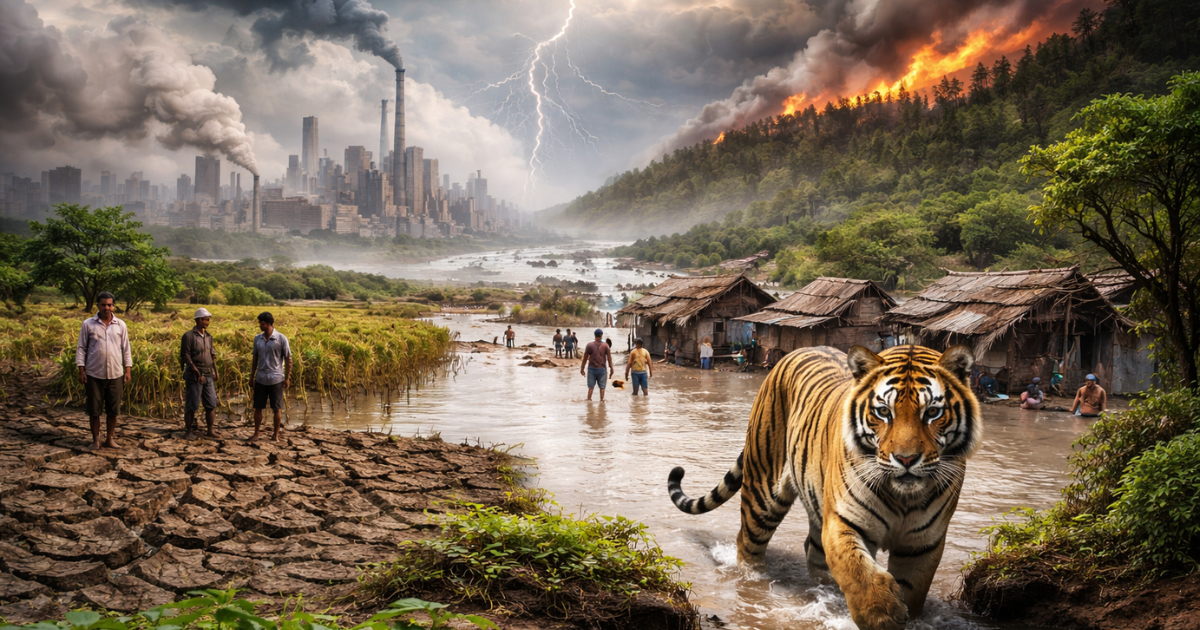
India faces rising extreme weather events, increasing floods, human–tiger conflict, and gaps in air pollution monitoring, highlighting urgent environmental challenges and the need for stronger climate resilience and governance reforms.
Syllabus Areas:GS III - Environment |
The Delhi-based research and advocacy organisation Centre for Science and Environment (CSE) released the State of India’s Environment 2026 on 25 February 2026.
Published annually since 1982, the report provides a comprehensive assessment of India’s environmental conditions, highlighting emerging trends in climate change, extreme weather events, biodiversity pressures, and air pollution governance.
The 2026 edition draws attention to the sharp increase in extreme weather events, rising human–wildlife conflicts, worsening flood risks, and serious gaps in air-quality monitoring across the country.
Sharp Rise in Extreme Weather Events
The report states that 2025 recorded the highest frequency and severity of extreme weather events in the past four years.
Types of extreme events recorded
-
Heatwaves
-
Cold waves
-
Heavy rainfall
-
Floods
Key statistics
-
Extreme weather occurred on 99% of days in 2025 (Jan–Nov data).
-
4,419 deaths were reported due to such events.
-
17.41 million hectares of crops were affected.
Comparison with previous years
Year |
% of Days with Extreme Events |
Deaths |
Crop Area Affected |
|
2025 |
99% |
4,419 |
17.41 million ha |
|
2024 |
88% |
3,393 |
3.61 million ha |
|
2023 |
89% |
3,208 |
2.09 million ha |
Worst-affected States
-
Himachal Pradesh – 267 days of extreme weather
-
Kerala – 173 days
-
Madhya Pradesh – 162 days
Major Concern
-
Increasing climate variability is causing widening ecological backlash.
-
Without decisive climate action, today’s disasters may become the normal future pattern.
Flood Risks Increasing Due to Climate Change
The report emphasises that global warming is intensifying flood risks in India.
Reasons
-
Increased extreme rainfall events
-
Urbanisation blocking natural drainage systems
-
Encroachment of floodplains
-
Loss of wetlands
Key Observation
Climate change is already influencing river systems, urban infrastructure, and land use patterns.
Policy Recommendation
India must shift from post-disaster response to pre-disaster resilience planning.
Suggested Nature-Based Solutions
-
Restoring wetlands
-
Reconnecting rivers with natural floodplains
-
Groundwater recharge
-
Rainwater harvesting
-
Restoration and construction of lakes
-
Climate-sensitive infrastructure planning (e.g., culverts, drainage systems)
Changing Behaviour of Tigers and Rising Human–Wildlife Conflict
The report highlights increasing tiger attacks on humans near forest areas.
Data
-
43 people killed by tigers between Jan–June 2025 near reserves.
-
44 deaths occurred during the same period in 2024.
Reasons for Increased Attacks
-
Habitat overlap between humans and tiger territory
-
Overcrowding in tiger reserves
-
Habitat loss and human encroachment
-
Declining natural prey base
-
Old or injured tigers unable to hunt wild prey
Key Statistic
-
Around 40% of tiger habitat overlaps with areas inhabited by about 60 million people.
Important Insight
-
Tiger populations inside protected areas have reached saturation, forcing animals to move outside reserves.
Implication
-
Rising human–wildlife conflict poses risks to both biodiversity conservation and rural livelihoods.
Major Gaps in Air Pollution Monitoring
The report raises serious concerns about inequality in air-quality monitoring across India.
Key findings
-
Only 15% of India’s population (≈200 million people) lives within 10 km of a continuous air-quality monitoring station.
-
85% of Indians (over 1.2 billion people) live in areas without reliable monitoring data.
Current Monitoring Pattern
Monitoring is concentrated mainly in:
-
Large cities
-
State capitals
-
Metropolitan regions
Areas with Little or No Monitoring
-
Smaller towns
-
Industrial districts
-
Peri-urban growth centres
Implications
-
Air pollution in many regions remains unmeasured and underreported.
-
Lack of data leads to policy blind spots and governance inequality.
CSE Observation
India currently has fragmented environmental data coverage — some regions have dense monitoring, while large parts of the country remain environmental “blind spots.”
Overall Assessment of India’s Environmental Situation
The report concludes that India is facing multiple interconnected environmental crises, including:
-
Increasing climate-driven extreme weather events
-
Rising flood vulnerability
-
Growing human–wildlife conflicts
-
Inadequate environmental monitoring systems
-
Climate change affecting ecosystems, agriculture, and human settlements
These challenges demand integrated climate action, improved environmental governance, and stronger resilience planning