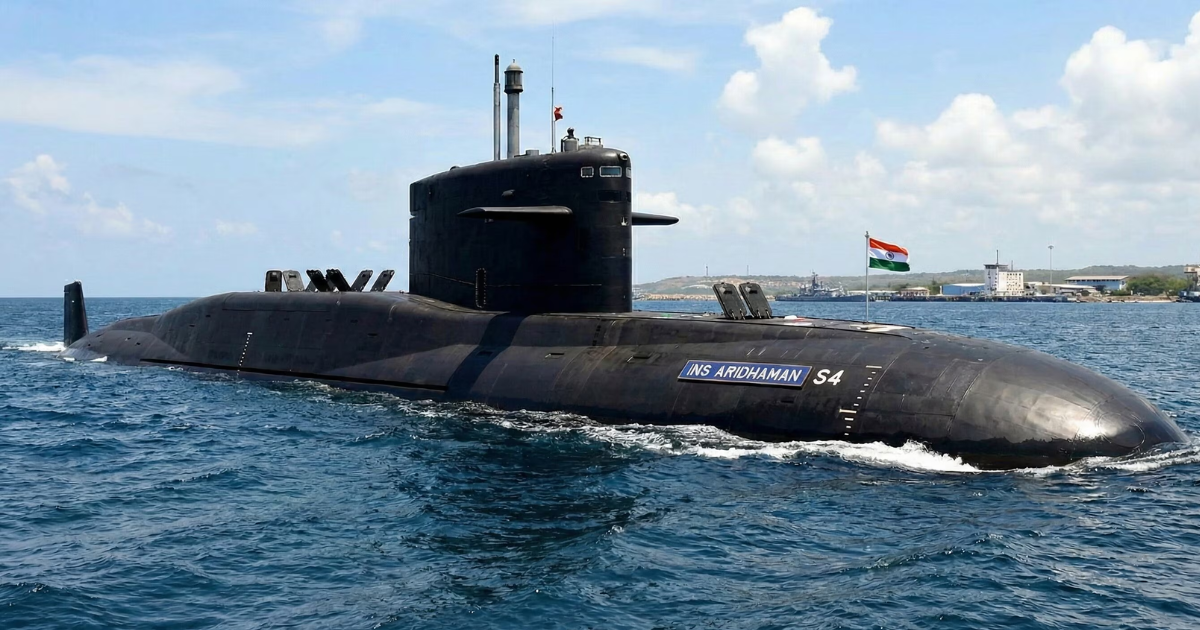
INS Aridhaman, India’s indigenous nuclear-powered ballistic missile submarine, strengthens sea-based nuclear deterrence, second-strike capability, and strategic security under India’s nuclear triad.
Syllabus Areas:GS III - Internal Security , S & T |
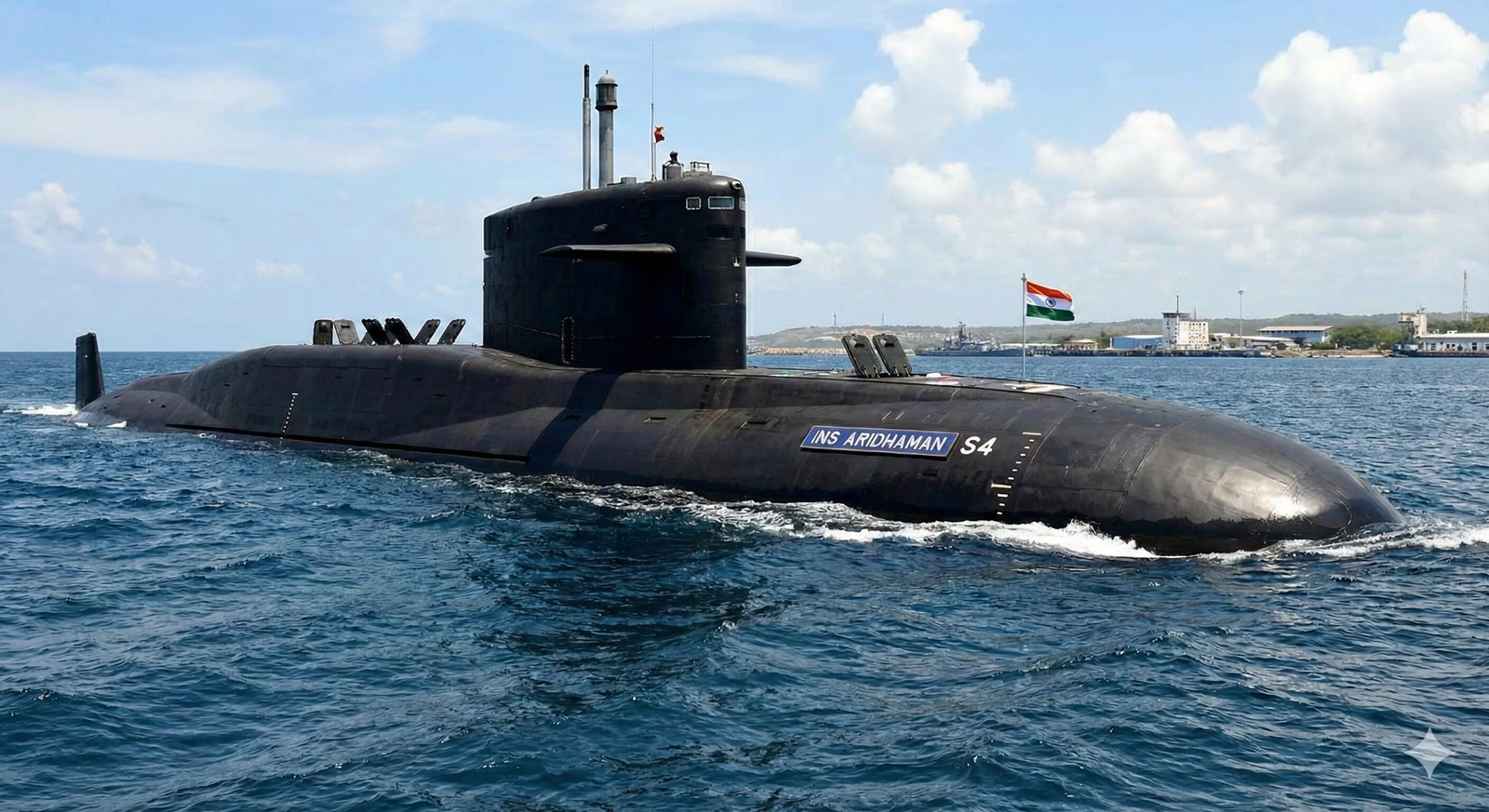
India is set to bolster its strategic maritime defence with the commissioning of INS Aridhaman — the country’s third Arihant-class nuclear-powered ballistic missile submarine (SSBN) — expected to enter service in April–May 2026 after completing sea trials.
Nuclear-Powered Ballistic Missile Submarine:A nuclear-powered ballistic missile submarine (SSBN) is a stealth underwater platform that combines nuclear propulsion with ballistic missiles carrying nuclear warheads. It is the most survivable leg of a country’s nuclear deterrent. What does it mean? Nuclear-powered
Ballistic missile
Submarine
|
What is INS Aridhaman?
-
INS Aridhaman is the third indigenous nuclear-powered ballistic missile submarine built under the Advanced Technology Vessel Project at the Ship Building Centre, Visakhapatnam.
-
It displaces roughly 7,000 tonnes, making it larger than its predecessors (INS Arihant and INS Arighaat).
-
Powered by an 83 MW compact light-water nuclear reactor, it has near-unlimited submerged endurance, limited primarily by crew supplies and maintenance needs.
Armament & Capabilities
-
The submarine can be armed with up to 24 K-15 Sagarika submarine-launched ballistic missiles (SLBMs) (range ~750 km) and/or eight longer-range K-4 SLBMs (strike range > 3,000 km).
-
These missile systems provide India with the ability to project nuclear deterrence from underwater platforms at significant stand-off distances.
-
Its stealth design, low acoustic signature, and deep-sea concealment capability make it difficult to detect, improving survivability and credibility as a strategic deterrent.
Strategic Significance:
-
The induction of INS Aridhaman deepens India’s sea-based leg of the nuclear triad — complementing land-based ballistic missiles and air-delivered nuclear weapons.
-
Operating under India’s Strategic Forces Command, it is a cornerstone of the second-strike capability — the assured ability to retaliate even after absorbing a nuclear attack.
-
With three SSBNs potentially operational (Arihant, Arighaat, Aridhaman), India is better positioned to achieve Continuous At-Sea Deterrence (CASD) — a posture where at least one SSBN remains on patrol at all times.
-
This enhances India’s strategic autonomy and deterrent credibility in the Indo-Pacific context, especially amid evolving maritime security dynamics with China and Pakistan.
Broader Context
|
Prelims Questions:
1. With reference to nuclear propulsion in submarines, consider the following statements:
-
It allows submarines to remain submerged for very long durations
-
It eliminates the need for atmospheric oxygen
-
It reduces acoustic stealth due to reactor noise
Which of the statements given above are correct?
(a) 1 and 2 only
(b) 1 and 3 only
(c) 2 and 3 only
(d) 1, 2 and 3
Answer: (a)
Explanation: Nuclear propulsion improves, not reduces, stealth.
2. Consider the following with reference to India’s nuclear doctrine:
-
No First Use
-
Minimum Credible Deterrence
-
Massive retaliation
SSBNs strengthen which of the above principles?
(a) 1 only
(b) 1 and 2 only
(c) 2 and 3 only
(d) 1, 2 and 3
Answer: (d)
Explanation: SSBNs make all three principles credible.
3. Which of the following countries possess operational SSBN capability?
-
United States
-
Russia
-
India
-
Japan
Select the correct answer using the code below:
(a) 1 and 2 only
(b) 1, 2 and 3 only
(c) 2, 3 and 4 only
(d) 1, 2, 3 and 4
Answer: (b)
Explanation: Japan does not have nuclear weapons or SSBNs.