Comprehensive overview of India’s Four-Year Undergraduate Programme under NEP 2020, covering its background, structure, implementation challenges, equity concerns, and implications for higher education policy and reform.
Syllabus Areas:GS II - Governance |
India’s higher education reform under the Four-Year Undergraduate Programme (FYUP) has reached a critical milestone, as the first cohort of students enrolled under the new structure enters its final semester. Introduced as part of the National Education Policy 2020, the programme was envisioned as a transformative step toward flexibility, multidisciplinary learning, and global alignment.
However, as implementation progresses across universities, the model is facing scrutiny regarding infrastructure, funding, faculty preparedness, and academic clarity. The experience of the first batch offers an opportunity to assess both the promise and practical challenges of this structural reform.
Higher Education Reform Under NEP 2020
The National Education Policy 2020 proposed a comprehensive overhaul of India’s higher education system. One of its central recommendations was restructuring the traditional three-year bachelor’s degree into a four-year flexible undergraduate programme, aligned with international academic standards.
The reform aimed to:
-
Introduce flexibility in learning pathways
-
Promote interdisciplinary education
-
Encourage early exposure to research
-
Enhance skill development and employability
-
Facilitate global mobility of students
The University Grants Commission (UGC) formalized the structure through its Curriculum and Credit Framework guidelines issued in December 2022.
Structure of the Four-Year Undergraduate Programme
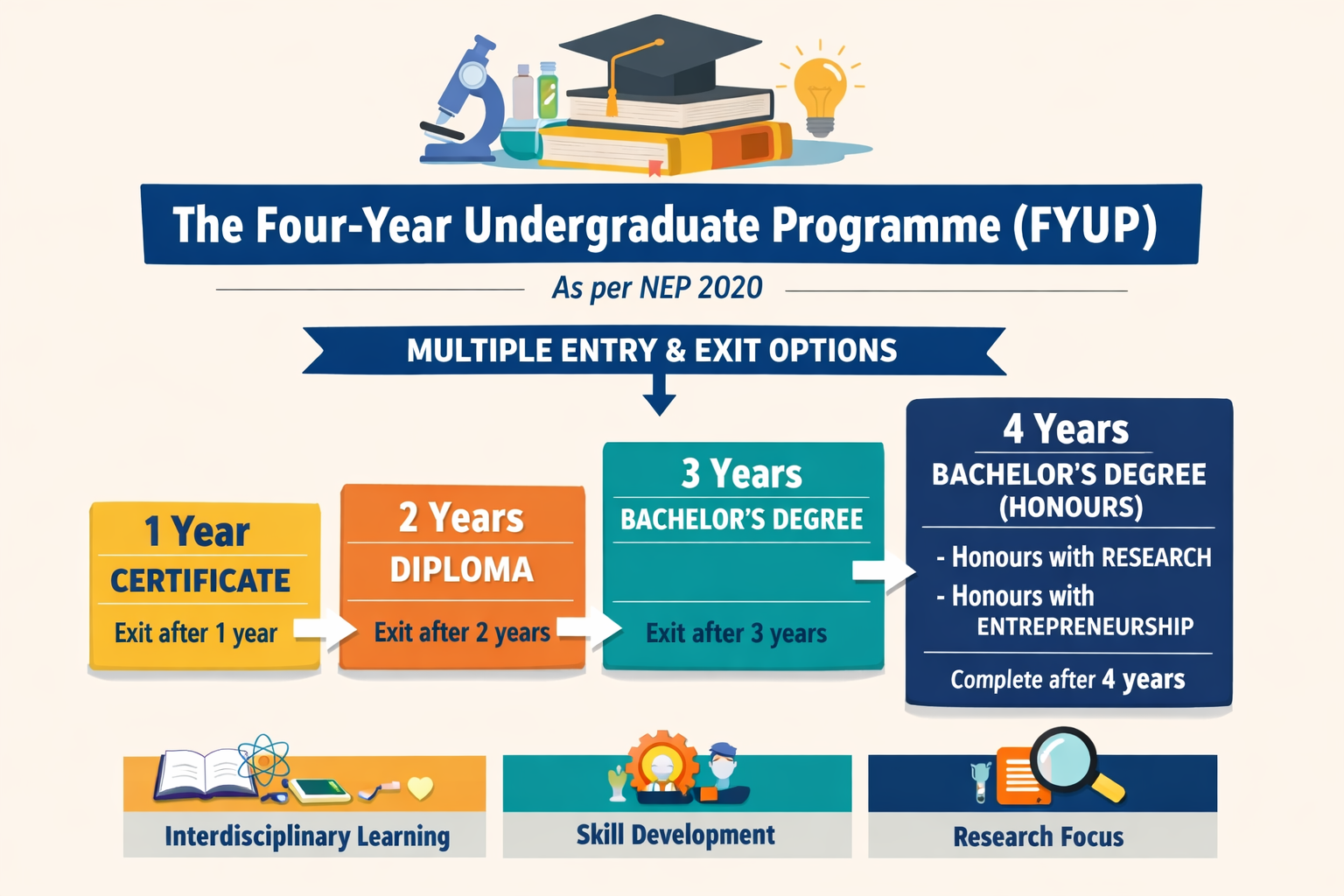
The programme departs significantly from the conventional model and introduces multiple entry and exit options.
Multiple Entry–Exit Framework
Students can exit at different stages:
-
After 1 year → Certificate
-
After 2 years → Diploma
-
After 3 years → Bachelor’s Degree
-
After 4 years → Bachelor’s Degree with Honours
-
Honours with Research
-
Honours with Entrepreneurship or specialized focus
This structure is designed to prevent academic loss due to dropouts while offering progressive academic recognition.
Implementation Across Universities
Several institutions began implementing the four-year programme from the 2022–23 academic session, even before detailed UGC guidelines were issued.
Key universities that adopted the programme include:
-
University of Delhi
-
Aligarh Muslim University
-
Ambedkar University (Delhi)
In 2023–24, the Union Government expanded the rollout to 105 universities, including central, state, private, and deemed-to-be universities.
The Karnataka government initially adopted the model but later decided to revert to the three-year structure from the 2024–25 academic year, citing concerns regarding access and feasibility.
Emerging Academic and Administrative Challenges
As the first batch approaches graduation, several implementation challenges have surfaced.
1. Infrastructure Constraints
Research-oriented fourth-year programmes require enhanced academic resources. However, several concerns have been raised regarding:
-
Limited laboratory capacity in science programmes
-
Restricted access to research institutions such as:
-
Teen Murti Library
-
National Archives of India
-
National Museum
In many institutions, expansion of infrastructure has not kept pace with academic restructuring.
2. Faculty Workload and Resource Gaps
The fourth-year research component has significantly increased faculty responsibilities:
-
Research supervision not always counted in workload norms
-
Shortage of additional teaching staff
-
Limited financial support from funding agencies
In institutions where a large proportion of students opted for the fourth year, faculty and administrative systems have faced considerable pressure.
3. Changing Academic Guidelines
Some students and faculty have reported frequent modifications in academic requirements, particularly regarding:
-
Research expectations
-
Publication standards
-
Dissertation evaluation criteria
Initial expectations of publication in indexed journals were reportedly revised later, creating uncertainty during implementation.
4. Equity and Access Concerns
The extension of the undergraduate programme by one year has raised concerns about:
-
Increased financial burden on students
-
Higher opportunity cost for economically weaker sections
-
Potential impact on access for rural students, Scheduled Castes, Scheduled Tribes, and women
The Karnataka government cited such concerns in its decision to discontinue the four-year model at the state level.
5. Financial Implications
The additional year entails:
-
Increased institutional expenditure
-
Need for expanded infrastructure
-
Extended student fee commitments
In the absence of proportional public funding, questions have been raised about sustainability, particularly in public universities.
Suggested Corrective Measures
Several academic stakeholders have proposed measures to strengthen implementation:
Feedback-Based Policy Adjustment
-
Structured consultation with faculty and students
-
Review of guidelines to reflect ground realities
Infrastructure Investment
-
Expansion of laboratories and library facilities
-
Greater financial support through mechanisms such as HEFA loans
-
Increased allocation of research grants
Rationalization of Research Expectations
-
Realistic research benchmarks for undergraduate students
-
Structured mentorship frameworks
-
Clear, stable evaluation norms
Broader Policy Context
The four-year undergraduate programme reflects a broader policy ambition: aligning India’s higher education system with global academic frameworks while fostering research culture domestically.
However, successful reform depends on:
-
Adequate funding
-
Institutional capacity building
-
Policy stability
-
Equitable access safeguards
The current phase serves as a testing period for whether structural reform can translate into qualitative transformation.
The Four-Year Undergraduate Programme represents one of the most significant higher education reforms in recent decades. Its objectives—flexibility, interdisciplinarity, and research integration—are aligned with contemporary global trends.
At the same time, the experience of the first batch highlights implementation gaps that require systematic attention. The debate now centers not on the intent of reform, but on the mechanisms needed to ensure that ambition is matched with institutional readiness and social equity.
As India evaluates the outcomes of the first cohort, the future trajectory of undergraduate education reform will likely depend on how effectively policy design is reconciled with ground-level realities.
Mains Questions:
1. Critically evaluate the Four-Year Undergraduate Programme under NEP 2020 with respect to access, equity, and quality. 150 Words