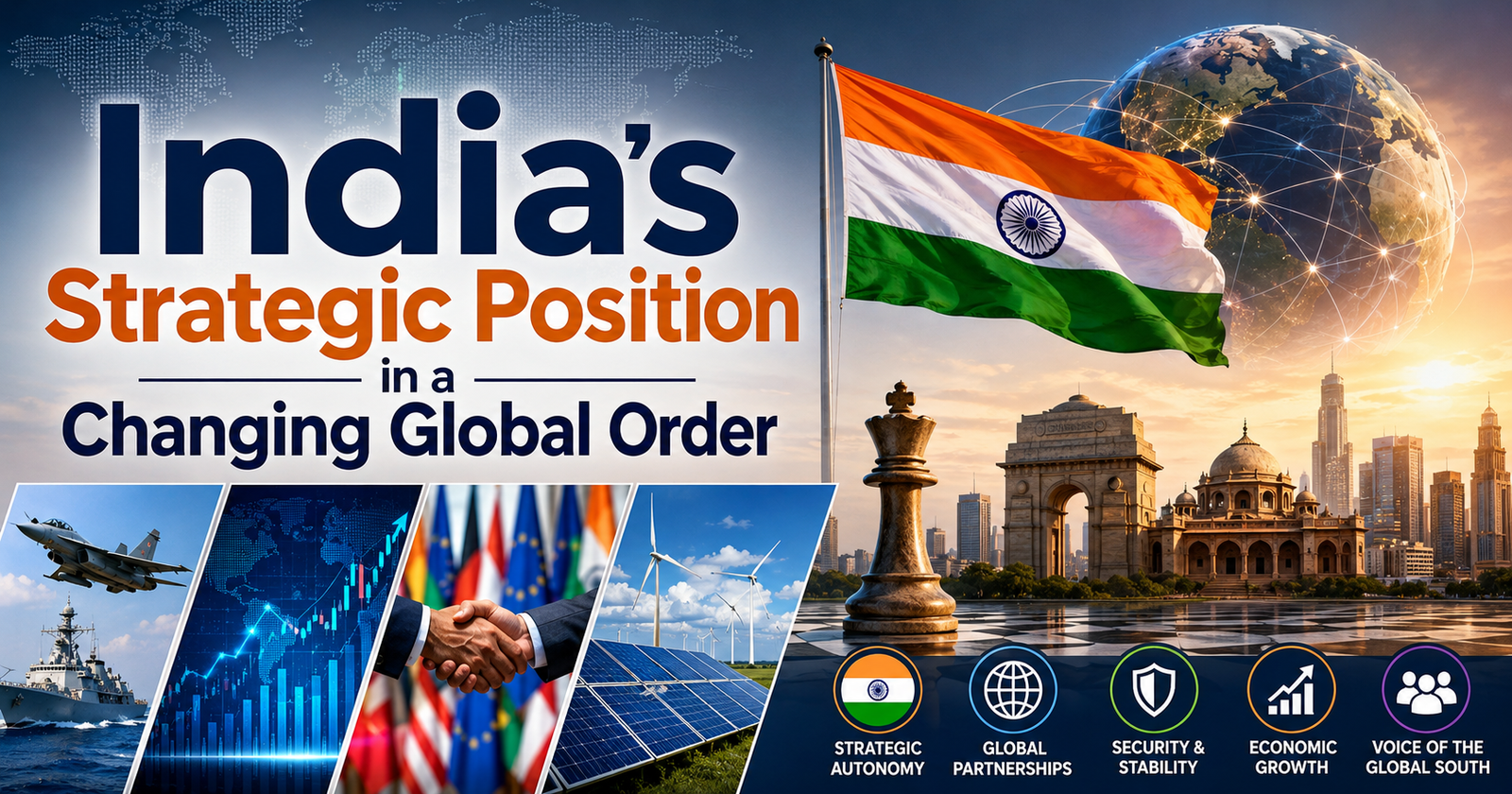
Explore India’s strategic role in the changing global order, Indo-Pacific geopolitics, India-China relations, QUAD partnerships, economic diplomacy, and India’s rise as a global power.
Syllabus Areas:GS II - International Relations |
The world today is changing rapidly. International politics, economic relations, technology, security alliances, and global power structures are witnessing major transformations. Countries are trying to protect their interests while adapting to new geopolitical realities. In this changing environment, India is emerging as an important global player with growing influence in world affairs.
From the Indo-Pacific region to global trade networks, from climate diplomacy to technology partnerships, India’s role is becoming increasingly significant. Many experts now believe that the 21st century could become highly important for India if the country successfully uses its economic potential, strategic location, young population, and diplomatic strength.
India’s strategic position is no longer limited to South Asia alone. Today, India is seen as:
-
A major economic power,
-
A democratic voice in global politics,
-
A trusted strategic partner,
-
A key player in maintaining regional stability.
As the global order changes from a unipolar system to a multipolar one, India’s importance is continuously increasing.
Understanding the Changing Global Order
After the Cold War ended in 1991, the world was largely dominated by the United States. This period is often called a unipolar world because one country had major influence over global politics, economy, and military affairs.
However, over the last two decades, many changes have occurred:
-
China has emerged as a major economic and military power,
-
Russia has become more assertive,
-
Middle powers such as India, Brazil, and Turkey are gaining influence,
-
Technology and economic competition are reshaping international relations.
As a result, the world is gradually moving toward a multipolar order where multiple countries influence global decisions.
In such a system, countries prefer strategic flexibility rather than depending completely on one power bloc. India has adapted well to this changing situation.
India’s Foreign Policy Approach
-
India’s foreign policy has evolved significantly over the years.
-
During the Cold War, India followed the policy of Non-Alignment, which meant avoiding alignment with either the American or Soviet blocs.
-
Today, India follows what experts call “multi-alignment.” This means India maintains good relations with different countries simultaneously based on national interests.
-
India today has strong relations with The United States, Russia, France, Japan, Australia, Gulf countries, ASEAN nations, African countries.
-
At the same time, India participates in various international groupings such as: QUAD, BRICS, G20, Shanghai Cooperation Organisation (SCO).
-
This balanced diplomacy allows India to protect its strategic autonomy while expanding its global influence.
India and China: Competition and Challenges
-
One of the most important aspects of India’s strategic environment is its relationship with China.
-
China’s rapid economic and military rise has changed Asian geopolitics. India and China are both large Asian powers with growing ambitions, which naturally creates competition.
-
The major challenge between the two countries is the unresolved border dispute. Tensions increased significantly after the Galwan Valley clash in 2020, where soldiers from both countries lost their lives.
-
Apart from border issues, competition also exists in: Trade, Infrastructure development, Regional influence, Maritime security, Technology.
-
China’s growing influence in South Asia and the Indian Ocean region has increased India’s security concerns. Projects under China’s Belt and Road Initiative are also viewed cautiously by India.
-
At the same time, India understands that direct confrontation is not beneficial. Therefore, India tries to maintain a balance between competition and diplomatic engagement.
Importance of the Indo-Pacific Region
The Indo-Pacific region has become one of the most important strategic regions in the world. It includes the Indian Ocean and Pacific Ocean regions through which a major portion of global trade passes.
For India, the Indo-Pacific is extremely important because:
-
India’s trade depends heavily on sea routes,
-
Energy imports pass through these waters,
-
Maritime security directly affects economic stability.
Many countries are concerned about increasing Chinese influence in the Indo-Pacific. Therefore, strategic cooperation among democratic countries has increased.
QUAD Grouping:
India has become an important member of the QUAD grouping, which includes:
-
India,
-
United States,
-
Japan,
-
Australia.
The QUAD focuses on:
-
Maritime security,
-
Supply chain resilience,
-
Technology cooperation,
-
Disaster management,
-
Regional stability.
India views the Indo-Pacific as a free, open, and inclusive region where international laws and freedom of navigation must be respected.
India as the Voice of the Global South
-
India has increasingly positioned itself as a representative of developing countries, often called the Global South.
-
Many developing nations face challenges such as Poverty, Climate change, Food insecurity, Debt burdens, Unequal global institutions.
-
India has consistently argued that global governance systems should become more inclusive and fair.
-
India’s leadership during the G20 Summit strengthened its image as a responsible global actor. India emphasized issues like:
-
Sustainable development,
-
Digital public infrastructure,
-
Climate finance,
-
Inclusive growth.
-
India’s ability to connect with both developed and developing countries has increased its diplomatic credibility.
Economic and Technological Importance
India’s strategic importance is not limited to politics and security alone. Economic and technological factors are equally important.
Today, many global companies are looking to diversify manufacturing away from China. India is trying to position itself as an alternative manufacturing hub.
Government initiatives such as:
-
Make in India,
-
Production Linked Incentive (PLI) schemes,
-
Semiconductor mission,
-
Digital India,
aim to strengthen India’s economic capabilities.
India’s growing digital economy, startup ecosystem, and technological innovation are attracting global investments.
Technology is becoming a major factor in international power. Countries leading in:
-
Artificial Intelligence,
-
Semiconductors,
-
Cybersecurity,
-
Space technology,
will have greater strategic influence in the future.
India is therefore investing heavily in technology and innovation.
India’s Strategic Strengths
-
Demographic Advantage: India has one of the world’s youngest populations. A large workforce can support economic growth and innovation if proper education and employment opportunities are created.
-
Democratic System: India is the world’s largest democracy. Democratic values improve India’s global image and create trust among international partners.
-
Geographic Location: India’s location in the Indian Ocean gives it major strategic importance in maritime trade and security.
-
Economic Growth: India is among the fastest-growing major economies in the world. Its large market attracts global businesses and investors.
Challenges Before India
-
Border and Security Concerns: Managing tensions with China and maintaining regional stability remain difficult tasks.
-
Technological Dependence: India still depends on imports for many advanced technologies and defence equipment.
-
Energy Security: India imports a large portion of its energy needs. Global conflicts can affect oil prices and economic stability.
-
Regional Instability: Political instability in neighbouring countries can create security and migration challenges.
-
Balancing Global Powers: India must maintain good relations with multiple countries without compromising strategic autonomy.
The Way Forward
India must continue strengthening:
-
Economic growth,
-
Defence capabilities,
-
Technological innovation,
-
Diplomatic partnerships,
-
Regional connectivity.
Investment in education, research, infrastructure, and manufacturing will play a major role in transforming India into a leading global power.
India should also continue supporting:
-
Peaceful diplomacy,
-
International cooperation,
-
Climate action,
-
Inclusive development.
India’s strategic position in the changing global order is becoming increasingly important. The country is emerging as a major voice in international politics, economic development, and regional security.
The changing world presents India with both opportunities and challenges. If India successfully strengthens its economy, technology, defence, and diplomacy, it can become one of the leading powers of the 21st century.
India’s rise is not only important for its own citizens but also for global stability and balanced international development. The coming decades may therefore become a defining period in India’s journey as a major global power.