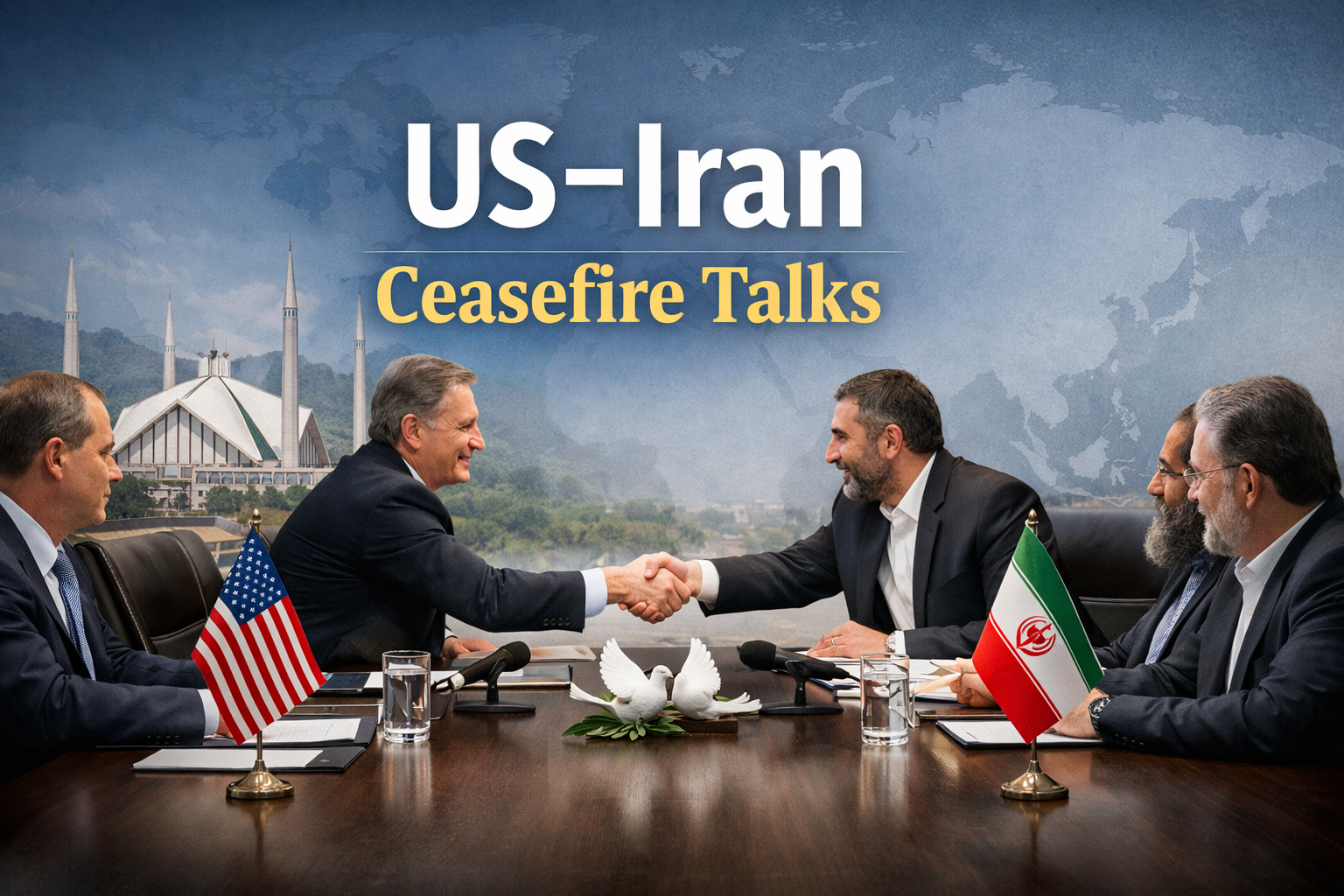
Explore the U.S.–Iran ceasefire talks, Pakistan’s mediation role, Israel’s concerns, and the geopolitical impact on West Asia, energy security, and global stability in this detailed analysis.
Syllabus Areas:GS II - International Relations |
The United States and Iran have initiated high-level negotiations in Islamabad to convert a recently declared two-week ceasefire into a permanent agreement, following a brief but intense military conflict involving the U.S., Israel, and Iran.
Background of the Ceasefire
-
The conflict escalated after the U.S. and Israel launched strikes on Iran, targeting strategic assets.
-
A 15-point peace proposal was reportedly sent by the U.S. to Iran via Pakistan’s military channels.
-
Former U.S. President Donald Trump announced a “double-sided ceasefire”:
-
U.S. would halt attacks.
-
Iran would reopen the Strait of Hormuz (critical oil route).
-
Iran agreed conditionally, stating it would stop attacks if the U.S. and Israel reciprocated.
Nature and Depth of Current Negotiations
The ongoing talks are not symbolic or preliminary—they have already progressed beyond political signaling into technical negotiation stages. Initially, leaders discussed broad commitments like ceasefire continuation and de-escalation. Now, domain experts (economic, nuclear, military, and legal) are involved.
This indicates:
-
Both sides are serious about institutionalising peace, not just managing optics.
-
Negotiations are addressing core conflict drivers, such as:
-
Iran’s nuclear programme
-
Economic sanctions imposed by the U.S.
-
Military de-escalation mechanisms in the region
However, this stage is also the most difficult, because:
-
Political agreements are flexible, but technical details require precision and verification mechanisms.
-
Any disagreement at this level can derail the entire process.
Pakistan’s Mediation: Strategic, Not Neutral
Pakistan’s role is not accidental—it is structurally positioned to act as a bridge.
Why Pakistan matters here:
-
It has working relations with all sides:
-
Strategic ties with the U.S.
-
Religious-political proximity with Iran
-
Engagement with Gulf monarchies
-
Crucially, Pakistan’s military had direct communication channels with Iran’s Revolutionary Guard (IRGC)—a key power centre in Iran.
This gives Pakistan an advantage:
-
It can translate political intent into actionable commitments, especially where military approval is required.
-
It reduces miscommunication risks, which are high in hostile environments.
However, Pakistan is not a neutral mediator in the classical sense:
-
It has its own stakes, including:
-
Energy security
-
Stability in the Gulf (large diaspora presence)
-
Regional strategic relevance
Therefore, Pakistan is acting as a “stakeholder mediator”, not a detached arbitrator.
Israel Factor: The Biggest Structural Obstacle
The strongest challenge to the ceasefire does not come from Iran or the U.S., but from Israel’s strategic position.
Under Benjamin Netanyahu, Israel’s stated objective was:
-
Regime change in Iran, not just temporary military deterrence.
This creates a contradiction:
-
The U.S. is now negotiating with the same Iranian regime, effectively abandoning Israel’s core war objective.
Israel’s response:
-
Conducted airstrikes in Beirut, targeting Hezbollah.
-
These strikes appear aimed at:
-
Provoking Iran into retaliation
-
Breaking the ceasefire momentum
Why this matters:
-
Even if U.S. and Iran agree, third-party spoilers like Israel can destabilize the agreement.
-
This transforms the conflict from bilateral → multi-actor, making resolution far more complex.
Role of External Powers: Silent but Decisive Influence
Several countries have supported the ceasefire process, but their roles differ in nature:
-
China:
-
Used its influence to bring Iran to the negotiating table
-
Interested in stable energy supply routes
-
Gulf countries (Saudi Arabia, UAE, etc.):
-
Support de-escalation due to economic vulnerability to conflict
-
However, underlying mistrust with Iran persists
-
Countries like Turkiye, Egypt, Qatar:
-
Act as regional stabilisers and diplomatic facilitators
This reflects a broader shift:
-
West Asia conflicts are no longer controlled by a single power.
-
Instead, there is a multi-polar diplomatic environment.
Strategic Importance of Strait of Hormuz
The Strait of Hormuz is not just a geographic feature—it is the core economic trigger of the conflict.
-
Around one-fifth of global oil trade passes through it.
-
Iran has the capability to block or disrupt this route.
Implications:
-
Any disruption leads to:
-
Global oil price spikes
-
Inflationary pressures worldwide
-
Countries like India are directly affected due to:
-
Heavy dependence on Gulf energy imports
This explains why reopening Hormuz was a central condition in the ceasefire deal.
Security Concerns and Choice of Islamabad
Unlike past negotiations (Doha, Oslo, etc.), these talks are being held in Islamabad due to serious security considerations.
Key risks:
-
Past incidents where negotiators were targeted and killed
-
Threat from non-state actors and terror groups
-
Risk of external sabotage (state or proxy actors)
Pakistan responded by:
-
Increasing security
-
Declaring local holidays
-
Restricting movement
Way Forward:
The success of negotiations depends on three hard realities:
-
Alignment between U.S. and Israel
-
Without this, agreements will face constant disruption.
-
Trust deficit between U.S. and Iran
-
Historical hostility means verification mechanisms are critical.
-
Control over proxy actors
-
Groups like Hezbollah can trigger escalation independently
The ceasefire talks signal a shift to diplomacy, but success depends on managing U.S.–Iran mistrust, Israel’s concerns, and regional complexities, with Pakistan’s mediation reflecting emerging multipolar conflict resolution dynamics.