India hosted the AI Impact Summit (February 16–20) in New Delhi, drawing over five lakh visitors and representatives from 88 countries and international organisations, culminating in the New Delhi Declaration on AI.
Syllabus Areas:GS II - Governance, International Relations GS III - Science and Technology, Security |
India hosted the AI Impact Summit (February 16–20) in New Delhi, drawing over five lakh visitors and representatives from 88 countries and international organisations, culminating in the New Delhi Declaration on AI, which emphasises democratisation, inclusion, and trusted AI.
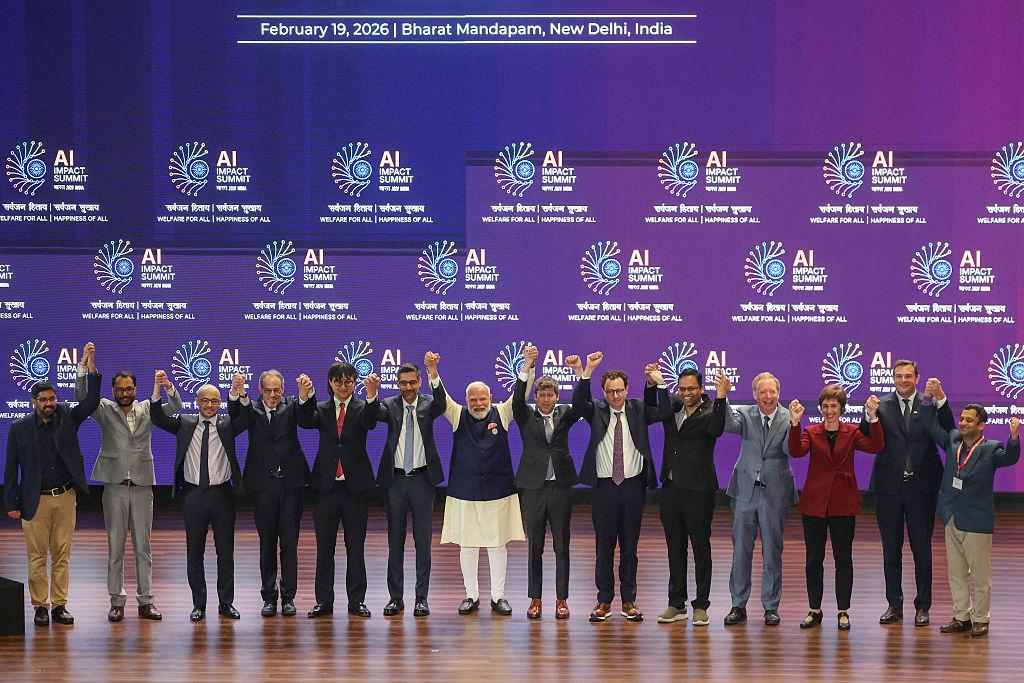
Background: Since when are AI Summits being held?
-
AI summits began in 2023, without any permanent international body convening them.
-
Hosting responsibility has rotated informally among participating countries.
-
2023 – Bletchley Park, UK: Focused on AI safety; India was represented by then MoS IT Rajeev Chandrasekhar.
-
2024 – Seoul: Continued multilateral dialogue on governance and innovation.
-
2025 – Paris (AI Action Summit): Co-chaired by Narendra Modi and Emmanuel Macron.
-
Marked a major ideological shift, as J.D. Vance rejected a “safety-first” framing and stressed innovation and investment.
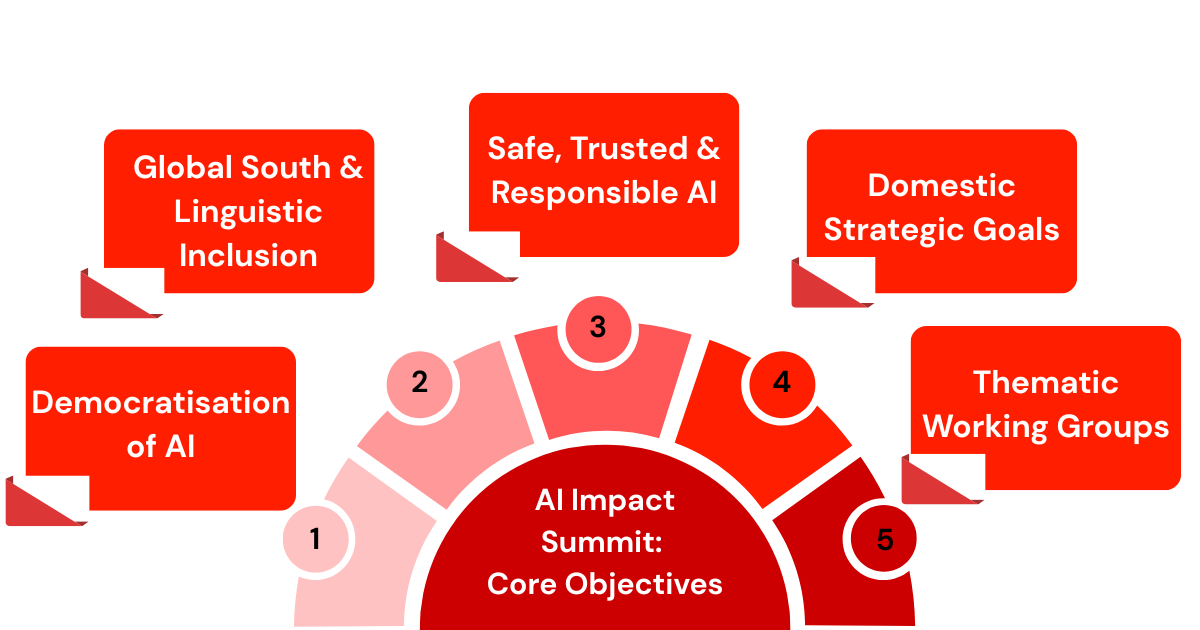
India-Hosted AI Impact Summit: Core Objectives
India advanced a distinct Global South–oriented AI vision, with the following priorities:
1. Democratisation of AI
-
AI capabilities should be accessible to as many people and countries as possible.
-
Opposes excessive concentration of AI power in a few corporations or geographies.
2. Global South & Linguistic Inclusion
-
Expansion of AI models to under-represented languages, especially non-Western and Indian languages.
-
Addressing bias in Western-trained LLMs (Large Language Models).
3. Safe, Trusted, and Responsible AI
-
Emphasis on trustworthiness, resilience, and safety, without stifling innovation.
4. Domestic Strategic Goals
-
Project India as a global hub for AI infrastructure and research.
-
Attract large-scale investments into data centres, chips, and frontier AI research.
-
Promote AI adoption in healthcare, agriculture, and education.
5. Thematic Working Groups
-
Human capital
-
Inclusion for social empowerment
-
Safe and trusted AI
-
Resilience, innovation, and efficiency
-
Democratising AI resources
-
AI for economic development and social good
Key Outcomes of the Summit
Massive Participation
-
Over 5 lakh visitors, surpassing G20 2023 attendance.
-
500+ global discussions, panels, and closed-door meetings.
Investment Commitments
-
$250 billion in overall investment commitments.
-
$20 billion earmarked for frontier deep-tech research.
Strategic & Geopolitical Outcomes
-
India joined the Pax Silica initiative led by the U.S., aimed at countering concentration in electronics manufacturing and critical minerals.
-
Broad consensus among 88 countries (including the U.S., China, and France) on the New Delhi Declaration on AI.
Major Corporate Announcements & Deals
Indian Industry
-
Reliance Industries Limited announced AI investments worth ₹210 lakh crore, slightly exceeding commitments by Adani Group.
-
Yotta Data Services committed $2 billion for data centre expansion using NVIDIA GPUs.
Global Tech Firms
-
Google detailed its $15 billion India investment, including a subsea cable connecting India and the U.S.
-
OpenAI signed a pact with Tata Group:
-
Leasing 100 MW data centre capacity from Tata’s HyperVault.
-
Providing advanced AI models to Tata employees.
-
Anthropic partnered with Infosys.
Landmark Technological Outcome: India’s Indigenous LLM
-
Launch of India’s first domestically trained multi-billion parameter LLMs by Sarvam AI.
-
Supported under the IndiaAI Mission with subsidised computing access.
-
Models claim benchmark-beating efficiency and are open-source.
-
A beta chatbot interface was launched post-summit.
Controversies & Setbacks
Despite its scale, the summit faced repeated disruptions:
-
Logistical failures on opening day due to overwhelming turnout.
-
Galgotias University incident, where a Chinese-made robodog was falsely presented as student innovation; the exhibitor was expelled.
-
Security breach, as Indian Youth Congress members disrupted the expo with protest slogans. Delhi Police detained the protesters and initiated investigation.
What does the New Delhi Declaration on AI say?
The declaration is voluntary and non-binding, aimed at inclusivity and consensus. Key components include:
-
Charter for Democratic Diffusion of AI
-
Global AI Impact Commons – repository of AI use cases.
-
Trusted AI Commons – tools, benchmarks, and best practices for secure AI.
-
International Network of AI for Science Institutions
-
AI for Social Empowerment Platform
-
AI Workforce Development Playbook & Reskilling Principles
-
Guiding Principles on Resilient and Efficient AI
The declaration positions AI as a driver of economic growth and social good, while respecting national priorities.
The AI Impact Summit 2026 marks a decisive moment in global AI governance, with India positioning itself as the voice of the Global South and a serious contender in AI infrastructure, talent, and policy leadership. The New Delhi Declaration reinforces cooperation, inclusion, and trust—while leaving the hard work of implementation to the years ahead.
Mains Questions:
1. “India’s approach to Artificial Intelligence governance reflects a balance between innovation, inclusion, and trust.” Critically examine this statement in the context of the New Delhi Declaration on AI. (150 words)
2. How can Artificial Intelligence be leveraged to address structural challenges in healthcare, agriculture, and education in India, while ensuring ethical use and data protection? (250 words)