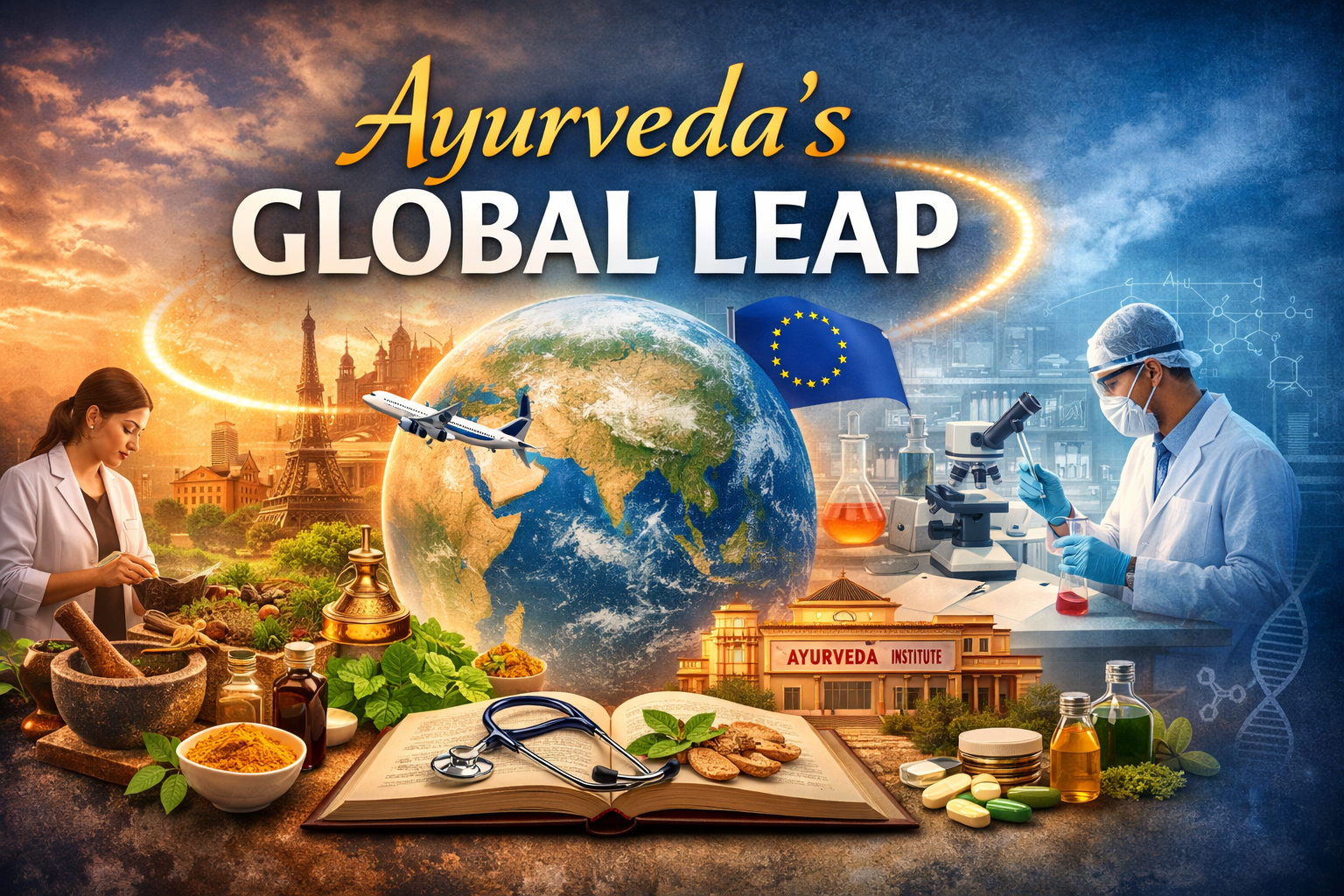
India’s Union Budget 2026–27 and the EU FTA push Ayurveda into the global mainstream. Explore opportunities, regulatory challenges, and the urgent need for scientific validation.
Syllabus Areas:GS II - Governance GS III - Economy, Science and Technology |
The Union Budget 2026–27, along with India’s new Free Trade Agreement (FTA) with the European Union, marks a turning point for Ayurveda and other traditional systems of medicine. What was once seen as an alternative or complementary practice is now being positioned as a central pillar of both India’s healthcare system and its global health diplomacy.
A Strong Domestic Push
The government’s intent is clearly visible in the numbers and policy direction. The budget allocation for the AYUSH Ministry has nearly doubled over the last five years, reaching ₹24,408 crore. This is not just incremental growth—it reflects a strategic shift.
One of the most significant announcements is the establishment of three new All-India Institutes of Ayurveda, designed on the lines of AIIMS. These institutions are expected to go beyond treatment and focus equally on education, research, and standard-setting, thereby elevating Ayurveda to a more formal and credible institutional level.
At the same time, the National AYUSH Mission has received a 66% increase in funding. This expansion aims to:
-
Modernise existing dispensaries
-
Integrate AYUSH clinics within government hospitals
-
Upgrade drug-testing laboratories
Taken together, these initiatives indicate a clear policy direction: traditional medicine is no longer being treated as a separate or secondary system, but as an integral part of mainstream healthcare.
Global Reach Through Trade Policy
While the Budget strengthens Ayurveda within India, the India–EU FTA extends its reach beyond national borders. The agreement creates new opportunities for Indian practitioners and businesses in Europe.
Under this framework:
-
AYUSH practitioners may offer their services in EU countries that lack specific regulations for traditional medicine
-
Indian companies can establish Ayurvedic clinics across Europe with greater policy certainty
-
There is a pathway toward mutual recognition of safety certifications, which could reduce the need for repeated testing
This is a significant step. Ayurveda is no longer confined to cultural or regional relevance—it is being positioned as a global healthcare offering.
A Critical Test: Regulation and Scientific Credibility
However, this expansion also brings new challenges. When Ayurveda moves into international markets, it enters systems that demand strict regulatory compliance and scientific validation.
In Europe, traditional medicine falls under the broader category of Traditional, Complementary, and Alternative Medicine (TCAM). This means that AYUSH products and practices will be evaluated based on:
-
Safety standards
-
Manufacturing quality
-
Evidence supporting therapeutic claims
If India fails to meet these expectations, the consequences could include legal disputes, reputational damage, and reinforcement of existing stereotypes about traditional medicine being unscientific.
This moment, therefore, is not just about expansion—it is about accountability.
The Urgent Need for Scientific Evidence
For Ayurveda to gain global credibility, it must embrace rigorous, transparent, and independent scientific evaluation.
At present, a significant concern is that many studies on AYUSH systems are funded or overseen by the same institutions that promote them. This creates a potential conflict of interest, which can undermine trust internationally.
To address this, India must:
-
Encourage independently funded clinical trials
-
Ensure transparency in research methodologies
-
Promote peer-reviewed publications
-
Be open to publishing negative or inconclusive results
Scientific scrutiny should not be seen as a threat. In fact, it is the very process that can strengthen Ayurveda’s credibility on the global stage.
Beyond the Debate: Tradition vs Science
-
A common argument in defense of traditional medicine is that scientific evaluation represents a form of Western or colonial bias.
-
While it is true that colonial history marginalized indigenous knowledge systems, it does not follow that all demands for evidence are invalid.
-
Rejecting scientific scrutiny in the name of cultural pride can be counterproductive.
-
Evidence-based validation does not weaken tradition—it legitimizes it in a global context.
-
India must move beyond this binary thinking and adopt a more confident approach: one that respects tradition while also welcoming critical evaluation.
Understanding Different Medical Frameworks
To engage meaningfully with Ayurveda, it is important to recognise that it is not just a collection of remedies, but a distinct system of knowledge.
Ayurveda views the body as:
-
An interconnected system
-
Influenced by environment, diet, and lifestyle
-
Defined by balance and equilibrium
Disease, in this framework, is seen as a disturbance in this balance rather than a localized defect.
In contrast, modern biomedicine focuses on:
-
Identifying specific causes
-
Targeting precise anatomical or physiological issues
-
Delivering highly specialized interventions
Both systems have their strengths. Ayurveda offers a holistic and preventive perspective, while biomedicine excels in diagnosis and targeted treatment.
Towards Coexistence, Not Competition
The question is not whether Ayurveda should replace modern medicine. That is neither practical nor necessary. The real opportunity lies in integration and dialogue.
Ayurveda can:
-
Complement modern treatments
-
Offer preventive healthcare models
-
Expand the understanding of health beyond purely biological terms
A balanced healthcare system can draw from both traditions, creating a more comprehensive approach to well-being.
The Way Forward
India stands at a crucial juncture. The globalisation of Ayurveda is not just an economic opportunity—it is a test of intellectual and institutional maturity.
To succeed, India must:
-
Align its regulatory frameworks with global standards
-
Invest in independent and high-quality research
-
Maintain transparency and openness in scientific inquiry
-
Build credibility through evidence, not assertion
Ayurveda’s journey into the global mainstream is both promising and demanding. Cultural confidence alone will not sustain this expansion. What is required is a careful balance between heritage and scientific rigor.
If India can achieve this balance, Ayurveda will not only gain global acceptance but also redefine how the world understands health and healing.
Mains Questions:
1. The Union Budget 2026–27 marks a shift in India’s approach towards traditional medicine. Examine the steps taken to mainstream AYUSH and discuss the challenges involved. 250 Words