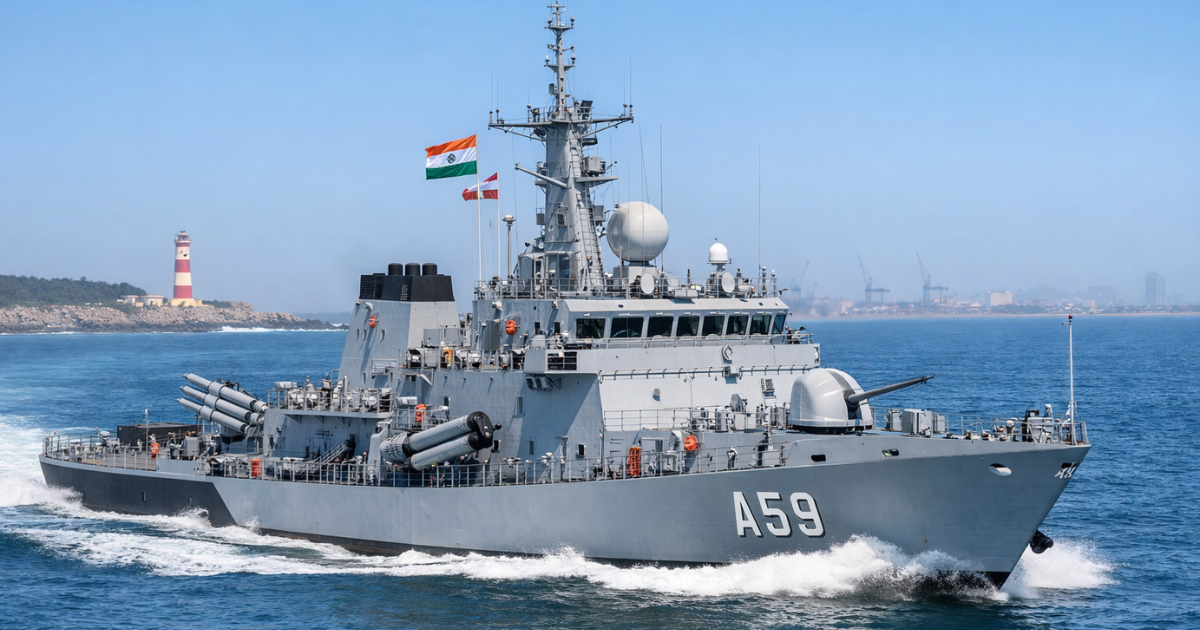
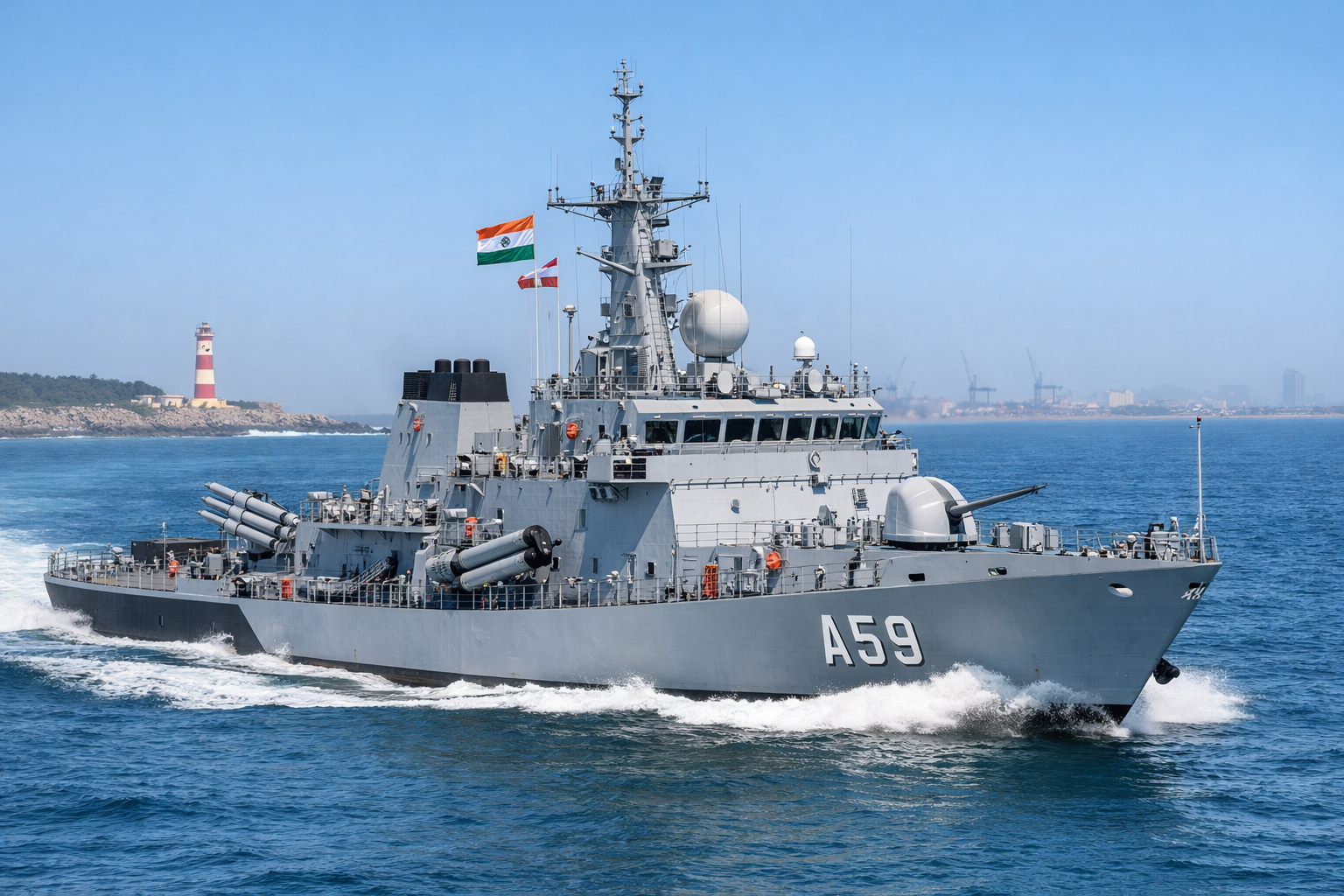
The Indian Navy has commissioned INS Anjadip, its fourth indigenously designed and built Anti-Submarine Warfare Shallow Water Craft (ASW-SWC), at Chennai Port.
Syllabus Areas:GS III - Security |
The induction marks a significant step in enhancing India’s coastal and littoral Anti-Submarine Warfare (ASW) capabilities, while also reinforcing the country’s push towards self-reliance in defence manufacturing.
Key Details:
|
Strategic Importance of INS Anjadip
-
INS Anjadip is specifically designed to detect, track, and neutralise enemy submarines in shallow coastal waters, an area increasingly vulnerable due to the growing submarine presence in the Indian Ocean Region (IOR).
-
Shallow waters pose unique detection challenges, making specialised platforms like ASW-SWCs critical.
Advanced Indigenous Weapon & Sensor Suite
The vessel is equipped with fully indigenous anti-submarine warfare systems, underscoring India’s technological maturity. Its key combat features include:
-
Modern shallow-water sonars for effective submarine detection in complex acoustic environments
-
Lightweight torpedoes for precise underwater strikes
-
Anti-submarine rockets to counter fast-moving underwater threats
-
Integrated Combat Management System (CMS) for real-time situational awareness and rapid decision-making
These systems collectively ensure high agility, precision, and combat effectiveness in near-shore operations.
Designed for the Littoral Combat Environment
Unlike blue-water warships, INS Anjadip is optimised for littoral (near-coast) warfare, where threats are asymmetric and reaction time is limited. The vessel will:
-
Secure India’s coastal waters and ports
-
Act as a deterrent against enemy submarine infiltration
-
Support low-intensity maritime operations
Multi-Role Operational Capability
Beyond ASW, INS Anjadip is capable of undertaking:
-
Coastal surveillance and patrols
-
Low-intensity maritime security operations
-
Search and Rescue (SAR) missions, enhancing humanitarian and disaster response readiness
This versatility increases its utility during both peace and conflict.
Symbolic Naming and Heritage
|
Boost to Aatmanirbharta in Defence
-
Speaking at the commissioning ceremony, Admiral Dinesh K. Tripathi highlighted that INS Anjadip reflects the growing strength of India’s indigenous design and industrial ecosystem.
-
He emphasised that Aatmanirbharta is now evolving from “Make in India” to “Trust in India”, signalling confidence in domestically developed defence platforms.
Role of Indian Shipbuilding Industry
The construction of INS Anjadip by Garden Reach Shipbuilders & Engineers demonstrates the increasing capability of Indian shipyards to deliver complex, high-technology naval platforms within the country.
Strategic Significance:
From a national security standpoint, INS Anjadip:
-
Strengthens India’s coastal defence architecture
-
Enhances anti-submarine dominance in the IOR
-
Reduces dependence on imports, aligning with defence indigenisation goals
-
Improves readiness against grey-zone and asymmetric maritime threats
The commissioning of INS Anjadip is more than the induction of a new warship—it is a strategic signal of India’s growing maritime self-reliance and preparedness. As submarine threats in coastal waters increase, platforms like INS Anjadip will play a decisive role in safeguarding India’s maritime interests while reinforcing confidence in indigenous defence capabilities.
Prelims Questions:
1. With reference to INS Anjadip, consider the following statements:
-
It is designed primarily for operations in deep ocean waters.
-
It is equipped with indigenous anti-submarine warfare weapons and sensors.
-
It can undertake search and rescue operations.
Which of the statements given above is/are correct?
A. 1 only
B. 2 and 3 only
C. 1 and 2 only
D. 1, 2 and 3
Answer: B
Exp: Statement 1 looks technical but is factually wrong—it’s for shallow/coastal waters.
2. Which of the following systems are typically associated with Anti-Submarine Warfare Shallow Water Crafts?
-
Shallow water sonar
-
Lightweight torpedoes
-
Anti-submarine rockets
Select the correct answer using the code below:
A. 1 only
B. 1 and 2 only
C. 2 and 3 only
D. 1, 2 and 3