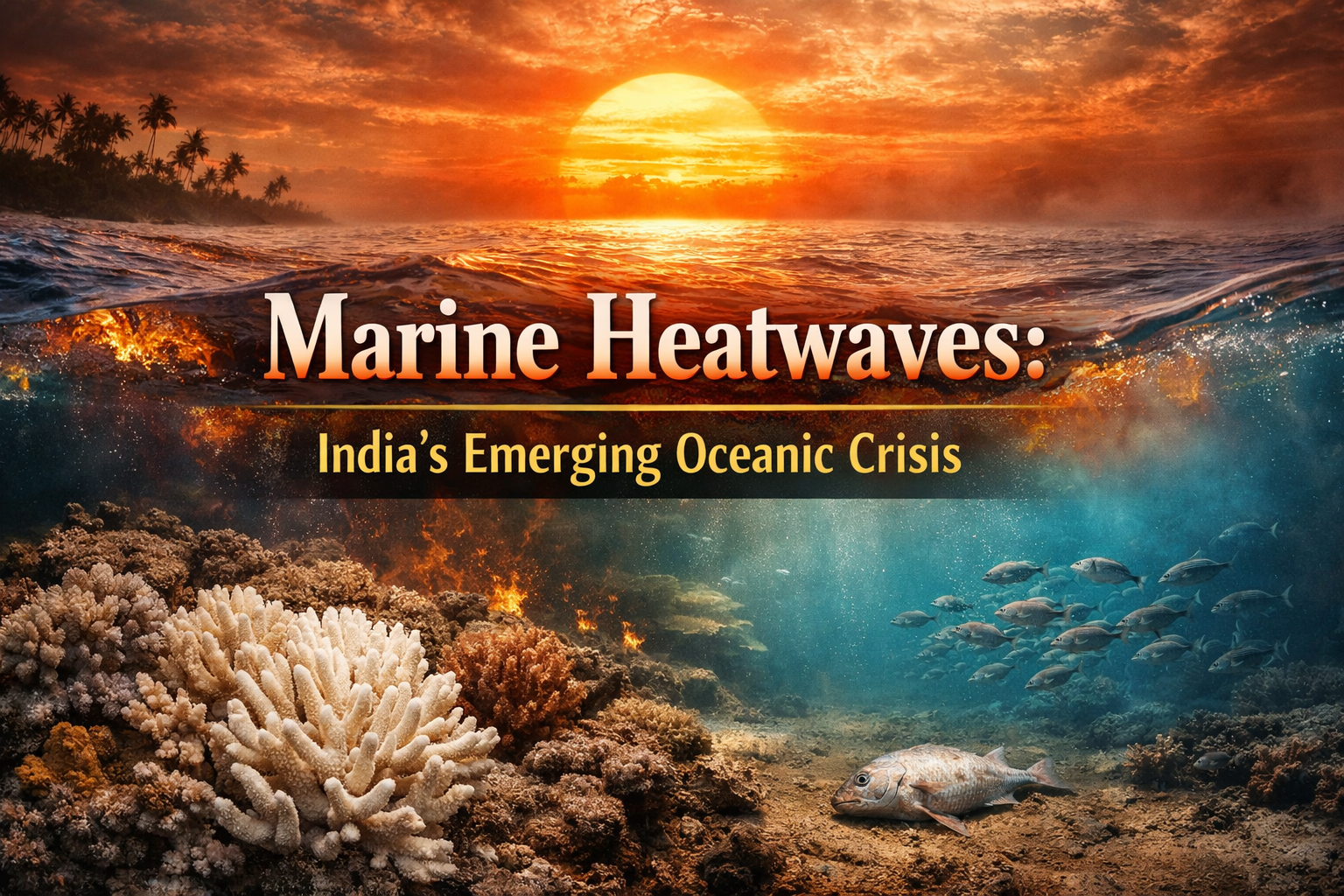
Marine heatwaves are rapidly intensifying due to climate change, impacting marine ecosystems, fisheries, and India’s coastal economy. Explore causes, impacts, and policy solutions in this detailed analysis.
Syllabus Areas:GS I - Geography GS III - Environment and Ecology |
Marine heatwaves (MHWs)—extended periods of abnormally high ocean temperatures—are no longer rare anomalies but a recurring feature of the global climate system. Recent scientific assessments indicate that a majority of the world’s oceans have experienced extreme heat conditions in the past few years, signalling a structural shift rather than temporary variability.
For a country like India, with over 7,500 km of coastline and a large population dependent on marine resources, this is not merely an environmental issue—it is a developmental, economic, and security concern.
What Exactly Are Marine Heatwaves?
A marine heatwave is defined as a prolonged event where sea surface temperatures exceed the 90th percentile of historical observations for at least five consecutive days.
Unlike atmospheric heatwaves, these events:
-
Persist longer (weeks to months)
-
Cover vast oceanic regions
-
Have delayed but cascading ecological impacts
Their significance lies in the fact that oceans regulate Earth’s climate. Any disruption here has system-wide consequences.
Why Are Marine Heatwaves Increasing?
1. Anthropogenic Climate Change: Oceans absorb nearly 90% of excess heat trapped by greenhouse gases. This accumulated heat is now manifesting as more frequent and intense marine heatwaves.
2. Ocean–Atmosphere Feedbacks: Reduced wind circulation and increased solar radiation trap heat in surface waters. Weak vertical mixing prevents cooler subsurface water from moderating temperatures.
3. Climate Variability (ENSO & IOD): Events like El Niño amplify warming by altering global circulation patterns. The Indian Ocean Dipole further influences regional temperature anomalies.
4. Changing Ocean Currents: Shifts in major currents lead to localized heat accumulation, intensifying regional marine heatwaves.
Ecological Consequences: A Chain Reaction
Coral Bleaching and Reef Collapse
Elevated temperatures force corals to expel symbiotic algae, leading to bleaching and eventual mortality. This is not just aesthetic damage—coral reefs support nearly 25% of marine biodiversity.
In India, regions like Gulf of Mannar and Lakshadweep have already witnessed significant bleaching episodes.
Disruption of Marine Food Chains
Marine heatwaves reduce phytoplankton productivity, the base of oceanic food webs. This triggers:
-
Decline in fish populations
-
Altered migration patterns
-
Reduced catch for fisheries
Loss of Critical Ecosystems
Habitats such as seagrass beds and kelp forests degrade under thermal stress. These ecosystems play a crucial role in:
-
Carbon sequestration
-
Coastal protection
-
Biodiversity support
Mass Mortality Events
Extreme events have led to large-scale deaths of fish, seabirds, and marine mammals, often linked to oxygen depletion and harmful algal blooms.
The Indian Context: A Growing Vulnerability
Arabian Sea as a Hotspot
The Arabian Sea has shown a threefold increase in marine heatwave events in recent decades. This has been linked to:
-
Intensification of cyclones
-
Increased rainfall variability
-
Changing monsoon behaviour
Impact on Coastal Economy
India’s fisheries sector employs millions. Marine heatwaves threaten:
-
Fish availability
-
Livelihood security
-
Export revenues
Additionally, coral degradation weakens natural coastal barriers, increasing vulnerability to storm surges and erosion.
Climate Linkages
Emerging research suggests that marine heatwaves can intensify extreme weather events, including heavy rainfall episodes over the Indian subcontinent. This establishes a direct link between ocean warming and terrestrial climate risks.
Why This Issue Deserves Policy Attention
Marine heatwaves are often termed an “invisible crisis” because they occur beneath the ocean surface. However, their impacts are:
-
Economically significant
-
Ecologically irreversible
-
Socially disruptive
Ignoring them would mean underestimating climate risk in its most systemic form.
Way Forward:
1. Strengthening Climate Mitigation: Reducing greenhouse gas emissions remains the most fundamental solution. Without addressing the root cause, adaptation will remain limited.
2. Developing Early Warning Systems: Satellite monitoring and ocean modelling should be integrated into real-time forecasting systems, similar to cyclone warnings.
3. Ecosystem-Based Adaptation
-
Coral reef restoration
-
Protection of marine biodiversity hotspots
-
Expansion of Marine Protected Areas (MPAs)
4. Integrating Ocean Policy: India’s climate strategy must move beyond land-centric approaches and incorporate ocean health into national planning frameworks, including the Blue Economy policy.
5. Enhancing Global Cooperation: Marine heatwaves are transboundary in nature. Effective response requires international scientific collaboration and data sharing.
Marine heatwaves represent a fundamental disruption of the ocean-climate equilibrium. Their impacts extend far beyond marine ecosystems, influencing weather patterns, food security, and economic stability.
For India, the challenge is not just to respond, but to anticipate and integrate oceanic risks into long-term policy planning.
The real test of governance will lie in recognizing that the future of climate resilience is as much about the oceans as it is about the land.