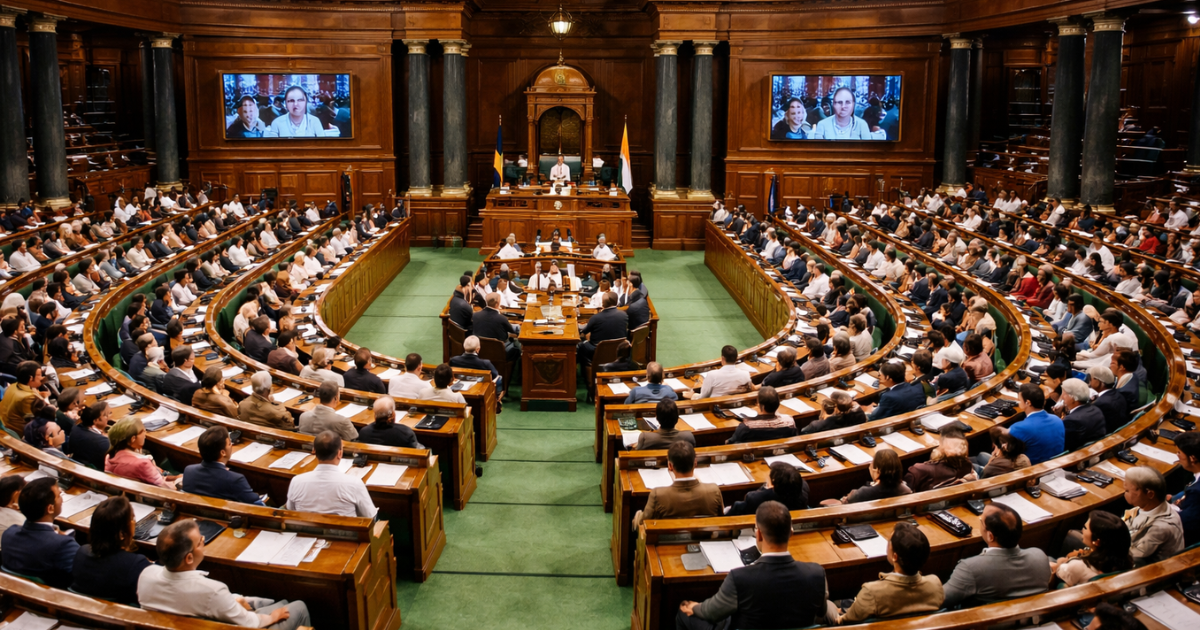
Recent developments during the Budget Session of Parliament have triggered a serious constitutional debate on the freedom of speech of Members of Parliament (MPs).
Syllabus Areas:GS II - Polity, Governance GS IV - Ethics |
Large portions of speeches made by Opposition leaders—particularly the Leader of the Opposition in the Rajya Sabha—were expunged from official records, raising concerns that parliamentary rules are being used to curtail a constitutionally guaranteed privilege under Article 105 of the Constitution.
Background: Freedom of Speech as a Parliamentary Privilege
-
Article 105(1) of the Constitution guarantees freedom of speech in Parliament to MPs.
-
This freedom is not identical to Article 19(1)(a) available to citizens; it is a special constitutional privilege, meant to ensure the effective functioning of the legislature.
-
Parliamentary privileges evolved from British constitutional practice, explained authoritatively by Erskine May, who emphasised that such privileges are indispensable for free and fearless legislative debate.
The framers of the Constitution consciously elevated free speech in the legislature as the core privilege of MPs.
Constitutional Position: Article 105 and Its Limits
What Article 105 Guarantees
-
MPs have the right to:
-
Speak freely in the House
-
Have their speeches fully and faithfully recorded
-
Enjoy immunity from legal proceedings for speeches made in Parliament
Permissible Constitutional Restrictions
-
Article 121:
-
Prohibits discussion on the conduct of judges of the Supreme Court of India or High Courts, except during impeachment proceedings.
-
These are explicit constitutional limits, not discretionary restrictions.
Rules of the House: Regulatory, Not Overriding
Parliamentary rules are framed to regulate proceedings, not to override constitutional rights.
Key Rules Restricting Speech
-
Sub judice matters
-
Personal allegations against individuals
-
Questioning the bona fides of fellow MPs
-
Allegations against constitutional authorities
-
Defamatory or incriminatory statements without prior notice
These rules are procedural safeguards, not instruments of censorship.
Expunging of Words: Power and Its Misuse
Rule 380 (Lok Sabha) / Equivalent Rajya Sabha Rules
-
Presiding Officers may expunge:
-
Unparliamentary
-
Defamatory
-
Indecent
-
Undignified words
Critical Constitutional Point:
-
The rule permits expunging only the offending words, not entire sentences or paragraphs.
Current Concern
-
Large-scale deletions have reportedly made Opposition speeches:
-
Incoherent
-
Meaningless
-
Constitutionally hollow
This raises a serious question:
If a speech is substantially erased from records, does the right under Article 105 remain real or become illusory?
Judicial Principle: Restrictions Cannot Eclipse Rights
The Supreme Court of India has repeatedly held:
-
Restrictions on fundamental or constitutional rights must not be so excessive that they destroy the right itself.
Applied to Parliament:
-
Rules cannot be interpreted or applied in a manner that stifles debate or silences dissent.
-
Mindless expunction violates the spirit of Article 105.
Democratic Norms and Parliamentary Ethics
Role of the Opposition
As constitutional scholar Ivor Jennings famously observed:
“The duty of the Opposition is to oppose.”
-
Attacking government policy and holding ministers accountable is not disorder, but democratic duty.
-
Parliamentary democracy survives on mutual forbearance:
-
Majority governs
-
Minority critiques
Without this balance, parliamentary government collapses.
Case Study:Historical Perspective: Nehruvian Parliamentary EthosIndia’s early parliamentary culture set high democratic standards:
This ethos is now visibly eroding. |
A Tragic Contemporary Development
-
India risks becoming an anomaly among democracies where:
-
Leaders of the Opposition are frequently prevented from speaking
-
Motions are moved seeking lifetime disqualification of MPs, despite the fact that:
-
Parliament has no such power under the Constitution
This reflects a serious breakdown in the relationship between the government and the Opposition.
Freedom of speech in Parliament is not a concession by the majority—it is a constitutional necessity. Weaponisation of rules against dissent not only violates Article 105 but also erodes the normative foundations of parliamentary democracy. As history and constitutional wisdom remind us, strong governments are not weakened by criticism; democracies are weakened when criticism is silenced.
Mains Questions:
1. Freedom of speech of Members of Parliament is fundamental to legislative accountability. Examine the constitutional and ethical limits on this freedom. (250 words)
2. “The strength of a democracy lies not in the absence of criticism, but in its capacity to absorb it.” (Essay)