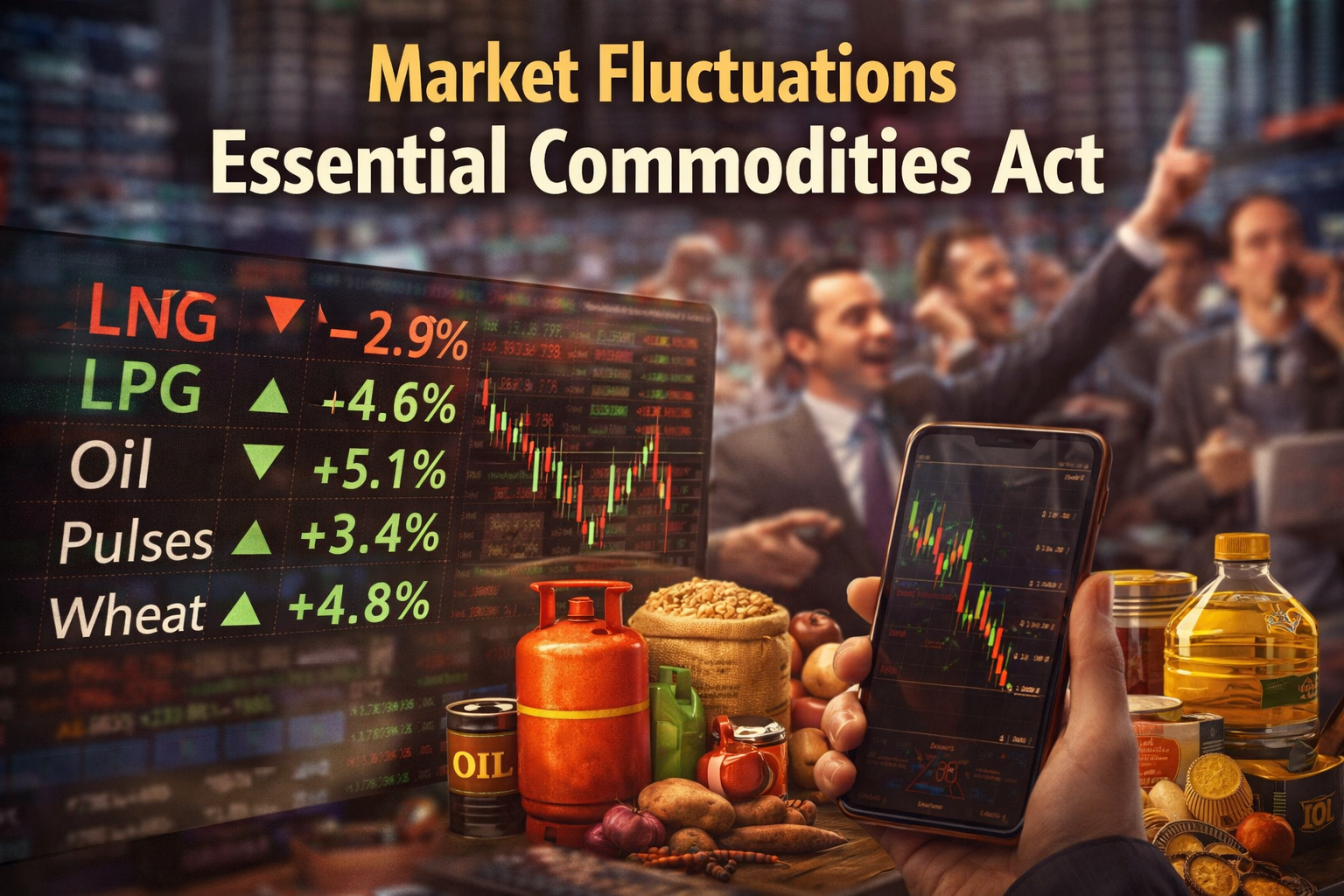
Explore how the Essential Commodities Act (ECA), 1955 influences market fluctuations, controls prices, ensures supply stability, and impacts LPG, oil, and food sectors amid India’s ongoing energy crisis.
Syllabus Areas:GS III - Economy |
The Union Government has invoked the Essential Commodities Act, 1955 in response to Disruptions in LPG Imports due to tensions in the Persian Gulf, especially around the Strait of Hormuz. This has exposed India’s heavy dependence on imports for cooking gas, triggering supply concerns.
What is the Essential Commodities Act (ECA), 1955?
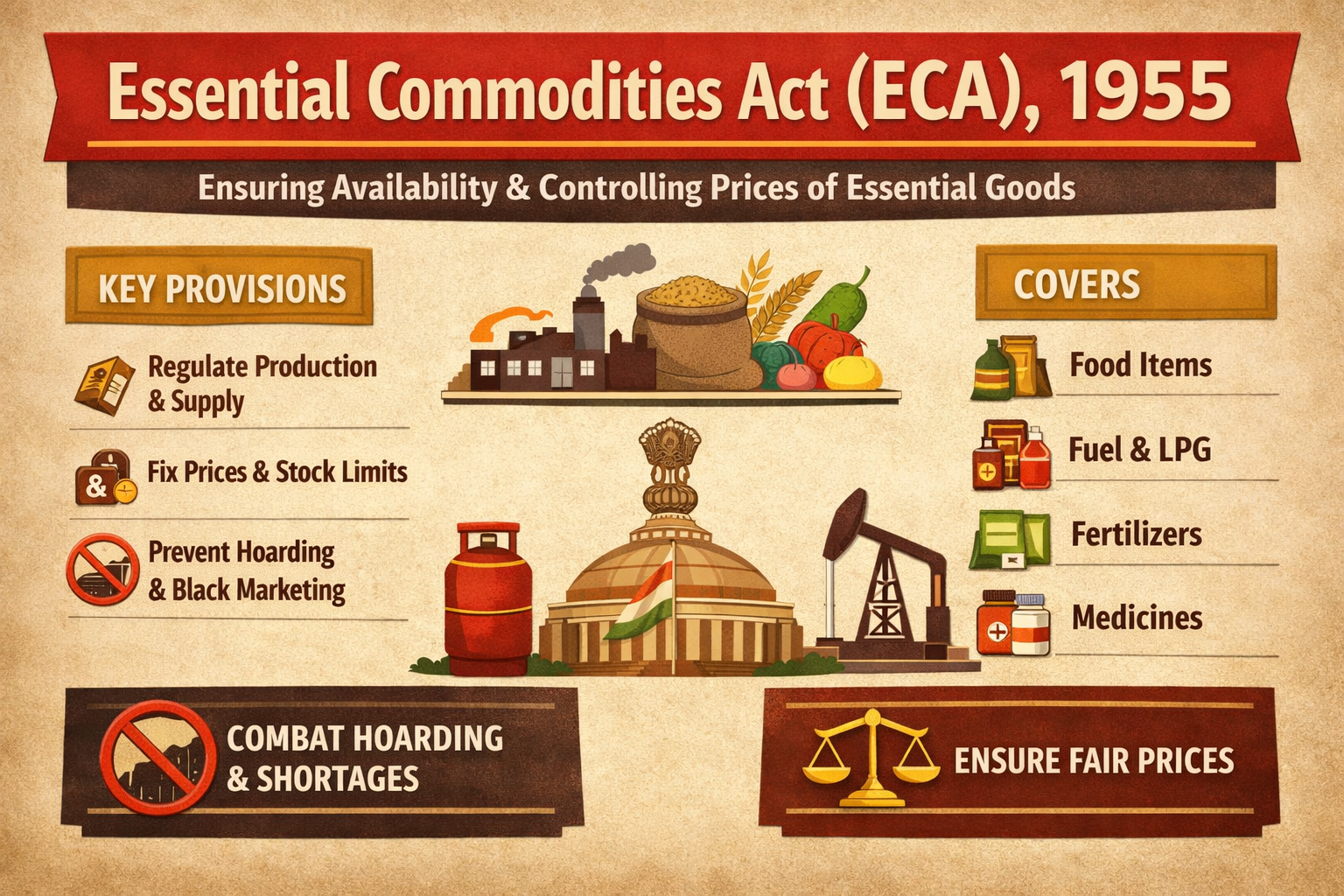
The ECA, 1955 is an emergency law that allows the government to regulate critical commodities to ensure availability and price stability.
Key Provisions:
-
Empowers the Centre to control production, supply, and distribution
-
Covers commodities such as:
-
Foodstuffs
-
Petroleum products (LPG, natural gas)
-
Fertilizers
-
Drugs
-
Under Section 3, the government can:
-
Fix prices
-
Impose stock limits
-
Regulate storage, transport, and distribution
-
Prevent hoarding and black marketing
-
Prioritize certain sectors or consumers
This Act reflects a command-and-control mechanism, used when markets fail during crises.
Why has the Government Invoked it Now?
Immediate Trigger:
-
Disruption in Strait of Hormuz (key global energy route)
-
Threat to LPG imports (India imports ~60%)
Structural Issues:
-
Domestic LPG production: ~41% of demand
-
Heavy import dependency:
-
~90% of LPG imports via Hormuz
-
Near-universal LPG access due to Ujjwala Yojana
How Does it Help Address the Gas Crisis?
The Act allows direct administrative intervention, bypassing market forces.
Measures Taken:
1. Boost Domestic LPG Production
-
Refineries ordered to divert:
-
Propane
-
Butane
-
Other C3 & C4 gases
→ exclusively for LPG production
Result: ~25% increase in domestic LPG output
2. Prioritisation of Household Consumption
-
LPG supply reserved for domestic households
-
Commercial users (restaurants, hotels) deprioritized
Ensures social equity + political stability
3. Natural Gas Allocation Control
-
Introduced priority-based distribution
Priority Order:
-
Household PNG
-
CNG (transport)
-
LPG production
-
Fertilizers
-
Industry
Overrides existing contracts → strong state control
4. Prevention of Hoarding & Price Rise
-
Enables:
-
Stock limits
-
Anti-black marketing actions
-
Maintains affordability during panic
Which Sectors are Affected?
1. Oil Refining Sector
-
Includes:
-
Public: IOCL, BPCL, HPCL
-
Private: Reliance, Nayara Energy
-
Forced to shift output toward LPG
-
Impact: Reduced petrochemical production
2. Petrochemical Industry
-
Feedstock diverted to LPG
-
Output disruption in plastics and chemicals
Economic trade-off: Energy security vs industrial output
3. Commercial Establishments
-
Restaurants, hotels, hostels
-
Facing LPG shortages
-
Immediate economic stress at MSME level
4. Fertilizer Sector
-
Gas supply reduced to ~70% - Risk to agriculture (especially kharif season)
5. Manufacturing & Industry
-
Gas supply capped (~80%)
-
Refineries get ~65%
Industrial slowdown possible
Critical Analysis
Positives:
-
Quick crisis response tool
-
Protects vulnerable households
-
Prevents inflation and panic
Concerns:
-
Distorts market mechanisms
-
Hurts industries and MSMEs
-
Short-term fix; not structural solution
Way Forward
-
Diversify import sources
-
Expand strategic LPG reserves
-
Boost domestic production
-
Invest in renewables & biogas
-
Rationalize consumption patterns
This episode highlights a fundamental truth that Energy security is not just an economic issue—it is a strategic and geopolitical necessity.
Prelims Questions:
1. With reference to the Essential Commodities Act, 1955, consider the following statements:
-
It allows the government to regulate production and distribution of essential commodities.
-
It empowers only State Governments to impose stock limits.
-
It can be invoked to prevent hoarding and black marketing.
Which of the statements are correct?
A. 1 and 2 only
B. 1 and 3 only
C. 2 and 3 only
D. 1, 2 and 3
Answer: B
Explanation: Centre has primary power (States act under delegation).
2. Which of the following commodities can be regulated under the Essential Commodities Act?
-
Fertilizers
-
Petroleum products
-
Drugs
-
Gold
A. 1, 2 and 3 only
B. 2 and 4 only
C. 1 and 4 only
D. All of the above
Answer: A
Gold is not covered.
Mains Question:
1. “The invocation of the Essential Commodities Act reflects the tension between market efficiency and state intervention.” Discuss. 250 Words