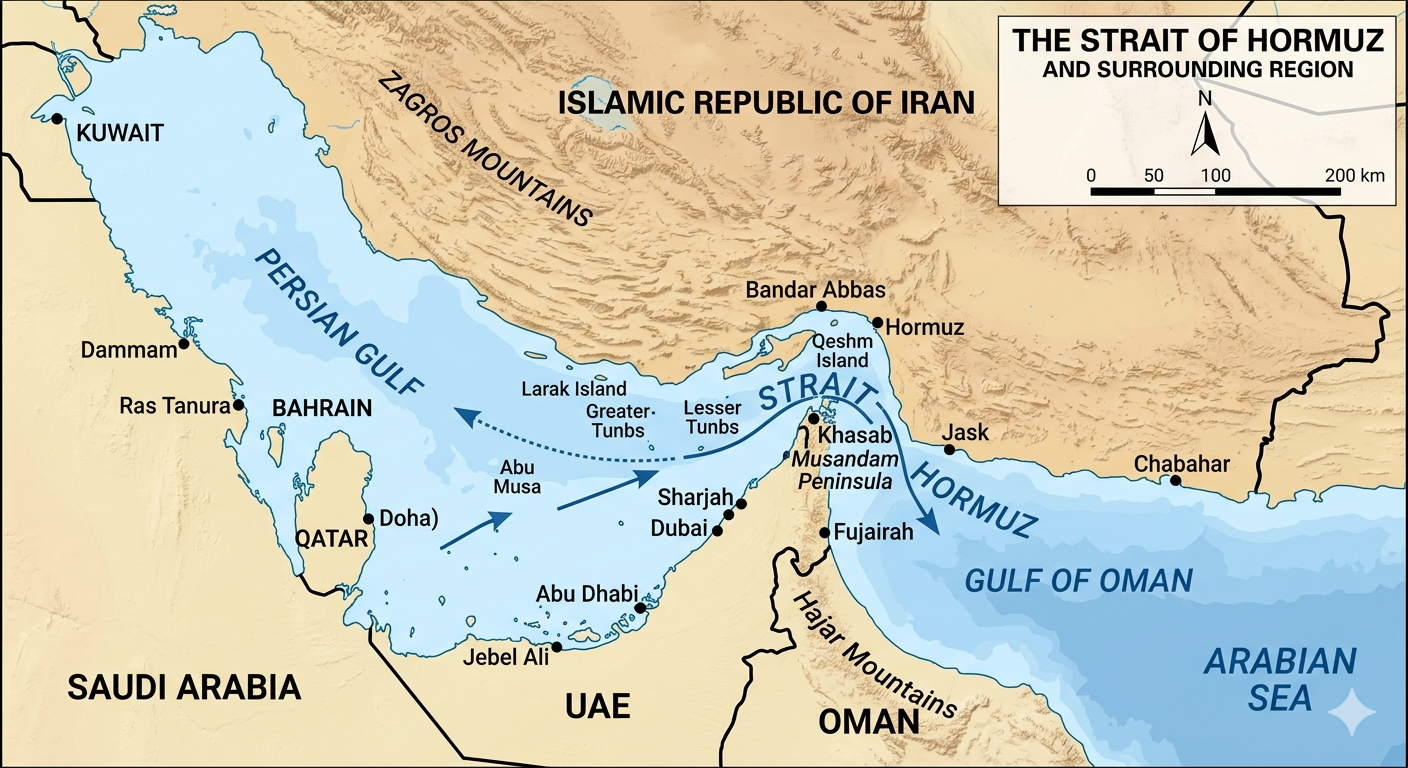
Rising tensions in West Asia have disrupted shipping through the Strait of Hormuz, a crucial global oil chokepoint. The crisis threatens energy supplies, trade routes, and India’s energy security and economy.
Syllabus Areas:GS II - International Relations GS III - Economy |
Rising tensions in West Asia following attacks between the United States / Israel and Iran have led to a near-collapse of commercial shipping through the Strait of Hormuz, one of the world’s most critical maritime chokepoints. Ship traffic has reportedly fallen by around 95%, raising concerns over global energy supplies and India’s energy security.
Strategic Significance of the Strait of Hormuz
-
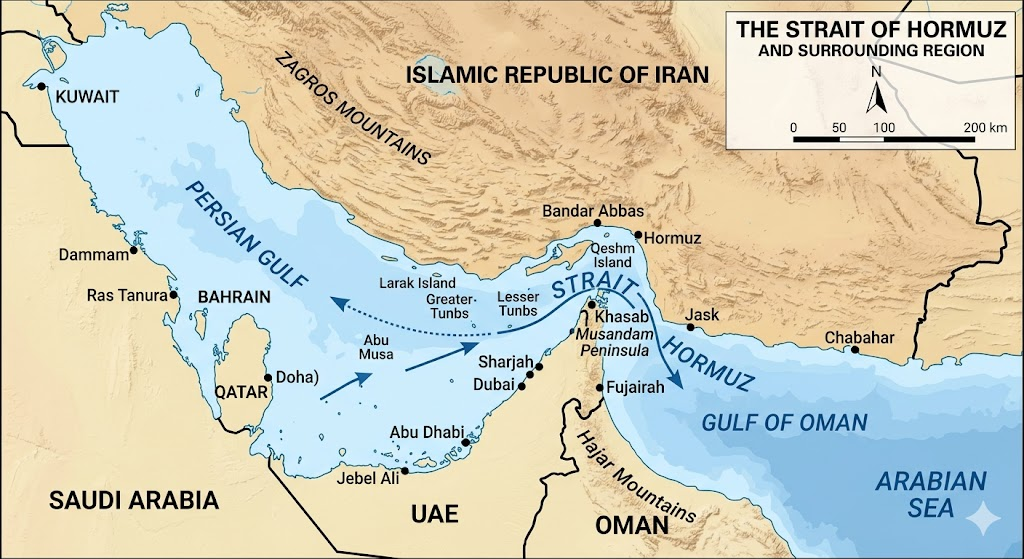
Geographical Location
-
Located between Iran, Oman, and the United Arab Emirates.
-
Connects the Persian Gulf to the Gulf of Oman and the wider Arabian Sea.
-
Narrow but Vital Passage
-
Narrowest width: 33 km.
-
Shipping lanes are even narrower (about 3 km per direction).
-
Global Energy Lifeline
-
Around 20% of global oil and gas shipments pass through this strait.
-
It is the primary export route for hydrocarbons from Gulf producers:
-
Saudi Arabia
-
Qatar
-
Kuwait
-
Iraq
-
Iran
-
Importance for India
-
Nearly 40% of India’s oil imports pass through the strait.
-
Major LNG imports from Qatar also transit this route.
-
Strategic Chokepoint
-
Any disruption can affect global energy prices, shipping costs, and economic stability.
Major Global Maritime Chokepoints
The Strait of Hormuz is part of a global network of crucial maritime bottlenecks.
Key Chokepoints
Chokepoint |
Importance |
|
Strait of Malacca |
Main maritime route connecting Indian Ocean to Pacific; vital for Chinese and East Asian trade |
|
Bab-el-Mandeb Strait |
Connects Red Sea to Gulf of Aden; key route for Europe–Asia trade |
|
Suez Canal |
Artificial canal linking Mediterranean Sea and Red Sea |
|
Panama Canal |
Connects Atlantic and Pacific Oceans |
|
Bosporus Strait and Dardanelles Strait |
Link Mediterranean and Black Sea |
Strategic insight:
Control or disruption of any of these chokepoints can reshape global trade routes and energy markets.
Sovereignty Over Maritime Chokepoints
Different chokepoints have different sovereignty arrangements.
Fully Sovereign Control
-
Egypt controls the Suez Canal
-
Panama controls the Panama Canal
-
Turkey has sovereign rights over:
-
Bosporus Strait
-
Dardanelles Strait
Shared or Strategic Oversight
-
Malaysia and Singapore secure the Strait of Malacca
-
Iran and Oman share the Strait of Hormuz
India’s Strategic Approach
India is strengthening naval presence in Andaman and Nicobar Islands to gain strategic leverage over the Strait of Malacca, which is crucial for monitoring Chinese trade routes.
Current Situation in the Strait
-
Massive Drop in Ship Traffic
-
Shipping activity has fallen by about 95%.
-
Attacks on Ships
-
Nine ships attacked in or near the strait.
-
Ships Stranded
-
Around 600 ships stuck in the region, including:
-
250 bulk carriers (coal, ores, grains)
-
200 oil tankers
-
50 LNG carriers
-
Insurance Crisis
-
Insurance premiums have increased 10–15 times.
-
One week of insurance in the strait may cost as much as a full year earlier.
-
Shipping Companies Avoiding Route
-
Shipping firms prefer detours or waiting, due to safety risks.
Can Countries Legally Close Such Straits?
Under international maritime law:
-
Seas are treated as global commons.
-
Merchant ships enjoy freedom of navigation.
-
Naval ships have right of innocent passage.
Therefore:
-
No country can legally close the Strait of Hormuz or Malacca.
-
However, security threats can effectively halt shipping.
Historical Example
During the Iran–Iraq War in the 1980s:
-
The United States Navy escorted merchant ships through the strait.
Alternative Routes for Oil Transport
Countries may attempt alternatives:
Saudi Arabia Pipeline Route
-
Oil can be transported to Yanbu on the Red Sea via pipelines.
-
The Bab-el-Mandeb Strait faces attacks by Houthi movement.
-
Ship traffic there has sharply declined since 2023.
Thus, true alternatives remain limited.
Why Iran Uses the Strait as Strategic Leverage
Iran views the strait as a geopolitical pressure tool.
Key motivations:
-
Force global pressure on Israel and the United States to stop hostilities.
-
Demonstrate strategic capability.
-
Influence global oil markets.
About 20% of ships passing the strait are Iranian, making the country an important stakeholder.
India’s Past Strategy (1980s Tanker War)
During the Iran–Iraq conflict:
-
The Shipping Corporation of India painted ships with large “INDIA” markings.
-
This signaled neutrality and reduced attacks.
This diplomatic neutrality helped India maintain trade.
Current Measures to Secure Shipping
The United States has proposed:
-
Naval escorts for merchant ships
-
Insurance support
-
Maritime security coordination.
India is exploring insurance support via the U.S. International Development Finance Corporation.
Impact on India’s Economy and Energy Security
Oil Imports
-
40% of India’s crude oil imports pass through the strait.
LNG Imports
-
50% of India’s LNG imports come from Qatar.
-
LNG supports:
-
City gas distribution
-
Power generation
-
Industrial fuel use
Fertilizer Production
-
30% of India’s natural gas goes to fertilizer manufacturing.
LPG Supply Risk
-
60% of India’s LPG imports come from Gulf region.
-
LPG is the primary cooking fuel in India.
Government Response
Measures include:
-
Increasing domestic propane–butane production
-
Prioritising cooking gas supply
-
Sourcing LNG from:
-
United States
-
Russia
-
Australia
Impact on Global Oil Prices
-
Brent crude currently below $90 per barrel.
-
During the Russia–Ukraine War, prices crossed $125.
Possible consequences if disruption continues:
-
Rise in crude oil prices
-
Higher petrol and diesel prices in India
-
Inflationary pressures
-
Increased fiscal burden on government subsidies.
The Strait of Hormuz is not merely a narrow waterway but a critical artery of global energy trade. Any disruption can trigger geopolitical tensions, energy shortages, and global economic shocks, making the situation strategically crucial for India and the world.
Prelims Questions:
1. Which of the following countries border the Strait of Hormuz?
-
Iran
-
Oman
-
United Arab Emirates
-
Saudi Arabia
Select the correct answer:
(a) 1 and 2 only
(b) 1, 2 and 3 only
(c) 1, 3 and 4 only
(d) 1, 2, 3 and 4
Answer: (b)
2. Consider the following major global chokepoints:
-
Strait of Malacca
-
Bab-el-Mandeb Strait
-
Suez Canal
-
Panama Canal
Which of the above connect two seas or oceans enabling global maritime trade routes?
(a) 1 and 2 only
(b) 1, 2 and 3 only
(c) 2, 3 and 4 only
(d) 1, 2, 3 and 4
Answer: (d)
Mains Questions:
1. Explain how disruptions in the Strait of Hormuz affect India’s energy security and economic stability. (150 Words)