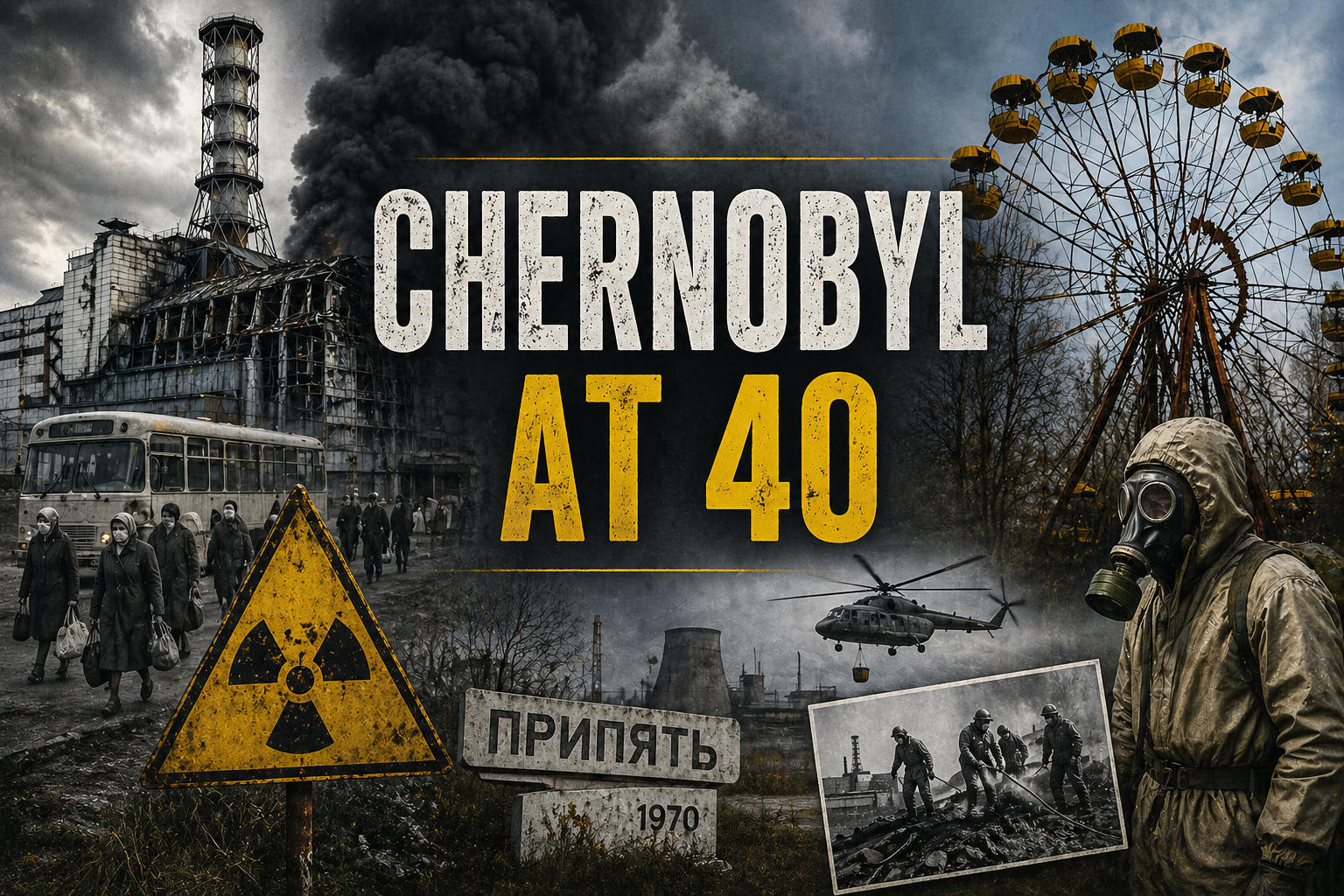
Marking 40 years of the Chernobyl disaster, explore key lessons in governance, nuclear safety, transparency, and disaster management for India and the world.
Syllabus Areas:GS II - Governance GS III - Disaster Management |
The year 2026 marks four decades since the catastrophic Chernobyl nuclear disaster of 26 April 1986, one of the worst industrial accidents in human history. The explosion at Reactor No. 4 of the Chernobyl Nuclear Power Plant, located near Pripyat in present-day Ukraine, then part of the Soviet Union, released massive amounts of radioactive material into the atmosphere, affecting millions across Europe.
Even after 40 years, Chernobyl remains more than a nuclear tragedy—it is a powerful reminder of the consequences of poor governance, secrecy, delayed crisis response, weak safety culture, and inadequate disaster preparedness. For countries like India that are expanding nuclear energy to meet climate and development goals, Chernobyl offers enduring lessons.
Historical Background of the Disaster
On the night of 26 April 1986, plant operators were conducting a safety test to determine whether residual turbine energy could power emergency cooling systems during a blackout. However, a combination of flawed reactor design, procedural violations, operator errors, and poor safety protocols led to an uncontrollable power surge.
Two explosions blew apart the reactor core, causing a fire that burned for days. Radioactive isotopes such as iodine-131, cesium-137, and strontium-90 were released into the air. Radiation clouds spread across Ukraine, Belarus, Russia, and parts of Europe.
Initially, Soviet authorities delayed public disclosure, evacuation, and international notification. This secrecy worsened exposure and public distrust.
Human and Environmental Impact
Human Consequences
-
Immediate deaths of plant workers and emergency responders.
-
Thousands exposed to dangerous radiation levels.
-
Increase in thyroid cancer cases, especially among children.
-
Long-term psychological trauma, displacement, and social disruption.
Environmental Consequences
-
Large areas contaminated and declared exclusion zones.
-
Forests, rivers, and farmland affected.
-
Radioactive residues remained for decades.
-
Loss of biodiversity in certain regions, though some wildlife later returned due to absence of human activity.
Economic Consequences
-
Massive clean-up costs.
-
Permanent relocation of populations.
-
Burden on Soviet and successor-state economies.
-
High healthcare and compensation expenditures.
Governance Failures Behind Chernobyl
Chernobyl was not merely a technical accident; it was also a failure of governance.
1. Culture of Secrecy: Authorities initially suppressed information about the scale of the accident. Residents of nearby Pripyat were evacuated only after significant delay. Transparency was sacrificed for political image.
2. Weak Safety Oversight: The Soviet nuclear system lacked independent regulators. Safety concerns were subordinated to production targets and bureaucratic hierarchy.
3. Poor Training and Accountability: Operators conducting the test lacked full understanding of reactor vulnerabilities. Decision-making was rigid, top-down, and slow.
4. Inadequate Emergency Preparedness:No robust evacuation or radiation emergency systems were ready for such an event.
Disaster Management Lessons for the Modern World
1. Prevention Through Safety Culture: Disaster management begins long before a disaster occurs. Strong safety standards, audits, simulations, and maintenance systems are essential.
2. Early Warning and Rapid Response: Real-time monitoring systems, automated alerts, and immediate evacuation protocols reduce casualties.
3. Inter-Agency Coordination: Health departments, local governments, police, scientific agencies, and disaster authorities must function in coordination.
4. Transparent Risk Communication: Public trust depends on credible and prompt communication. Rumors flourish when governments remain silent.
5. Long-Term Rehabilitation: Disasters do not end after rescue operations. Compensation, health monitoring, livelihood restoration, and mental health support are equally important.
Relevance for India
India is expanding clean energy sources, including nuclear power, to meet rising energy demand and climate commitments. Nuclear energy can support low-carbon growth, but safety remains non-negotiable.
India’s Nuclear Infrastructure
India operates multiple nuclear power stations under the Nuclear Power Corporation of India Limited and is regulated by the Atomic Energy Regulatory Board.
Indian Concerns
-
Public protests near nuclear plants over safety fears.
-
Need for transparent environmental assessments.
-
Emergency preparedness in nearby districts.
-
Waste management and liability concerns.
Legal Framework
The National Disaster Management Authority and the Disaster Management Act, 2005 provide a framework for coordinated disaster response. India also enacted the Civil Liability for Nuclear Damage Act, 2010.
Chernobyl, Fukushima and Global Nuclear Debate
The 2011 Fukushima Daiichi Nuclear Disaster showed that even advanced economies can face nuclear emergencies due to natural disasters and system failures.
This keeps the global debate alive:
Arguments Supporting Nuclear Power
-
Low carbon emissions
-
Reliable baseload electricity
-
Energy security
Concerns
-
Catastrophic accident risk
-
Waste disposal issues
-
High capital cost
-
Public opposition
The real question is not simply nuclear vs non-nuclear, but whether governance capacity matches technological ambition.
Policy Lessons for India
1. Independent Regulation: Strengthen autonomy, transparency, and technical capacity of nuclear regulators.
2. Public Communication: Regular disclosure of safety audits, emergency plans, and environmental monitoring.
3. Local Preparedness: Conduct evacuation drills, hospital readiness exercises, and district-level planning around plants.
4. Technology Upgradation: Use safer reactor designs with passive cooling systems and modern containment mechanisms.
5. Liability and Compensation: Ensure speedy compensation systems and clear accountability in case of accidents.
6. Multi-Hazard Planning: Nuclear facilities must account for earthquakes, floods, cyclones, cyber threats, and sabotage risks.
Ethical and Administrative Dimensions
For public administrators, Chernobyl raises important ethical questions:
-
Should governments hide information to avoid panic?
-
How much precaution is enough in high-risk sectors?
-
Can economic targets override safety?
-
How should states compensate affected citizens?
The clear answer: governance legitimacy depends on protecting life, not protecting image.
Forty years after Chernobyl, the radioactive smoke has cleared, but the lessons remain urgent. Technology without accountability can become dangerous. Development without preparedness can become destructive.
For India and the world, Chernobyl is a warning that disasters are rarely caused by machines alone—they are often caused by human arrogance, secrecy, and institutional weakness. The best tribute to history is not remembrance alone, but reform.