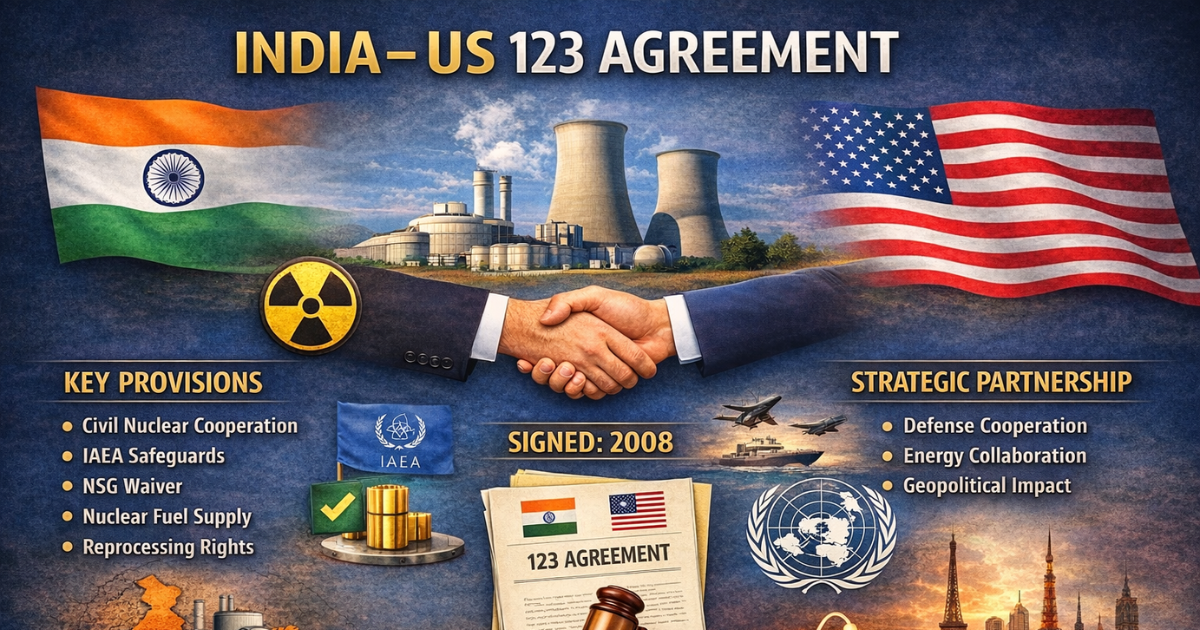
India–US 123 Agreement explained: history, key provisions, NSG waiver, IAEA safeguards, significance for India’s nuclear energy, strategic partnership with the United States, and its impact on global nuclear politics.
Syllabus Areas:GS II - International Relations |
The India–US 123 Agreement, also called the India–United States Civil Nuclear Agreement or Indo-US Nuclear Deal, is a landmark bilateral agreement that enables cooperation between India and the United States in the field of civilian nuclear energy. The agreement was formally signed on 10 October 2008 and marked a major turning point in India’s relations with the global nuclear order and with the United States.
The term “123 Agreement” originates from Section 123 of the U.S. Atomic Energy Act of 1954, which provides the legal framework for nuclear cooperation between the United States and other countries.
Through this agreement, the United States agreed to facilitate civilian nuclear trade with India, while India agreed to place its civilian nuclear facilities under international safeguards. The deal ended India’s decades-long nuclear isolation and opened access to nuclear fuel, technology, and reactors from the global market.
Historical Background
(a) India’s Nuclear Isolation
India’s nuclear program began in the 1950s under the leadership of Homi J. Bhabha. However, the international nuclear environment changed dramatically after India conducted its first nuclear test in 1974 (Pokhran-I).
Following this test:
-
The United States and other countries imposed restrictions on nuclear trade with India.
-
The Nuclear Suppliers Group (NSG) was formed to regulate nuclear exports.
-
India was excluded from global nuclear commerce because it was not a signatory to the Nuclear Non-Proliferation Treaty (NPT).
As a result, India faced severe constraints in importing nuclear fuel and technology for its civilian nuclear power program.
(b) Strategic Changes after the Cold War
Several geopolitical developments encouraged closer cooperation between India and the United States:
-
End of the Cold War
-
India’s economic liberalization in 1991
-
Rise of China in Asia
-
Growing recognition of India as a responsible nuclear power.
By the early 2000s, the United States began viewing India as an important strategic partner in Asia.
(c) 2005 Joint Statement
The foundation of the nuclear deal was laid during the 18 July 2005 Joint Statement between Indian Prime Minister Manmohan Singh and US President George W. Bush.
Key commitments included:
-
India would separate civilian and military nuclear facilities.
-
Civilian facilities would be placed under International Atomic Energy Agency (IAEA) safeguards.
-
The United States would work to enable full civil nuclear cooperation with India.
This statement initiated negotiations that eventually led to the 123 Agreement.
Negotiation and Approval Process
The agreement required multiple international and domestic approvals.
Step 1: Hyde Act (2006)
The Henry J. Hyde Act (2006) was passed by the US Congress to allow nuclear cooperation with India despite its non-membership in the NPT.
Step 2: Separation Plan
India prepared a civil-military nuclear separation plan, identifying which nuclear facilities would be open to international inspection.
Step 3: IAEA Safeguards Agreement (2008)
The International Atomic Energy Agency (IAEA) approved an India-specific safeguards agreement allowing inspections of designated civilian nuclear facilities.
Step 4: Nuclear Suppliers Group (NSG) Waiver
In September 2008, the NSG granted a special waiver allowing nuclear trade with India even though it is not a member of the NPT.
Step 5: Final Signing (2008)
The agreement was formally signed on 10 October 2008 by the Indian External Affairs Minister and the US Secretary of State.
Key Provisions of the 123 Agreement
(a) Civil Nuclear Cooperation
The agreement enables:
-
Transfer of civilian nuclear technology
-
Supply of nuclear fuel
-
Cooperation in nuclear research and energy production.
(b) Separation of Civil and Military Nuclear Facilities
India agreed to:
-
Separate its civilian nuclear facilities from military ones
-
Place civilian facilities under IAEA safeguards permanently.
India identified 35 nuclear facilities to be placed under safeguards.
(c) Access to International Nuclear Market
The agreement allows India to:
-
Import uranium fuel
-
Purchase nuclear reactors
-
Participate in global nuclear commerce.
(d) Strategic Fuel Reserve
The agreement allows India to build a strategic reserve of nuclear fuel to ensure uninterrupted reactor operation.
(e) Reprocessing Rights
India can reprocess spent nuclear fuel under safeguards in a designated facility.
(f) Termination Clause
If India conducts a future nuclear weapons test, the United States has the right to terminate nuclear cooperation.
Significance of the Agreement
(1) End of Nuclear Isolation
The deal ended nearly three decades of nuclear sanctions against India.
India gained access to nuclear technology and fuel from many countries.
(2) Boost to Nuclear Energy
India planned to significantly expand nuclear power generation.
The agreement was expected to help India increase nuclear power capacity through imported reactors and fuel.
(3) Strategic Partnership with the United States
The agreement transformed India-US relations into a strategic partnership.
It strengthened cooperation in:
-
Defense
-
Technology
-
Energy
-
Space.
(4) Recognition of India as a Responsible Nuclear Power
Although India is not part of the NPT, the deal effectively recognized India as a responsible nuclear state with advanced nuclear technology.
(5) Access to Global Nuclear Trade
After the NSG waiver, India signed nuclear cooperation agreements with many countries including:
-
France
-
Russia
-
Canada
-
Australia
-
Japan
-
Kazakhstan.
Criticism and Concerns
Despite its benefits, the agreement faced criticism both internationally and within India.
(a) Non-Proliferation Concerns
Critics argued that:
-
The deal weakened global non-proliferation norms.
-
It allowed a country outside the NPT to receive nuclear assistance.
(b) Strategic Dependence on the US
Some Indian political parties feared the agreement could increase strategic dependence on the United States.
(c) Nuclear Weapons Concerns
Some analysts argued that imported nuclear fuel could allow India to divert domestic uranium to weapons production.
(d) Political Controversy in India
The agreement created a major political crisis in India:
-
Left parties withdrew support from the government.
-
The Manmohan Singh government survived a trust vote in Parliament in 2008.
Implementation Challenges
Despite the historic nature of the agreement, progress in building US-origin nuclear reactors has been slow due to:
-
India’s Civil Liability for Nuclear Damage Act (2010), which holds suppliers liable for accidents.
-
Commercial concerns of US nuclear companies.
-
Regulatory and financial issues.
However, cooperation continues in nuclear technology and fuel supply.
Impact on India’s Nuclear Energy Program
The agreement strengthened India’s three-stage nuclear program by enabling:
-
Import of uranium for existing reactors.
-
Faster expansion of nuclear power generation.
-
Integration with global nuclear technology networks.
It also supports India’s long-term energy transition toward low-carbon electricity.
Strategic and Geopolitical Importance
The 123 Agreement has major geopolitical implications.
(1) Indo-US Strategic Alignment
The agreement symbolized a major shift in US foreign policy toward India.
(2) Balance of Power in Asia
Some analysts view the agreement as part of the United States’ effort to strengthen relations with India amid China’s rising influence in Asia.
(3) Global Energy Cooperation
The deal also encouraged cooperation in:
-
Nuclear safety
-
Non-proliferation
-
Clean energy development.
The India–US 123 Agreement represents one of the most significant diplomatic and strategic developments in India’s post-Cold War foreign policy.
By ending India’s nuclear isolation and enabling civilian nuclear cooperation with the world’s largest nuclear technology supplier, the agreement reshaped global nuclear politics and strengthened India-US relations.
Although implementation has faced challenges, the deal continues to be a cornerstone of the India–US strategic partnership and remains critical for India’s long-term energy security, technological advancement, and global diplomatic stature.