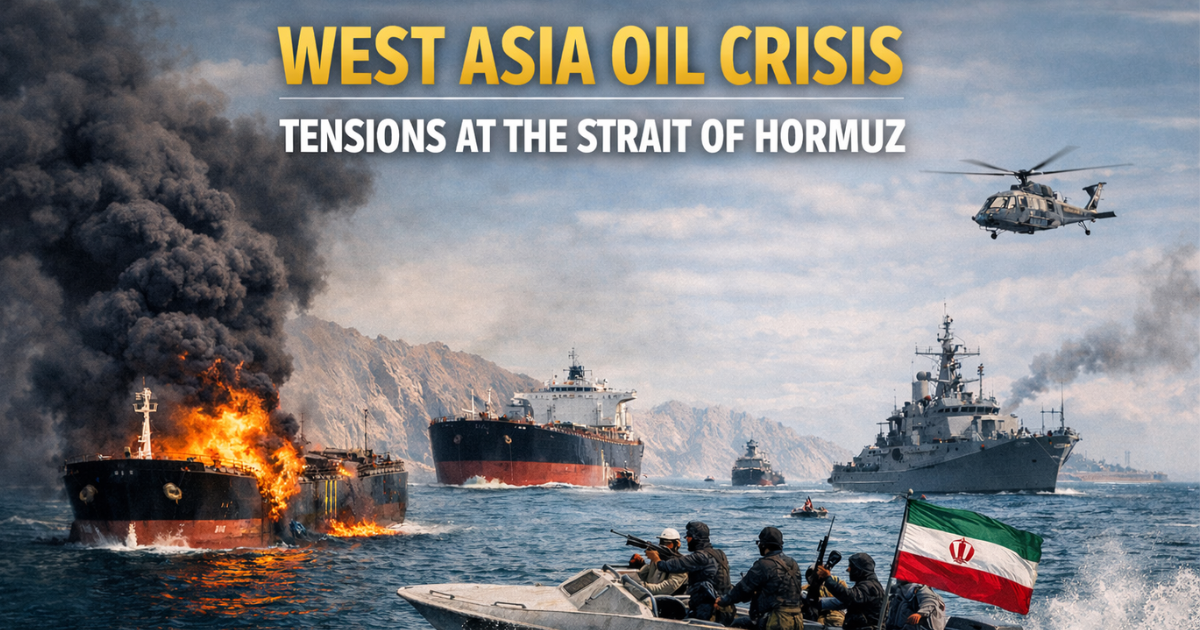
West Asia conflict and the Strait of Hormuz crisis threaten global energy security. Explore its impact on oil prices, global supply chains, India’s energy security, inflation risks, and the government’s response strategies.
Syllabus Areas:GS II - International Relations GS III - Economy |
The recent military escalation between the United States, Israel - Iran Truce has triggered a major geopolitical crisis in West Asia. In retaliation for U.S.–Israel strikes on Iran, Tehran has targeted U.S. bases in several Gulf countries and effectively closed the Strait of Hormuz, a crucial global oil shipping route.
This development has disrupted oil and gas supply chains, caused sharp increases in global energy prices, and raised concerns about global energy security and economic stability.
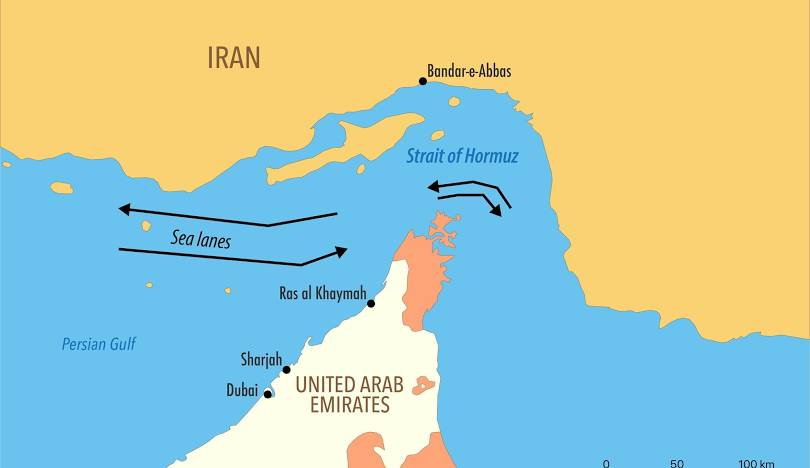
Understanding the Strait of Hormuz and Its Strategic Importance
1. The Strait of Hormuz
The Strait of Hormuz is a narrow maritime passage connecting the Persian Gulf to the Gulf of Oman and the Arabian Sea.
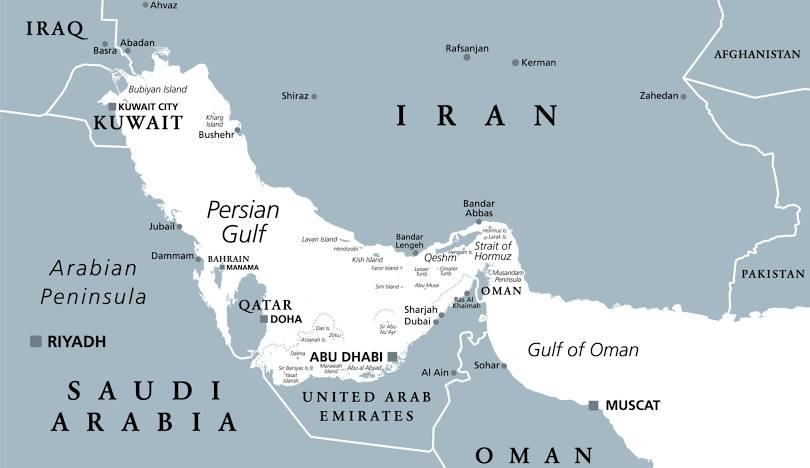
Key strategic facts:
-
Nearly 20% of the world’s oil supply passes through this strait daily.
-
It is one of the most important energy chokepoints in the global economy.
-
Major oil exporters dependent on this route include:
-
Saudi Arabia
-
Iraq
-
Iran
-
Kuwait
-
United Arab Emirates
The strait handles roughly 18–19 million barrels (one barrel = 159 liters) of oil per day, making it critical for global energy trade.
Escalation of the West Asian Conflict
The crisis began when the United States and Israel launched military strikes on Iran on February 28, 2026.
Key developments include:
-
The operation, reportedly named Operation Epic Fury, targeted multiple Iranian locations.
-
More than 500 sites in Iran were hit, leading to significant casualties.
-
Iran retaliated with missile and drone attacks on Israel and U.S. military bases in Gulf countries such as:
-
Qatar
-
UAE
-
Saudi Arabia
-
Kuwait
-
Bahrain
-
Jordan
These actions have transformed what was initially described as a pre-emptive strike into a wider regional conflict.
Closure of the Strait of Hormuz
One of the most consequential retaliatory actions by Iran was the closure of the Strait of Hormuz.
Mechanisms of the Closure
Iran’s military and the Islamic Revolutionary Guard Corps (IRGC):
-
Issued warnings prohibiting ships from passing through the strait
-
Laid mines in strategic maritime zones
-
Conducted attacks on vessels
-
Threatened to target any ship attempting to cross the strait
As a result:
-
Shipping traffic through the strait dropped sharply.
-
More than 150 vessels remained stranded in the Persian Gulf.
Disruptions to Global Energy Infrastructure
The conflict has already affected major energy facilities across the Gulf.
Key developments include:
LNG Production Halted
-
Qatar temporarily halted liquefied natural gas production at the world’s largest LNG export facility.
Refinery Shutdowns
-
Oil refineries in Saudi Arabia and Iraq have suspended operations.
Maritime Shipping Disruptions
-
Major shipping companies have diverted vessels away from the region due to security risks.
Surge in Global Oil and Gas Prices
The crisis has caused a sharp spike in global energy prices.
Key trends:
-
Oil prices increased by around 12% within a week.
-
Brent crude rose significantly amid fears of supply disruption.
-
Analysts warn that prices could cross $100 per barrel if the conflict continues.
Energy price increases could lead to:
-
Higher inflation globally
-
Increased transportation costs
-
Slower economic growth in many countries
Importance of West Asia in Global Oil Supply
West Asia remains the most important energy producing region in the world.
Key statistics:
-
The region accounted for 31% of global oil production in 2024.
-
It contributed 38% of global oil exports.
-
Five of the world’s top oil-producing countries are located in the region:
-
Saudi Arabia
-
UAE
-
Iraq
-
Iran
-
Kuwait
This concentration of energy resources means that any conflict in the region has immediate global economic repercussions.
Impact on Major Oil Importers: China and India
China
China is the largest importer of oil passing through the Strait of Hormuz.
Key details:
-
China imported around 5.4 million barrels per day via the strait in early FY25.
-
About 56% of China’s oil imports come from West Asian countries.
China has tried to reduce vulnerability by:
-
Building large strategic oil reserves
-
Storing Iranian oil in tankers and onshore facilities
Currently, China holds around 1.2 billion barrels in strategic and commercial reserves.
India
India is the second largest importer affected by the disruption.
Key facts:
-
India receives about 2.1 million barrels of crude oil per day through the strait.
-
According to the Ministry of Petroleum, India has strategic reserves sufficient for around 25 days.
However, a prolonged closure could lead to:
-
Rising fuel prices
-
Higher import bills
-
Pressure on the Indian economy and inflation
Broader Global Economic Implications
The crisis has wider global implications beyond energy markets.
-
Inflationary Pressure: Higher energy prices could push global inflation upward.
-
Supply Chain Disruptions: Shipping reroutes and halted maritime traffic may disrupt global trade.
-
Financial Market Volatility: Stock markets have already shown fluctuations due to uncertainty in energy markets.
-
Risk of a Wider Regional War: If the conflict expands further in West Asia, it could destabilize global energy markets for an extended period.
Way Forward:
1. Maintain Stable Retail Fuel Prices
-
The government should ensure that petrol and diesel prices remain stable despite temporary increases in global crude oil prices.
-
Sudden price hikes can increase transportation and production costs, leading to higher inflation and reduced consumer spending.
2. Use the Financial Buffer of Oil Marketing Companies
-
India’s Oil Marketing Companies (OMCs) have strong financial reserves due to earlier periods when crude prices fell but retail prices remained high.
-
These companies can absorb short-term losses instead of immediately passing the burden to consumers.
3. Prioritise Domestic Fuel Supply
-
During a crisis, the government may direct refineries to prioritise domestic demand over fuel exports.
-
This ensures adequate availability of petrol and diesel in the domestic market and prevents supply shortages.
4. Utilize Strategic Petroleum Reserves
-
India has strategic oil reserves and fuel stocks sufficient for more than two months.
-
These reserves can be used to manage temporary supply disruptions and stabilize the market.
5. Prevent Inflationary Pressure
-
Higher oil prices raise the cost of transportation, logistics, and manufacturing, which can increase the prices of many goods.
-
Since a 10% rise in crude prices can raise inflation by about 20 basis points, controlling fuel prices is crucial.
6. Prepare for Worst-Case Scenarios
-
The government should prepare for possible extreme price spikes similar to the $147 per barrel level seen in 2008 by planning emergency supply measures and price-stabilization strategies.
Overall, the government’s focus should be on maintaining price stability, ensuring energy security, and protecting the economy from inflation during global energy disruptions
The escalating conflict involving Iran, the United States, and Israel has created one of the most serious geopolitical crises in recent years. The effective closure of the Strait of Hormuz, through which a significant portion of the world’s oil flows, has amplified concerns over global energy security.
While strategic reserves and alternative pipelines may temporarily mitigate the impact, a prolonged disruption could trigger higher oil prices, inflation, and economic instability worldwide. For major importers like China and India, the crisis underscores the urgent need for energy diversification, strategic reserves, and geopolitical stability in West Asia.