At the India Energy Week (IEW) 2026, the Prime Minister announced $500 billion investment opportunities in India’s energy sector.
Syllabus Areas:GS III - Economy, Environment |
This reaffirmed India’s shift from energy security to energy independence, with green hydrogen and green ammonia emerging as strategic pillars. In this backdrop, India’s green ammonia auction conducted by Solar Energy Corporation of India (SECI) has attracted global attention for setting new cost and contract benchmarks, positioning India as a potential leader in global clean ammonia markets.
What it is Green Ammonia?Green ammonia (NH₃) is ammonia produced using:
Production process
Grey Ammonia:Grey ammonia is ammonia produced using hydrogen derived from fossil fuels, mainly natural gas. Current status
|
Strategic Importance of Green Ammonia
-
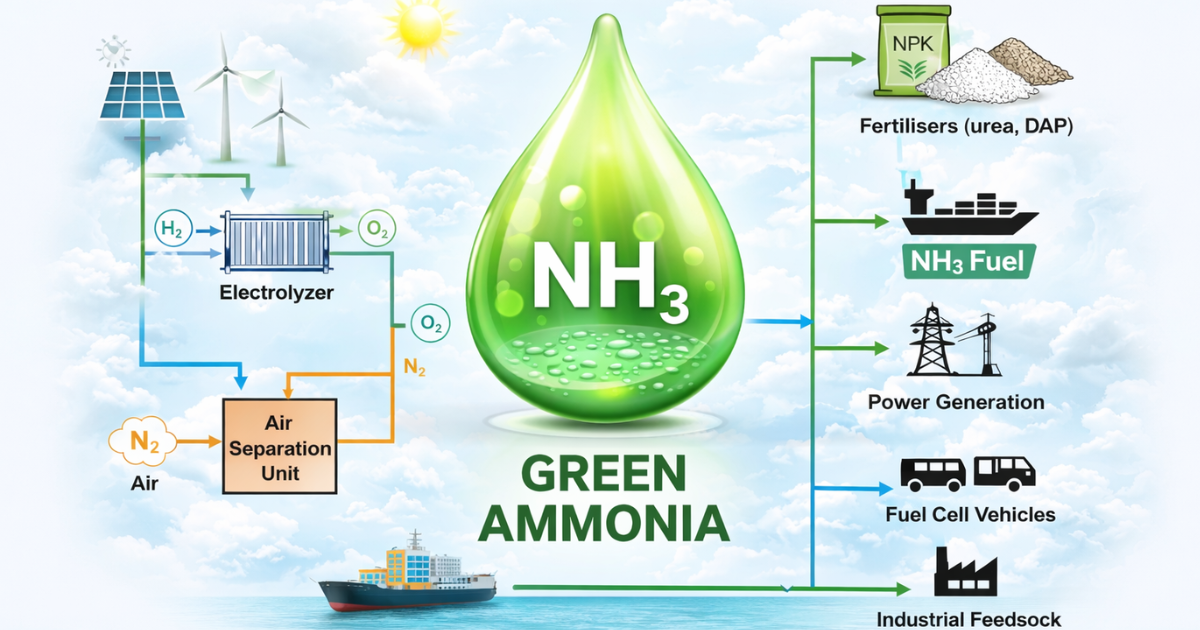
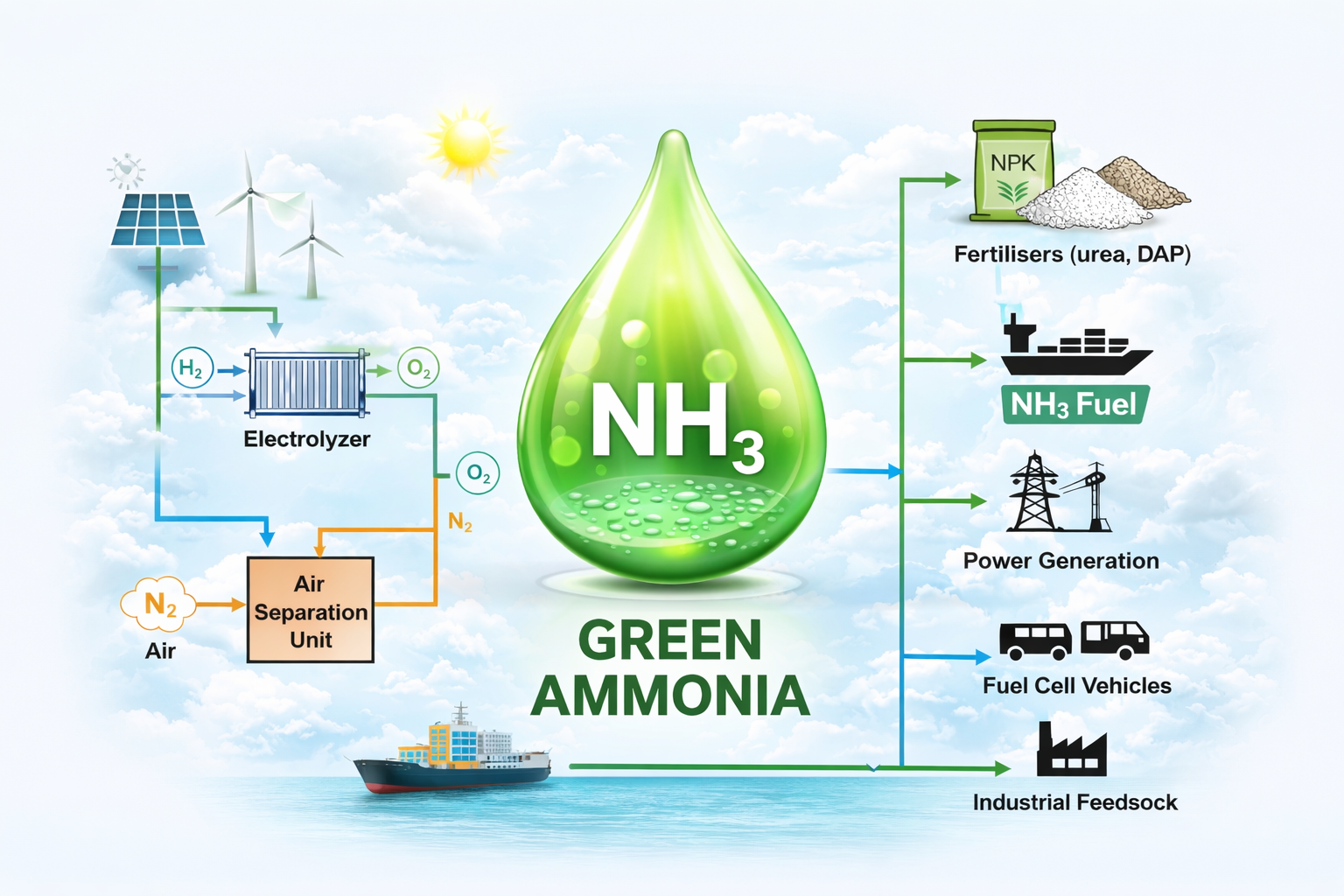
Green ammonia is produced by combining nitrogen with green hydrogen.
-
It is currently the leading commercial application of green hydrogen.
-
Applications include:
-
Fertilisers (replacement of grey ammonia)
-
Clean energy storage
-
Marine fuel and shipping
-
Major regions advancing adoption: EU, India, South Korea.
Green ammonia bridges India’s energy transition with industrial decarbonisation, especially fertilisers, which are otherwise hard-to-abate.
Green hydrogen:Green hydrogen is hydrogen produced by splitting water (H₂O) using electricity generated from renewable sources such as solar or wind. |
Global Context: Aggregated Procurement Models
-
Aggregated procurement is emerging as a key tool to create demand certainty.
-
Examples:
-
H2Global – EU’s hydrogen import strategy.
-
South Korea’s Clean Hydrogen Portfolio Standard (CHPS) – bulk clean ammonia procurement.
-
India’s SIGHT programme under the National Green Hydrogen Mission.
India’s Green Ammonia Auction – Scale and Design
-
SECI floated the tender in June 2024 under the Strategic Interventions for Green Hydrogen Transition (SIGHT) programme.
-
Demand aggregated:
-
724,000 tonnes/year
-
Across 13 fertiliser plants
-
Contracts concluded in August 2025.
-
Offered 10-year fixed-price offtake agreements, critical for investor confidence.
Long-tenor, fixed-price contracts directly address the biggest barrier—market uncertainty.
Record Market Participation and Competition
-
15 bidders participated.
-
7 unique awardees won 13 delivery contracts.
-
One firm alone secured 6 contracts (3,70,000 tonnes/year).
High participation signals private sector confidence in India’s policy and contract design.
Breakthrough on Cost Competitiveness
-
Production-linked incentives:
-
₹8.82/kg (Year 1)
-
₹7.06/kg (Year 2)
-
₹5.30/kg (Year 3)
-
Discovered green ammonia prices:
-
₹49.75–₹64.74 per kg
-
($572–$744 per tonne)
-
Grey ammonia price in India: up to $515 per tonne.
Critical Assessment:
While green ammonia is still costlier, the gap has narrowed sharply, especially with:
-
Long-term contracts
-
Subsidy support
-
Insulation from gas price volatility
Notably, these prices are 40–50% lower than H2Global auction benchmarks, setting a new global reference point.
Contract Refinements and Risk Allocation
-
Tender faced multiple extensions due to concerns over:
-
Risk-sharing
-
Payment security
-
Offtake clarity
-
SECI revised terms to create a balanced, bankable framework.
Lesson for governance:
Policy credibility is built not by rigid design, but by iterative course correction.
Logistics and Delivery Advantage
-
SECI pre-identified delivery points.
-
Most fertiliser plants are near coastal locations, enabling:
-
Shipping-based ammonia transport
-
Green ammonia under contracts equals ~30% of India’s ammonia imports.
Strategic Payoff:
-
Reduces exposure to:
-
Global gas price shocks
-
Currency volatility
-
Geopolitical disruptions
Why India is Gaining a Global Edge
India’s emerging leadership is driven by:
-
Low renewable energy costs
-
Large-scale logistics capability
-
Robust contract structures
-
Targeted fiscal incentives
As global demand for clean ammonia rises (shipping, power, industry), India can transition from importer to exporter.
Challenges to Sustain Momentum
-
For developers:
-
Strong technical & financial due diligence
-
Hybrid renewable systems with storage
-
Transparent monitoring frameworks
-
For policymakers:
-
Stable grid access & banking rules
-
Harmonised incentives
-
Stronger safety standards
-
Alignment with global certification norms
Role of Finance
-
Need for:
-
Long-tenor blended finance
-
Risk-mitigation instruments
-
Extended offtake-backed lending
-
This can crowd in private capital and de-risk first movers.
India’s green ammonia auction marks a structural turning point in the global clean energy transition. By combining aggregated demand, long-term contracts, competitive pricing and policy flexibility, India has demonstrated a replicable model for scaling green hydrogen derivatives. If supported by regulatory stability and innovative finance, India is well placed to emerge not merely as a participant, but as a rule-setter in global clean ammonia markets.
Mains Questions:
1. How can domestic production and long-term offtake of green ammonia enhance India’s energy security in the context of global gas market volatility and geopolitical risks? (150 words)