The National Green Tribunal clears the ₹1.92 lakh crore Great Nicobar Island mega infrastructure project, highlighting its strategic importance while mandating strict environmental safeguards. Read key points, analysis, and UPSC-ready insights.
Syllabus Areas:GS III - Environment GS IV - Ethics |
The National Green Tribunal (NGT) has cleared the way for the ₹1.92 lakh crore Great Nicobar Island mega infrastructure project, citing its strategic and national importance, while directing strict compliance with environmental safeguards. The decision has revived debate on the balance between strategic development and ecological protection.
In a significant ruling with long-term strategic and environmental implications, the National Green Tribunal (NGT) has dismissed petitions challenging the environmental clearance (EC) granted to the Great Nicobar Island mega infrastructure project in 2022. Emphasising India’s strategic interests, the Tribunal held that it found “no good ground to interfere”, provided that all environmental conditions are strictly and fully complied with.
About the Great Nicobar Island Project
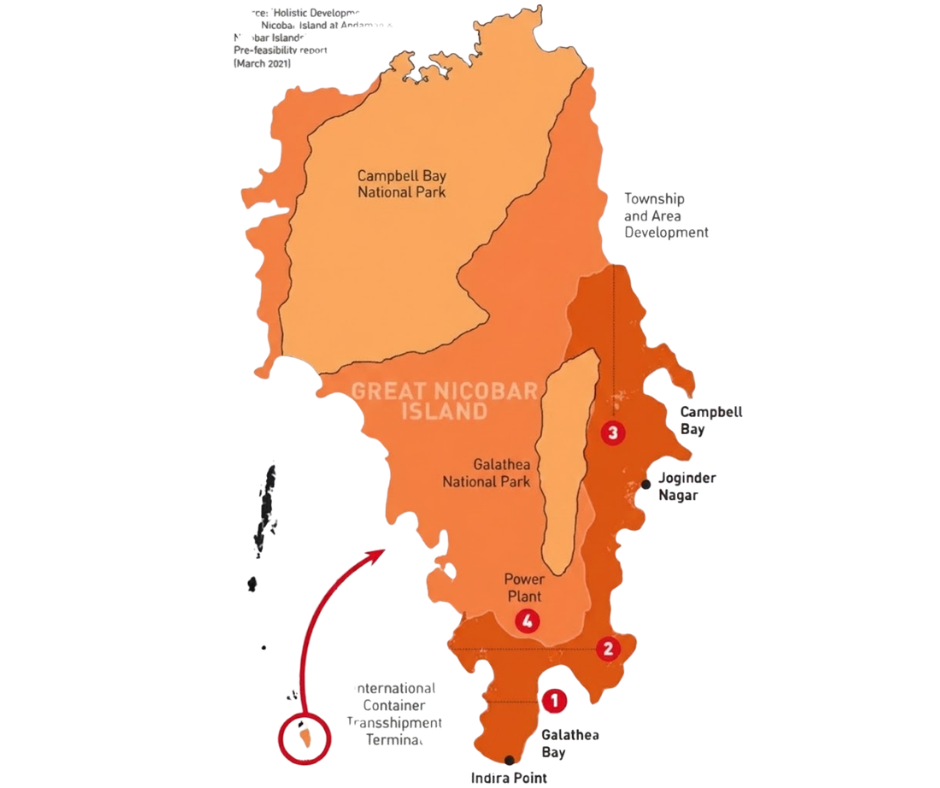
The proposed project on Great Nicobar Island includes:
-
A transshipment port
-
An international airport
-
A power plant
-
A new township
The project is envisioned as a strategic maritime and economic hub, enhancing India’s presence in the eastern Indian Ocean region, close to key global shipping routes.
Background of the Legal Challenge
-
Environmental clearance was granted in 2022.
-
In 2023, an earlier NGT Bench directed the formation of a High-Powered Committee (HPC) to examine:
-
Protection of coral reef colonies
-
Leatherback turtle nesting sites
-
Allegations that parts of the project lie in ecologically protected zones
-
Multiple applications were filed alleging inadequate environmental scrutiny and flawed assessment processes.
National Green Tribunal (NGT):National Green Tribunal (NGT) is a specialised statutory body established in 2010 under the National Green Tribunal Act, 2010 to ensure effective and expeditious disposal of cases related to environmental protection and conservation of natural resources. Key Points:
|
Key Arguments Raised by the Applicants
-
Limited Terms of Reference for HPC
Applicants argued that the HPC was restricted to only three issues, ignoring broader ecological and social concerns. -
Inadequate Environmental Impact Assessment (EIA)
-
EIA was conducted for only one season, instead of the mandatory three seasons.
-
Alleged non-compliance with environmental regulations.
-
Ecological Sensitivity
-
Threats to coral reefs
-
Disturbance to leatherback turtle nesting grounds
-
Potential shoreline erosion
-
Tribal Rights and Consent
-
Indigenous communities — Nicobarese and Shompen tribes — alleged:
-
Their consent was not lawfully obtained
-
Forest rights were not settled as required under law
NGT’s Observations and Rationale
1. Strategic Importance
-
The Tribunal explicitly noted that the project is of “strategic, defence and national importance”.
-
It accepted the Union government’s stance that:
-
The HPC report cannot be made public due to confidential and privileged information.
2. Adequacy of Environmental Safeguards
-
NGT held that:
-
Adequate safeguards are built into the EC conditions.
-
It had already refused to interfere with the EC in its 2023 order.
3. High-Powered Committee (HPC)
-
The Bench found:
-
No error in drafting the HPC’s terms of reference.
-
Applicants failed to point out any substantial unexamined issue.
-
The remaining concerns were considered “dealt with” by the HPC.
Specific Environmental Directions Issued by the NGT
Coral Reefs
-
Responsibility placed on the Ministry of Environment, Forest and Climate Change (MoEFCC) to:
-
Protect coral reefs along the coast
-
Ensure coral regeneration using proven scientific methods
-
MoEFCC directed to prepare and approve a detailed implementation plan.
Shoreline Erosion
-
The Tribunal held MoEFCC responsible to ensure:
-
No shoreline erosion or change occurs due to:
-
Foreshore development
-
Other construction activities
EIA Duration Issue
-
On the one-season EIA:
-
NGT accepted the government’s submission that:
-
Andaman & Nicobar Islands are not high-erosion zones
-
Hence, three-season data was not required
Role of ICRZ Notification, 2019
-
NGT stressed that development must strictly adhere to the Island Coastal Regulation Zone (ICRZ) Notification, 2019.
-
It rejected the idea of prohibiting the project merely on apprehensions, advocating a balanced approach between:
-
Strategic development
-
Environmental protection
Pending Issues and Parallel Legal Proceedings
-
While EC challenges have been disposed of by the NGT:
-
Forest clearance aspects are still under challenge before the Calcutta High Court.
-
Social concerns remain unresolved regarding:
-
Tribal forest rights
-
Lawful consent under forest and tribal protection laws
The NGT’s ruling marks a decisive push towards strategic infrastructure development in ecologically sensitive regions, while placing the onus of environmental protection squarely on the government. The success or failure of the Great Nicobar project will ultimately depend not on judicial clearance, but on strict compliance, transparency, and accountability in execution — a test case for India’s commitment to sustainable development in strategically critical zones.
Prelims Questions:
1. With reference to the Island Coastal Regulation Zone (ICRZ) Notification, 2019, consider the following statements:
-
It is applicable specifically to islands like Andaman & Nicobar and Lakshadweep.
-
It replaces the Coastal Regulation Zone (CRZ) framework for mainland India.
-
It allows certain strategic projects subject to environmental safeguards.
Which of the statements given above is/are correct?
a) 2 and 3 only
b) 1 and 3 only
c) 2 only
d) 1, 2, and 3
Answer:
(b) 1 and 3 only
Explanation:
ICRZ is island-specific, not a replacement for mainland CRZ.
2. Leatherback turtles, often mentioned in environmental debates, are important because:
-
They are listed as Vulnerable by IUCN.
-
Great Nicobar Island is one of their major nesting sites in India.
-
They depend on coral reefs for nesting.
Which of the statements given above is/are correct?
a) 1 and 3 only
b) 2 only
c) 1 and 2 only
d) 1 only
Answer:
(b) 2 only
Explanation:
They are Critically Endangered, nest on sandy beaches, not coral reefs.
Mains Questions:
1. “Strategic infrastructure projects in ecologically sensitive regions pose complex governance challenges.” Discuss this statement in the context of the Great Nicobar Island mega infrastructure project and the recent National Green Tribunal ruling. (250 words)
2. A project of national strategic importance threatens ecological balance and indigenous livelihoods. As a policymaker, how would you resolve this ethical dilemma? (150 Words)
Learn More Strategies of UPSC CSE Preparation: