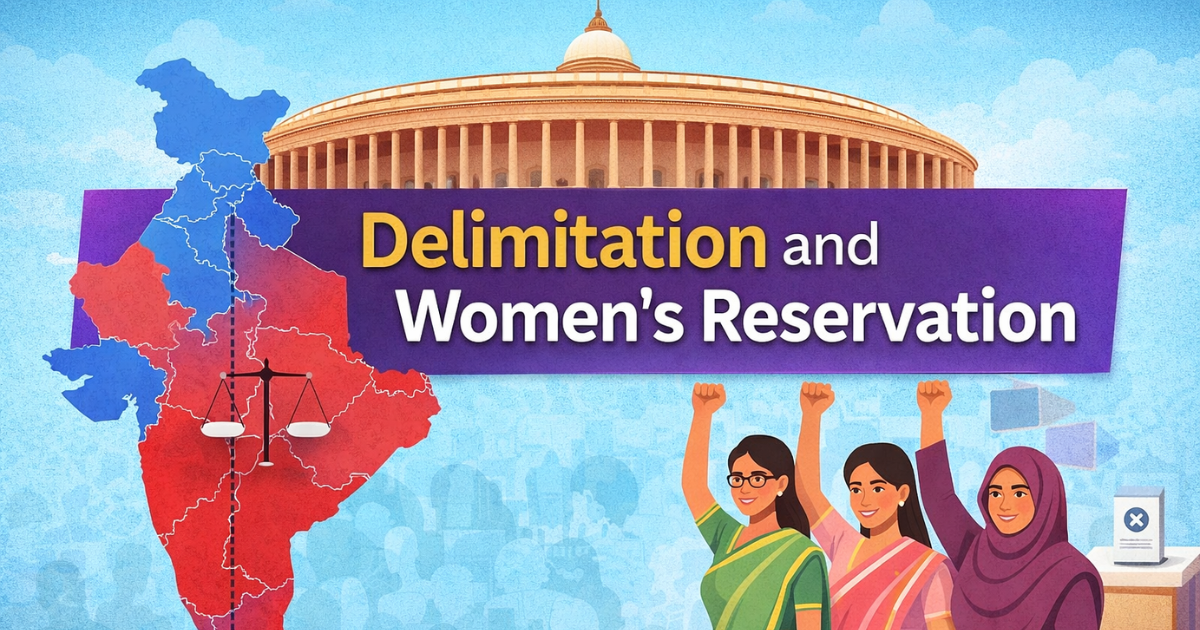
Delimitation vs women’s reservation—will representation come at the cost of federal balance? A detailed UPSC-focused analysis of the ongoing debate.
Syllabus Areas:GS II - Polity and Governance |
The debate on delimitation of parliamentary constituencies has resurfaced in the context of the implementation of the Women’s Reservation law (106th Constitutional Amendment). The law mandates 33% reservation for women in the Lok Sabha and State Assemblies, but its implementation is linked to the next delimitation exercise after Census.
This linkage has triggered concerns, especially from southern states, that delimitation based on population may reduce their political representation, despite their success in population control. Thus, the issue has evolved into a deeper debate on representation, federal fairness, and political equity.
Understanding Delimitation
Delimitation refers to the redrawing of boundaries of electoral constituencies to reflect changes in population.
-
Conducted by a Delimitation Commission
-
Aims to ensure equal representation (one person, one vote principle)
-
Last delimitation was based on the 2001 Census
-
The process has been frozen until 2026 to encourage population control
Women’s Reservation: The Link with Delimitation
The Women’s Reservation law introduces a progressive reform, but with a crucial condition:
-
Reservation will be implemented only after the next Census and delimitation
-
This creates a time lag and structural dependency
Key Concern:
Should a social justice reform (women’s representation) depend on a technical exercise (delimitation)?
This is where the debate intensifies.
Core Issue: Representation vs Federal Balance
1. Population-Based Representation
-
Northern states with higher population growth may gain more seats
-
Southern states, which successfully controlled population, may lose relative representation
2. Federal Imbalance
-
Southern states argue this penalizes good governance
-
Raises concerns about equity in federal structure
3. Political Consequences
-
Potential shift in political power balance
-
Risk of regional alienation
Arguments in Favour of Delimitation-Based Approach
-
Ensures updated and accurate representation
-
Maintains demographic legitimacy
-
Prevents outdated constituency structures
Arguments Against the Current Approach
-
Punishes states that implemented population control policies
-
Delays women’s political empowerment
-
Creates regional imbalance in Parliament
Possible Solutions
1. Decoupling Women’s Reservation from Delimitation
-
Implement reservation immediately
-
Avoid unnecessary delay in reform
2. Balanced Representation Model
-
Consider factors beyond population:
-
Development indicators
-
Governance performance
3. Constitutional Safeguards
-
Protect representation of states that controlled population
-
Ensure federal equity
4. Transparent Delimitation Process
-
Strengthen independence of the Delimitation Commission
-
Ensure non-partisan execution
Way Forward
India stands at a crucial juncture where it must balance:
-
Democratic equality
-
Federal fairness
-
Gender justice
A rigid population-based approach may undermine federal harmony, while delaying women’s reservation weakens inclusive democracy. The need is for a nuanced, balanced, and forward-looking framework that aligns representation with both equity and efficiency.
The delimitation debate is no longer just a technical exercise—it is a test of India’s constitutional maturity. The challenge lies in ensuring that democracy remains representative without becoming divisive, and that reforms like women’s reservation are implemented without structural bottlenecks.
A thoughtful approach today will determine whether India strengthens its democratic foundations—or strains its federal fabric.