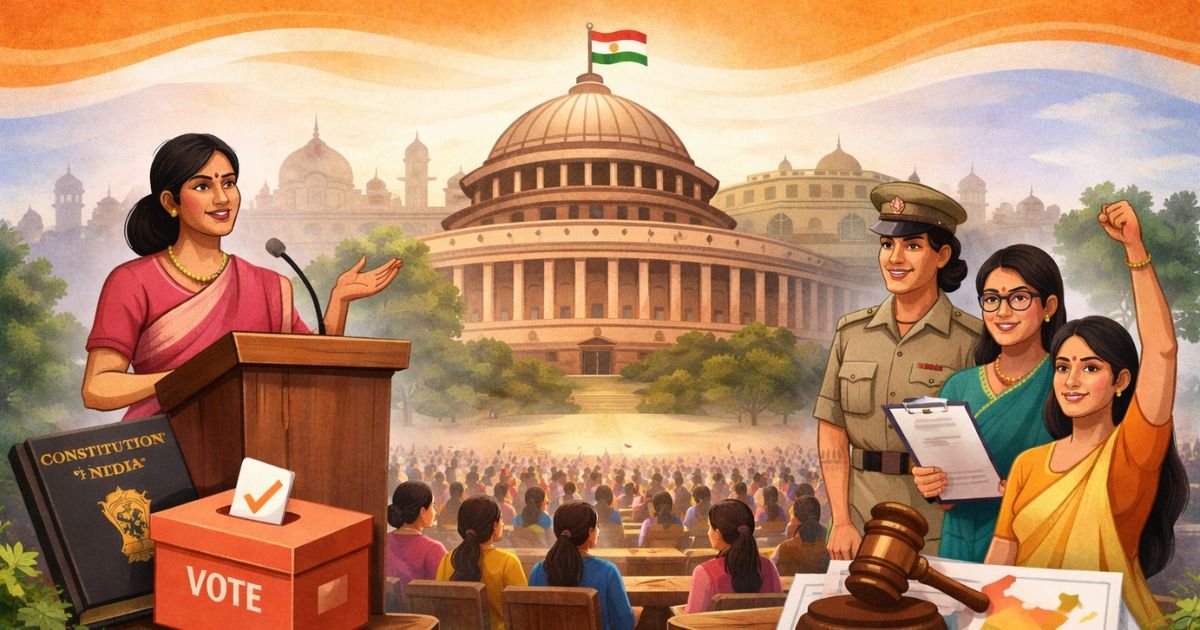
Explore the Women’s Reservation Act, its historical background, key provisions, implementation challenges, and significance for gender equality in Indian politics, aiming to ensure 33% representation of women in legislatures.
Syllabus Areas:GS II - Polity & Governance |
The Nari Shakti Vandan Adhiniyam has recently come into focus as discussions continue regarding its implementation timeline. Although the Act guarantees 33% reservation for women in the Lok Sabha and State Legislative Assemblies, it will be implemented only after the next census and delimitation exercise.
Since the delimitation of constituencies is expected after 2026, many experts believe that the reservation may become operational only by the 2029 general elections. This has sparked debate on whether the reform should be implemented earlier to ensure faster progress toward gender equality in political representation.
Historical Background
-
The demand for reservation for women in legislative bodies has existed for several decades. Despite women playing an important role in India’s freedom movement, their representation in elected institutions remained limited after independence.
-
A major step toward improving women’s political participation occurred in the early 1990s through local governance reforms.
-
The 73rd Constitutional Amendment Act and 74th Constitutional Amendment Act introduced 33% reservation for women in Panchayati Raj Institutions and Urban Local Bodies.
-
These reforms brought millions of women into grassroots governance, enabling them to serve as village heads, panchayat members, and municipal councillors. The success of this model strengthened the argument for similar reservations in Parliament and State Assemblies.
-
The Women’s Reservation Bill was first introduced in Parliament in 1996, but political disagreements prevented its passage for many years. After nearly three decades of debate, the bill was finally passed in 2023, marking a historic milestone in India’s democratic evolution.
Key Provisions of the Act
The Women’s Reservation Act introduces several important provisions aimed at improving gender representation in legislative bodies.
1. Reservation of Seats
The Act mandates 33% reservation for women in:
-
The Lok Sabha
-
State Legislative Assemblies
This means that one-third of all seats in these legislatures will be reserved for women candidates.
2. Reservation within SC/ST Quotas
The Act also provides one-third reservation for women within the seats reserved for Scheduled Castes and Scheduled Tribes, ensuring representation for women from marginalized communities.
3. Rotation of Reserved Constituencies
Reserved constituencies will be rotated after each delimitation exercise, allowing different regions to benefit from the reservation over time.
4. Duration
The reservation is expected to remain in effect for 15 years, although Parliament may extend the provision if necessary.
Current Status of Women in Indian Politics
Women’s representation in Indian politics has improved gradually but remains relatively low.
-
Women constitute about 15% of members in the Lok Sabha, the highest in India’s history.
-
In many State Legislative Assemblies, women’s representation remains below 10%.
These numbers highlight the structural challenges women face in entering electoral politics, including limited access to political networks, campaign funding, and party nominations.
Importance of Women’s Representation
Increasing women’s representation in legislatures has several democratic and developmental benefits.
- Strengthening Democracy: Greater participation of women ensures that political institutions reflect the diversity of society.
- Inclusive Policy Making: Women leaders often prioritize issues such as:
-
-
Health
-
Education
-
Nutrition
-
Social welfare
-
Gender justice
-
These areas are crucial for inclusive development and social progress.
- Social Transformation: Women in political leadership positions serve as role models, encouraging greater participation of women in public life.
Implementation Challenges
Despite the passage of the Act, several challenges remain in its implementation.
- Census Requirement: The reservation will take effect only after the completion of the next national census, which will update population data.
- Delimitation Process: Following the census, constituencies will undergo delimitation, a process that redraws electoral boundaries based on population changes.
- Political Readiness: Political parties must also ensure that women candidates receive adequate support, training, and resources to participate effectively in elections.
Concerns and Criticisms
While the Act has been widely welcomed, some concerns have been raised.
- Delay in Implementation:
-
Linking the reform to census and delimitation may postpone the reservation by several years.
-
- Demand for Sub-Quota:
-
Some groups have demanded a separate quota for Other Backward Classes (OBC) women to ensure equitable representation.
-
- Proxy Representation:
-
Experiences in some local bodies suggest that elected women representatives may face pressure from male family members, highlighting the need for capacity building.
-
Lessons from Local Governance
The experience of reservation in Panchayati Raj institutions offers valuable insights. Since the introduction of reservation in local bodies, millions of women have entered politics and demonstrated effective leadership.
Women leaders at the local level have contributed to improvements in:
-
Education and school infrastructure
-
Drinking water and sanitation
-
Healthcare services
-
Community development initiatives
These outcomes demonstrate that reservation can successfully promote women’s political participation and leadership.
Way Forward
For the Women’s Reservation Act to achieve its full potential, several measures are necessary.
-
Capacity Building: Training women leaders in governance and policymaking.
-
Political Party Reforms: Encouraging parties to provide greater opportunities for women candidates.
-
Financial Support: Ensuring access to campaign resources and funding.
-
Social Awareness: Promoting gender equality and encouraging women to participate in public life.
The Women’s Reservation Act represents a historic step toward gender equality in Indian politics. By ensuring one-third representation for women in legislative bodies, it seeks to correct the long-standing imbalance in political participation.
However, the true impact of the reform will depend on timely implementation, supportive political structures, and social acceptance. If implemented effectively, the Act has the potential to transform India’s democratic landscape by ensuring that women play a greater role in governance, policymaking, and leadership.