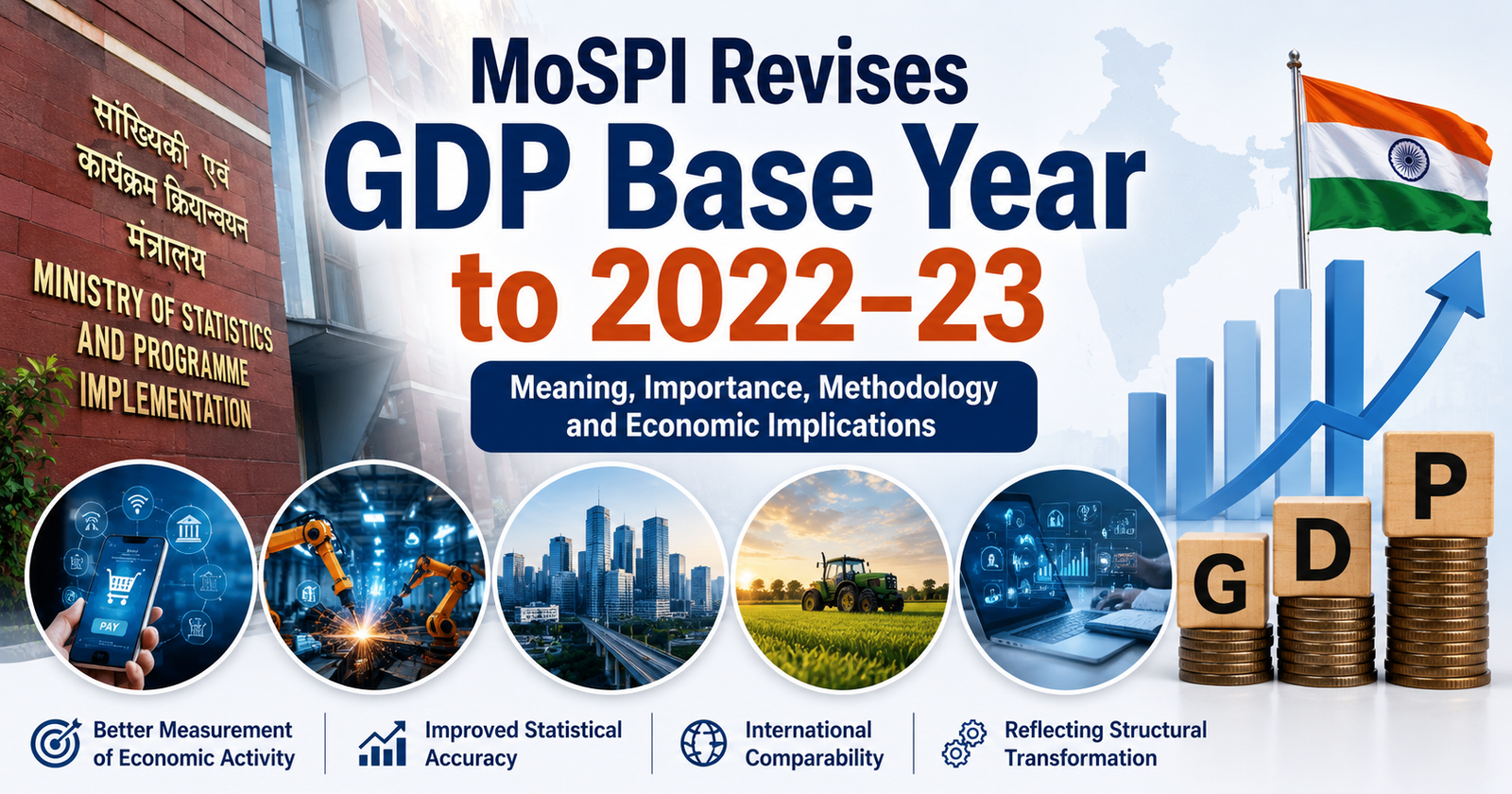
Explore MoSPI’s GDP base year revision to 2022–23, its methodology, significance, economic implications, statistical reforms, policymaking impact and importance for India’s evolving economy.
Syllabus Areas:GS III - Economy |
India’s Ministry of Statistics and Programme Implementation (MoSPI) has announced the revision of the Gross Domestic Product (GDP) base year to 2022–23. The move is considered an important statistical and economic reform aimed at improving the accuracy of national income estimation and ensuring that India’s economic data reflects present-day production patterns, consumption behaviour and structural changes in the economy.
The revision assumes significance because India’s economy has undergone major transformations during the past decade due to:
-
Digitalization
-
Expansion of the service sector
-
Growth of startups and platform economy
-
Manufacturing changes
-
Consumption pattern shifts
-
Technological advancement
Updating the GDP base year helps policymakers, economists and investors obtain a more realistic picture of the Indian economy.
What is GDP?
Gross Domestic Product (GDP) refers to the total monetary value of all final goods and services produced within a country during a specific period, usually one year.
GDP is one of the most important indicators used to measure:
-
Economic growth
-
Productivity
-
Income generation
-
Development trends
Types of GDP
1. Nominal GDP
Calculated using current market prices.
2. Real GDP
Adjusted for inflation using prices from a selected base year.
Real GDP provides a more accurate picture of actual economic growth.
What is a GDP Base Year?
The base year is the reference year used to calculate real GDP and inflation-adjusted economic growth.
In the base year:
-
Prices are treated as standard or constant.
-
Economic comparisons are made relative to this year.
Changing the base year ensures that calculations reflect contemporary economic structures and price patterns.
Why is Changing the Base Year Necessary?
Over time, economies evolve significantly.
Structural Changes in the Economy
India’s economy today is very different from what it was a decade ago due to:
-
Rise of digital economy
-
E-commerce growth
-
Platform-based services
-
Urbanization
-
Formalization of economy
-
Technological transformation
Older base years may fail to capture these changes accurately.
Previous GDP Base Years in India
India periodically revises GDP base years.
|
Base Year |
Introduced |
|
1948–49 |
Initial estimates |
|
1960–61 |
Economic restructuring |
|
1980–81 |
Industrial modernization |
|
1993–94 |
Liberalization phase |
|
2004–05 |
Expanding services sector |
|
2011–12 |
Current system before revision |
|
2022–23 |
Latest revision |
Each revision attempted to align national accounts with changing economic realities.
Why 2022–23 Was Chosen
The year 2022–23 was selected because:
-
It reflects post-pandemic economic normalization.
-
It captures new digital consumption patterns.
-
It includes recent industrial and service-sector trends.
-
More reliable and updated datasets are available.
The revision is also intended to improve the quality of macroeconomic indicators.
Objectives of the GDP Base Year Revision
1. Better Measurement of Economic Activity
Modern economic sectors such as:
-
Digital payments
-
Online commerce
-
App-based services
-
Startup ecosystem
need better representation in GDP calculations.
2. Improved Statistical Accuracy
Updating the base year helps:
-
Reduce estimation distortions
-
Improve data quality
-
Capture changing consumption patterns
3. International Comparability
Most countries periodically revise national accounting methods.
The revision aligns India’s GDP estimation with:
-
International statistical standards
-
UN System of National Accounts (SNA)
4. Reflecting Structural Transformation
India’s economy is increasingly:
-
Service-driven
-
Technology-intensive
-
Consumption-oriented
The revised base year helps capture these transitions.
Importance of GDP Base Year Revision
1. Better Economic Policymaking
Accurate GDP data helps governments:
-
Design budgets
-
Allocate resources
-
Formulate welfare schemes
-
Plan infrastructure investments
2. Improved Monetary Policy
The Reserve Bank of India (RBI) depends on economic data for:
-
Interest rate decisions
-
Inflation management
-
Liquidity control
More accurate GDP estimation strengthens monetary policy effectiveness.
3. Investor Confidence
Reliable economic statistics improve:
-
Global investor confidence
-
Credit ratings
-
Ease of doing business perception
4. Better Understanding of Economic Growth
Revised methodology helps policymakers understand:
-
Which sectors are growing
-
Employment trends
-
Productivity changes
-
Consumption behaviour
Concerns and Criticisms
GDP revisions often generate debates among economists.
1. Data Reliability Concerns
Some economists argue that:
-
Informal sector estimation remains difficult
-
Employment data gaps persist
2. Political Interpretation
GDP revisions can become politically sensitive because:
-
Growth figures influence public perception
-
Economic performance becomes a political issue
3. Complexity of Informal Economy
India’s large unorganized sector makes accurate estimation challenging.
Capturing:
-
Small businesses
-
Informal labour
-
Rural economic activity
remains difficult.
Role of MoSPI
The Ministry of Statistics and Programme Implementation is responsible for:
-
National statistical systems
-
GDP estimation
-
Economic surveys
-
Data collection and dissemination
It plays a critical role in evidence-based policymaking.
Challenges Before India’s Statistical System
1. Informal Sector Measurement: A major challenge due to India’s large unorganized economy.
2. Real-Time Data Availability: Data collection delays can affect accuracy.
3. Coordination Across Agencies: Different datasets require harmonization.
4. Digital Economy Estimation: New economic activities require updated frameworks.
The Way Forward
-
Strengthening Data Infrastructure: India must invest in digital statistical systems, real-time economic databases, AI-assisted analysis
-
Improving Transparency: Clear methodology publication improves credibility and trust
-
Integrating Big Data: Modern economic measurement increasingly depends on GST networks, digital payments, online business transactions
-
Enhancing Statistical Capacity: Training statisticians and improving institutional capability are essential.
The revision of India’s GDP base year to 2022–23 marks an important step toward modernizing the country’s statistical architecture. As India’s economy undergoes rapid transformation driven by technology, urbanization and digitalization, outdated economic measurement systems can no longer capture the true scale and structure of economic activity.
The new base year aims to provide:
-
More accurate GDP estimation
-
Better representation of emerging sectors
-
Improved policymaking support
-
Enhanced global credibility
Although methodological challenges remain, especially regarding the informal economy, the revision reflects India’s broader commitment to strengthening evidence-based governance and aligning with global statistical standards.
In the coming years, reliable economic statistics will become increasingly important as India aspires to emerge as one of the world’s leading economies.