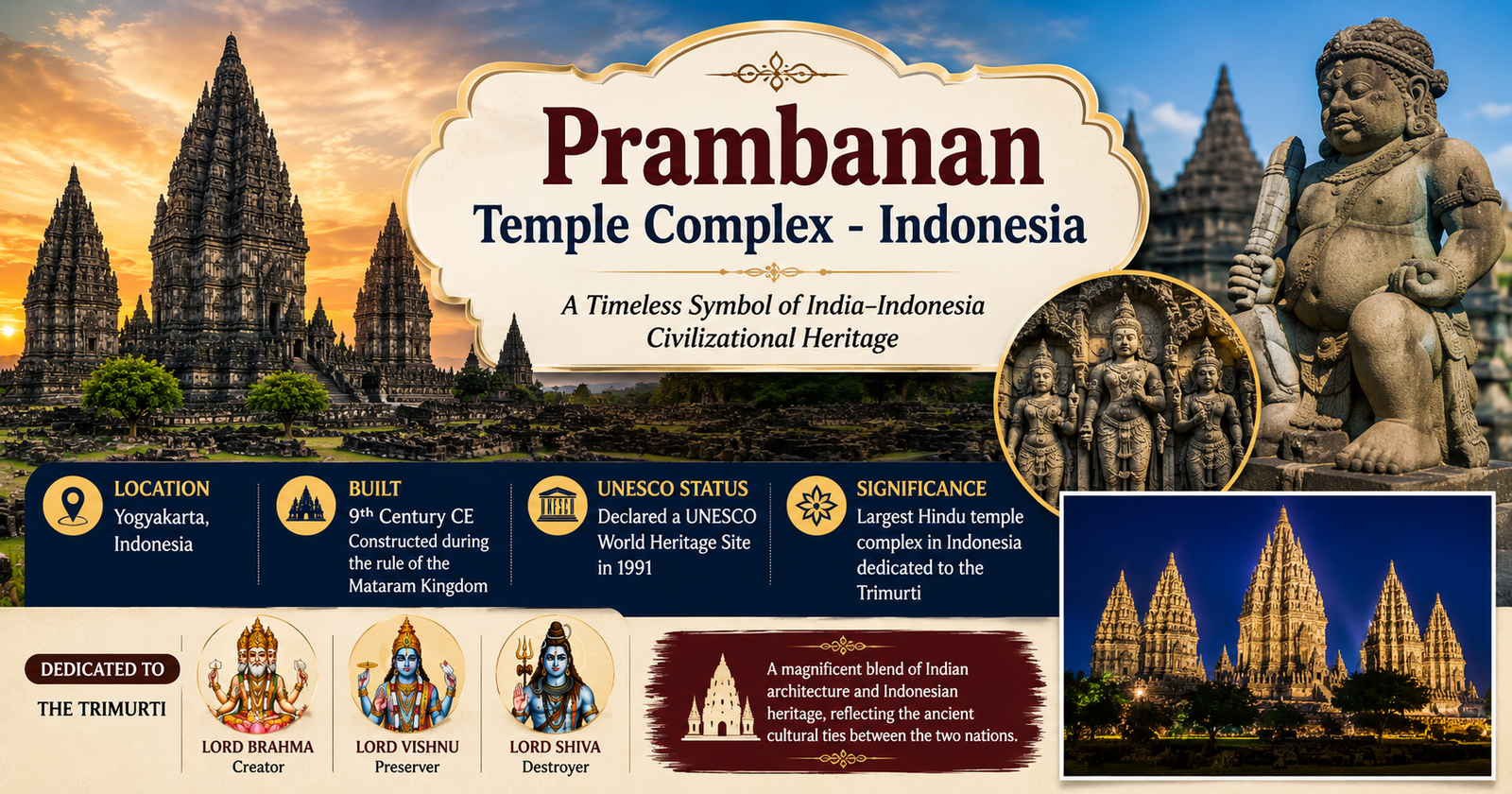
Explore the Prambanan Temple Complex, Indonesia's largest Hindu temple, showcasing India-Indonesia civilizational ties, UNESCO heritage status, remarkable architecture, and India's ASI-led restoration initiative.
Syllabus Areas:
GS I - Culture
GS II - International Relations
Prime Minister Narendra Modi visited the UNESCO World Heritage Site - Prambanan Temple Complex in Yogyakarta, Indonesia. During the visit, Indonesian President Prabowo Subianto accompanied the Prime Minister, and both leaders jointly unveiled a plaque marking the commencement of the Archaeological Survey of India (ASI)'s conservation and restoration project at the temple complex. The restoration initiative originated during President Prabowo Subianto's State Visit to India (2025)
India Begins Restoration of Prambanan Temple
-
India has officially started the conservation and restoration project of the historic Prambanan Temple Complex.
-
The project will be carried out by the Archaeological Survey of India (ASI).
-
The inauguration was marked by unveiling a commemorative plaque by the leaders of India and Indonesia.
About Prambanan Temple Complex
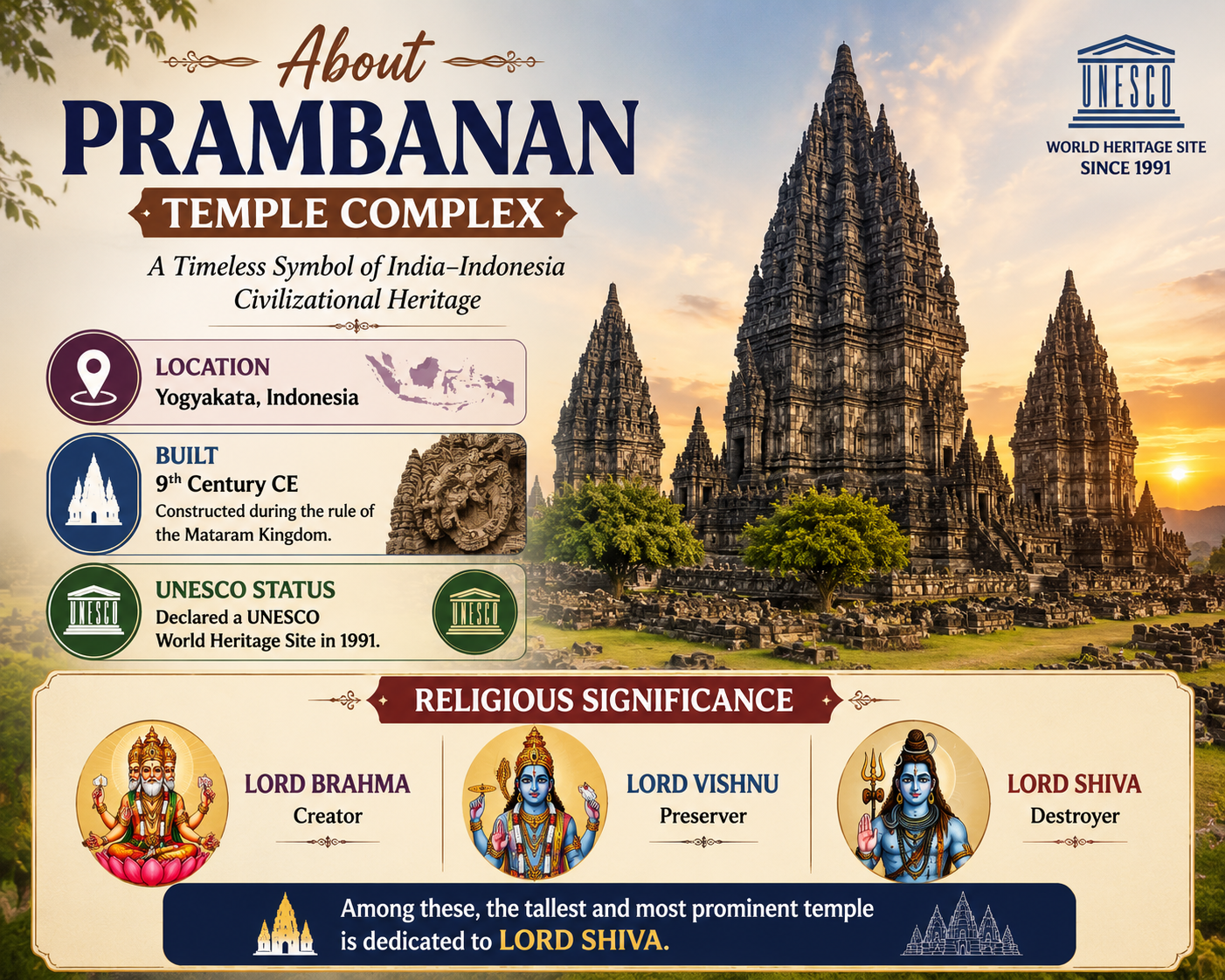
Architectural Features
-
Built using volcanic stone.
-
Excellent example of classical Hindu temple architecture.
-
Famous for its:
-
Tall pointed towers (Shikharas)
-
Intricate stone carvings
-
Sculptures depicting scenes from the Ramayana and Bhagavata Purana.
-
The temple complex originally contained over 240 temples.
Cultural Importance
The temple reflects:
-
Spread of Indian culture and Hindu civilization to Southeast Asia.
-
Ancient maritime and trade links between India and Indonesia.
-
Shared traditions in religion, art, architecture and literature.
-
Strong historical influence of Sanskrit and Hindu epics in Indonesian culture.
Even today, Indonesia preserves many elements of Hindu heritage despite being the world's largest Muslim-majority country.
India's Restoration Initiative
The restoration project aims to:
-
Preserve the structural integrity of the temple.
-
Restore damaged heritage structures.
-
Use scientific conservation techniques.
-
Protect the monument for future generations.
-
Strengthen cultural diplomacy between India and Indonesia.
The project demonstrates India's expertise in archaeological conservation and heritage preservation.
-
During bilateral discussions: Both leaders agreed to explore India's assistance in restoring temples within the Prambanan complex. This understanding has now been translated into action through the ASI project.
India's Role in Heritage Conservation Abroad
India has emerged as a trusted partner in restoring cultural heritage across Southeast Asia.
Archaeological Survey of India (ASI) has contributed to:
-
Documentation of the Borobudur Temple Compounds in Indonesia.
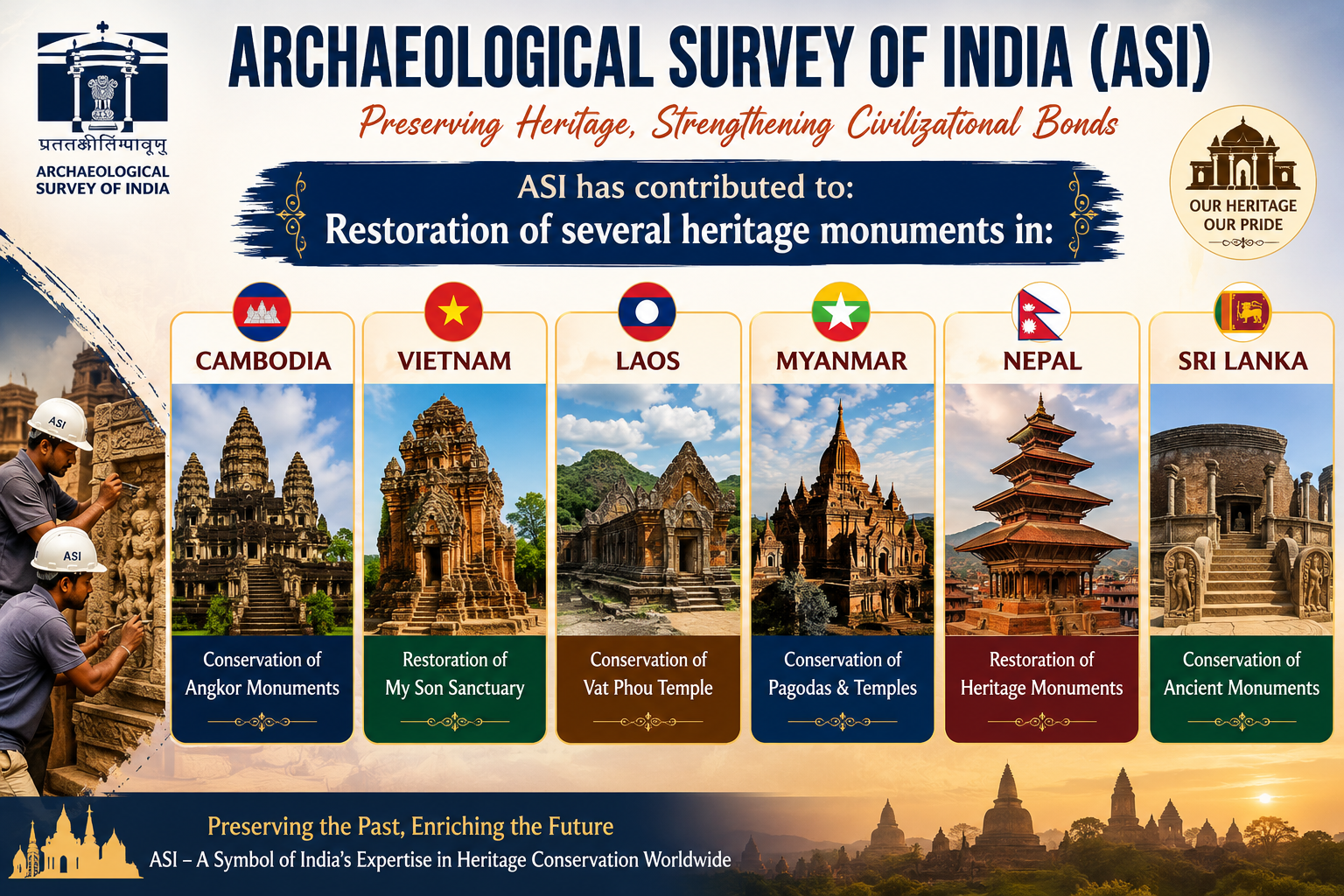
India's conservation projects promote the protection of shared Asian heritage.
Significance for India
-
Cultural Diplomacy: Strengthens India's soft power through heritage conservation.
-
Act East Policy: Reinforces India's engagement with Southeast Asian countries.
-
Civilizational Connect: Revives historical links dating back over a thousand years.
-
Heritage Conservation: Showcases India's globally recognized expertise in archaeological restoration.
-
Bilateral Relations: Deepens India–Indonesia cooperation beyond trade and defence.
Cultural Relations Between India and Indonesia
India and Indonesia share one of the oldest civilizational relationships in Asia, spanning over 2,000 years. Their connection is rooted in trade, religion, language, literature, art, and architecture rather than conquest.
1. Ancient Maritime Trade
-
Indian traders began sailing to the Indonesian archipelago around the 1st century CE.
-
They traded Spices (cloves, nutmeg, pepper), Textiles, Precious stones, Gold.
-
Along with goods, they carried Indian culture, languages, and religious ideas.
2. Spread of Hinduism and Buddhism
Between the 1st and 14th centuries CE:
-
Hinduism and Buddhism spread from India to Indonesia through merchants, scholars, and monks.
-
Several powerful kingdoms adopted Indian traditions, including:
-
Kutai Kingdom
-
Srivijaya Empire
-
Majapahit Empire
-
Mataram Kingdom
Today, Indonesia is home to some of the world's greatest Hindu and Buddhist monuments.
3. Magnificent Temple Heritage
Prambanan Temple
-
Largest Hindu temple complex in Indonesia.
-
Dedicated to the Trimurti:
-
Brahma
-
Vishnu
-
Shiva
Borobudur Temple
-
World's largest Buddhist monument.
-
Reflects Indian Buddhist philosophy and architecture.
These monuments symbolize the shared heritage of both countries.
4. Influence of Sanskrit
Many Indonesian words come from Sanskrit.
Examples:
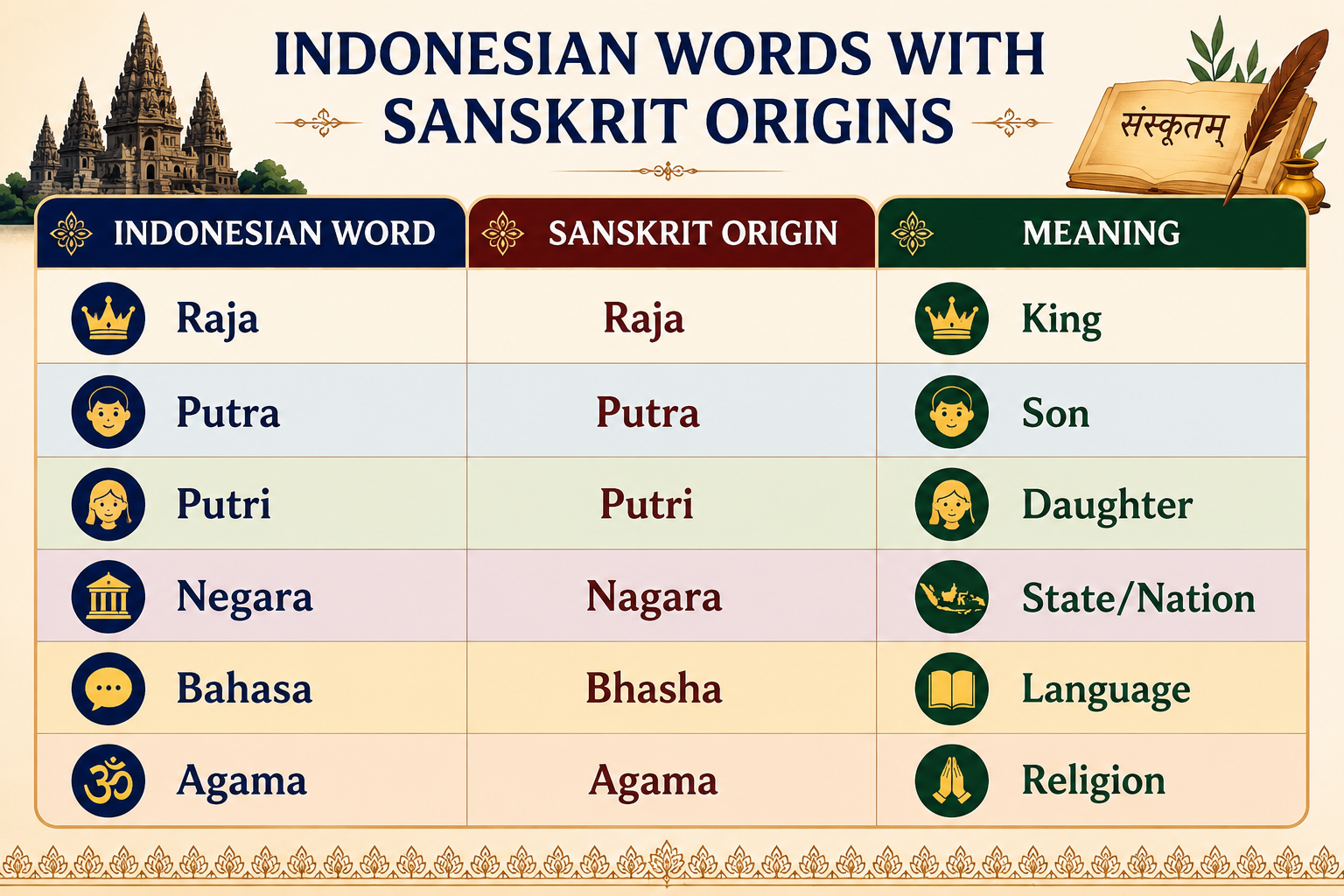
Many official institutions in Indonesia still use Sanskrit-derived names.
5. Ramayana and Mahabharata
Indian epics remain an integral part of Indonesian culture.
They are performed through:
-
Wayang Kulit (Shadow Puppet Theatre)
-
Traditional dance dramas
-
Temple festivals
-
Cultural performances
The Ramayana Ballet at Prambanan Temple is one of Indonesia's most famous cultural attractions.
6. Bali – A Living Hindu Civilization
-
Bali is predominantly Hindu.
-
Around 85–90% of Bali's population follows Balinese Hinduism.
-
Daily rituals, temples, festivals, and customs reflect Indian cultural influence while evolving into a unique local tradition.
Major festivals include: Nyepi (Day of Silence), Galungan, Kuningan
7. National Symbols Influenced by Indian Culture
-
Indonesia's national emblem is Garuda, inspired by the divine eagle from Hindu mythology.
-
The national airline is also named Garuda Indonesia.
-
The national motto:
-
"Bhinneka Tunggal Ika" comes from an Old Javanese poem influenced by Sanskrit traditions and means:
-
"Unity in Diversity." India later adopted a similar principle through its own celebration of unity amid diversity.
8. Shared Art and Architecture
-
Indian influence is visible in Temple architecture, Sculpture, Classical dance, Traditional music, Stone carvings, Ancient inscriptions. Many inscriptions are written in Sanskrit using Indian scripts.
9. Shared Democratic and Strategic Partnership
Beyond culture, both countries:
-
Are major Indo-Pacific democracies.
-
Work together in forums such as:
-
ASEAN-led mechanisms
-
East Asia Summit
-
G20
-
Indian Ocean Rim Association (IORA)
-
Cooperate in maritime security, trade, defence, and connectivity.
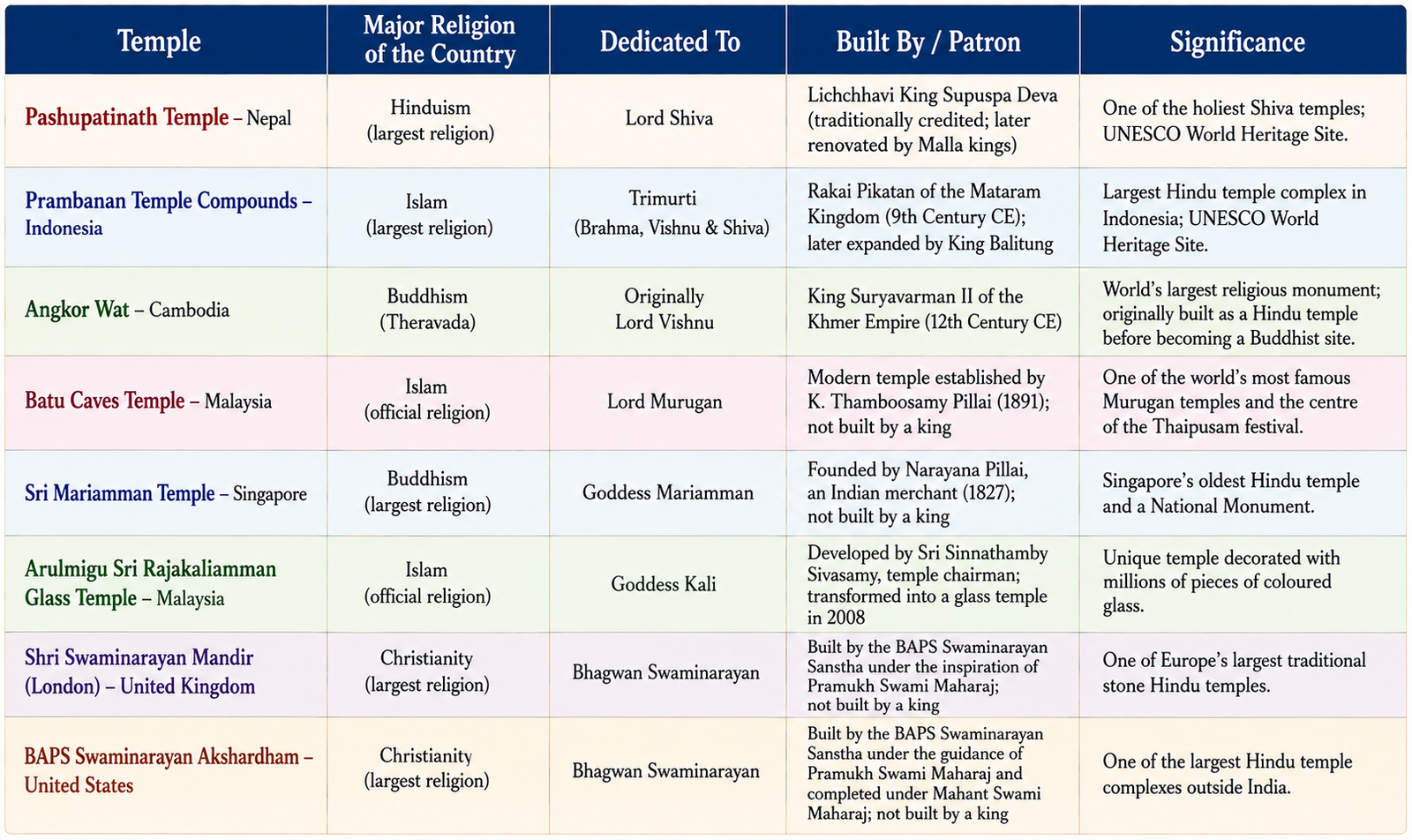
Hindu Temples in other part of the World: