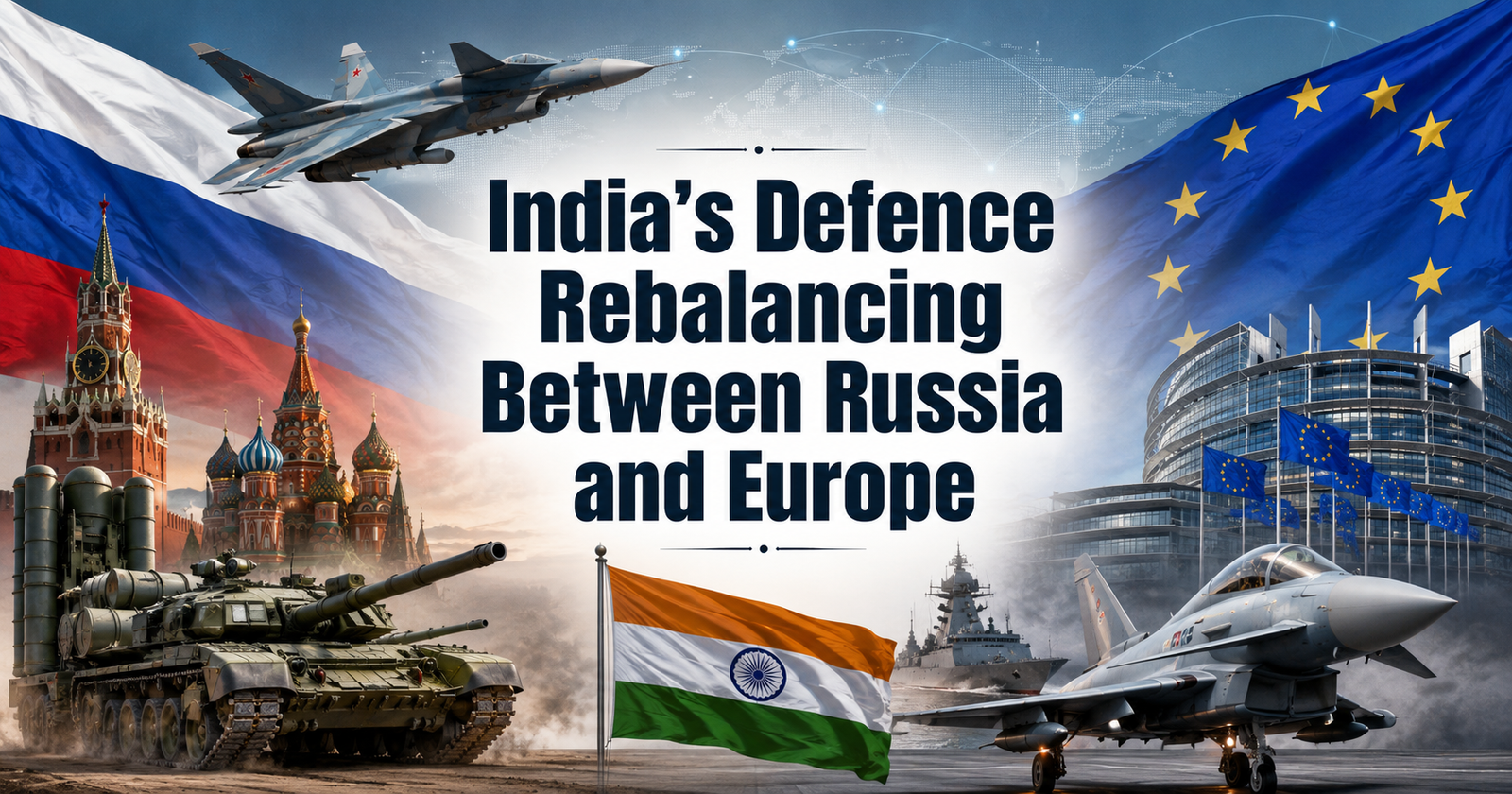
India’s defence strategy is evolving as it balances long-standing ties with Russia and expanding partnerships with Europe, focusing on strategic autonomy, defence modernisation, technology collaboration, and indigenous military manufacturing capabilities.
Syllabus Areas:GS II - International Relations GS III - Science & Technology (Defence Technology) |
India’s defence policy is undergoing a gradual but significant transformation. For decades, Russia remained India’s primary defence partner, supplying fighter aircraft, tanks, submarines, missile systems, and strategic military technology. However, changing geopolitical realities, supply-chain disruptions caused by the Ukraine conflict, technological requirements, and India’s long-term strategic ambitions are pushing New Delhi towards a more diversified defence partnership model.
Today, India is increasingly expanding defence cooperation with European countries such as France, Germany, and other members of the European Union while simultaneously maintaining its long-standing relationship with Russia. This shift reflects India’s attempt to balance strategic autonomy, national security interests, and defence modernization in an increasingly uncertain global order.
Historical Background of India–Russia Defence Relations
Since the Cold War era, the Soviet Union and later Russia played a central role in India’s defence preparedness.
Key Features of the Partnership
-
Nearly 60–70% of India’s military equipment has Russian or Soviet origin.
-
Russia supported India during crucial geopolitical moments, including the 1971 Indo-Pakistan war.
-
India acquired advanced platforms such as:
-
Sukhoi fighter aircraft
-
T-90 tanks
-
MiG aircraft
-
S-400 missile systems
-
Nuclear submarine leasing arrangements
Why Russia Became India’s Trusted Partner
-
Russia was willing to transfer sensitive technologies.
-
Western countries often imposed sanctions or restrictions on India.
-
Soviet weapons were comparatively affordable and suited Indian operational requirements.
As a result, Russia became deeply integrated into India’s military infrastructure.
Why India is Rebalancing its Defence Strategy
Although Russia remains an important strategic partner, several recent developments have compelled India to diversify its defence partnerships.
1. Impact of the Russia–Ukraine War
The Ukraine conflict exposed the vulnerabilities of overdependence on a single defence supplier.
Major Concerns for India
-
Delay in delivery of defence equipment and spare parts
-
Disruption in supply chains
-
Financial transaction difficulties due to Western sanctions
-
Reduced Russian industrial capacity because of wartime requirements
India realized that excessive dependence on one supplier could create operational risks during crises.
2. Need for Advanced Defence Technology
Modern warfare increasingly depends on:
-
Artificial intelligence
-
Cyber capabilities
-
Drone systems
-
Electronic warfare
-
Space-based surveillance
-
Precision weapon systems
European countries, especially France and Germany, possess advanced technologies in several of these areas. India is therefore seeking partnerships that provide:
-
technological collaboration
-
joint production
-
research partnerships
-
industrial cooperation
3. India’s Push for Defence Indigenisation
The “Atmanirbhar Bharat” initiative aims to strengthen domestic defence manufacturing.
India no longer wants to remain merely an importer of weapons. Instead, it seeks:
-
local manufacturing
-
technology transfer
-
co-development of platforms
-
export-oriented defence production
European partnerships are increasingly attractive because many European countries are open to collaborative manufacturing models.
4. Geopolitical Multipolarity
India’s foreign policy is based on strategic autonomy rather than military alliances.
In the emerging multipolar world:
-
India wants to maintain ties with Russia,
-
deepen relations with Europe,
-
strengthen partnerships with the United States,
-
and simultaneously protect its independent decision-making capacity.
Diversification helps India avoid excessive dependence on any single bloc.
Growing Defence Cooperation with Europe
France: India’s Most Important European Defence Partner
France has emerged as one of India’s closest strategic partners.
Areas of Cooperation
-
Rafale fighter aircraft
-
Scorpene submarines
-
Maritime security cooperation
-
Indo-Pacific strategy
-
Space and cyber collaboration
Why France is Important for India
France consistently supports India’s strategic autonomy and generally avoids intrusive political conditions in defence cooperation.
India also sees France as a reliable long-term partner in the Indo-Pacific region.
Germany’s Emerging Role
Germany is gradually increasing engagement with India in defence and industrial cooperation.
Key Areas
-
Naval cooperation
-
Green defence technologies
-
Industrial manufacturing partnerships
-
Supply-chain resilience
Germany’s strong industrial ecosystem complements India’s manufacturing ambitions.
Wider European Union Engagement
The European Union is becoming strategically important for India due to:
-
technological innovation,
-
clean energy transition,
-
critical mineral partnerships,
-
semiconductor cooperation,
-
and defence-industrial collaboration.
India views Europe not merely as a market but as a strategic technology partner.
Challenges in India’s Defence Rebalancing
1. Dependence on Existing Russian Systems
A large portion of India’s armed forces still relies on Russian-origin equipment.
This creates practical challenges because:
-
maintenance systems are Russian-linked,
-
spare parts are sourced from Russia,
-
training infrastructure is built around Russian platforms.
A sudden shift away from Russia is therefore neither feasible nor strategically desirable.
2. Cost of Western Defence Platforms
European and Western defence systems are often more expensive than Russian equipment.
This raises concerns regarding:
-
affordability,
-
long-term maintenance costs,
-
operational integration.
India must carefully balance modernization with fiscal realities.
3. Strategic Sensitivities
India must manage diplomatic balance carefully.
If India moves too rapidly toward Western defence ecosystems:
-
Russia may deepen military ties with China,
-
strategic trust between India and Russia may weaken,
-
regional geopolitical calculations may shift unfavorably.
Therefore, India’s approach remains cautious and calibrated.
Strategic Importance for India
1. Reducing Vulnerability: Diversification minimizes risks arising from sanctions, wars, or supply disruptions.
2. Technological Modernization: Partnerships with Europe can accelerate India’s access to advanced military technologies.
3. Strengthening Domestic Manufacturing: Joint ventures and technology transfers support India’s defence industrial base.
4. Preserving Strategic Autonomy: India seeks partnerships without entering formal military alliances.
India’s defence rebalancing between Russia and Europe is not a sudden strategic shift but a carefully calibrated adaptation to changing global realities. Russia continues to remain an important defence partner, but India is increasingly recognizing the importance of diversification, technological modernization, and supply-chain resilience.
By strengthening defence cooperation with European nations while maintaining independent strategic decision-making, India is attempting to build a more flexible, resilient, and future-ready national security architecture. The success of this approach will depend on India’s ability to balance diplomacy, indigenisation, economic capacity, and geopolitical interests in an increasingly competitive world order.
Prelims Questions:Q1. With reference to India’s defence imports, consider the following statements:
Which of the statements given above are correct? A. 1 and 2 only Answer: B. 1 and 3 only Explanation: Russia continues to remain a major defence supplier to India. However, India is increasingly diversifying towards countries such as France and other European partners. India still operates many Russian-origin systems, so statement 2 is incorrect. Q2. Which of the following defence platforms are correctly matched with their country of origin?
A. 1 and 2 only Answer: A. 1 and 2 only Explanation: Scorpene submarines are originally from France, not Germany. Q3. The term “Strategic Autonomy,” frequently seen in India’s foreign policy discourse, refers to: A. Complete military isolation from global powers Answer: C. Independent foreign policy decision-making based on national interest Explanation: Strategic autonomy means India avoids formal alliance dependency and retains freedom in foreign policy and strategic decisions. Q4. Which of the following factors have encouraged India to diversify its defence partnerships?
Select the correct answer using the code below: A. 1, 2 and 3 only Answer: A. 1, 2 and 3 only Explanation: Russia has not withdrawn from Asian geopolitics. The other factors are valid reasons behind India’s diversification efforts. Q5. With reference to the “Atmanirbhar Bharat” initiative in defence, consider the following statements:
Which of the statements given above are correct? A. 1 only Answer: B. 1 and 2 only Explanation: India allows foreign investment and collaboration in defence under regulated frameworks. Hence statement 3 is incorrect. Q6. France has emerged as a key defence partner for India primarily because:
Select the correct answer using the code below: A. 1 and 2 only Answer: A. 1 and 2 only Explanation: France has generally maintained stable strategic engagement with India and did not adopt the same restrictive posture as some Western countries after 1998. Q7. Which of the following best explains the strategic significance of defence diversification for India? A. It allows India to become part of NATO. Answer: B. It reduces operational vulnerability arising from overdependence on a single supplier. Q8. Consider the following statements regarding India–Europe defence cooperation:
Which of the statements given above are correct? A. 1 and 2 only Answer: D. 1, 2 and 3 |