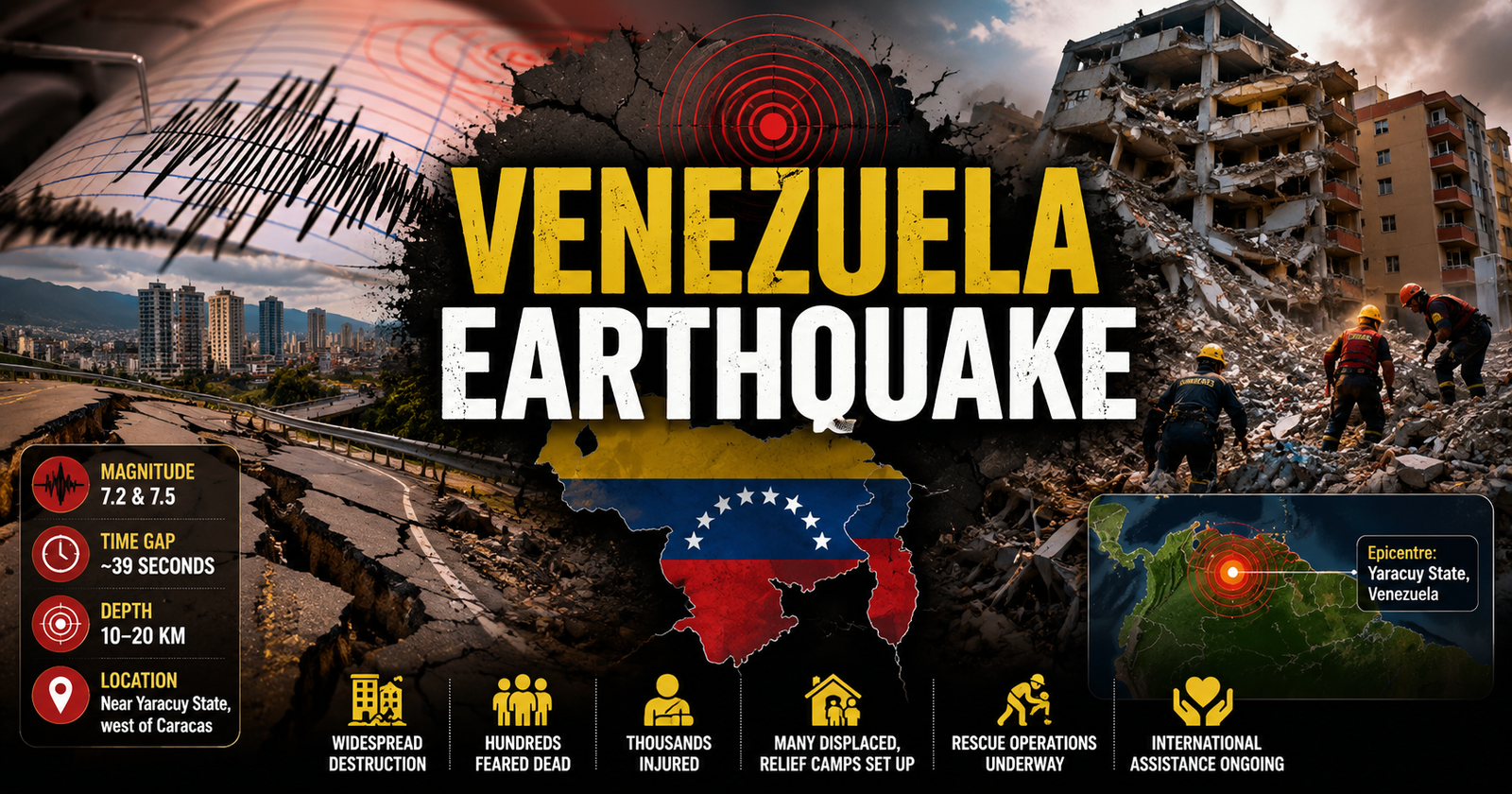
Explore the Venezuela Earthquake 2026 with its causes, tectonic setting, seismic waves, Android Earthquake Alerts, disaster impact, and UPSC-focused concepts explained in a simple, comprehensive manner.
Syllabus Areas:
GS I - Geography
GS III - Science and Technology
Venezuela was struck by two powerful earthquakes within seconds of each other on 24 June 2026, causing widespread destruction across northern Venezuela, including parts of Caracas and Yaracuy State. The shallow-focus earthquakes triggered the collapse of buildings, disrupted essential services, and prompted large-scale rescue operations.
Why did the earthquake occur in Venezuela?
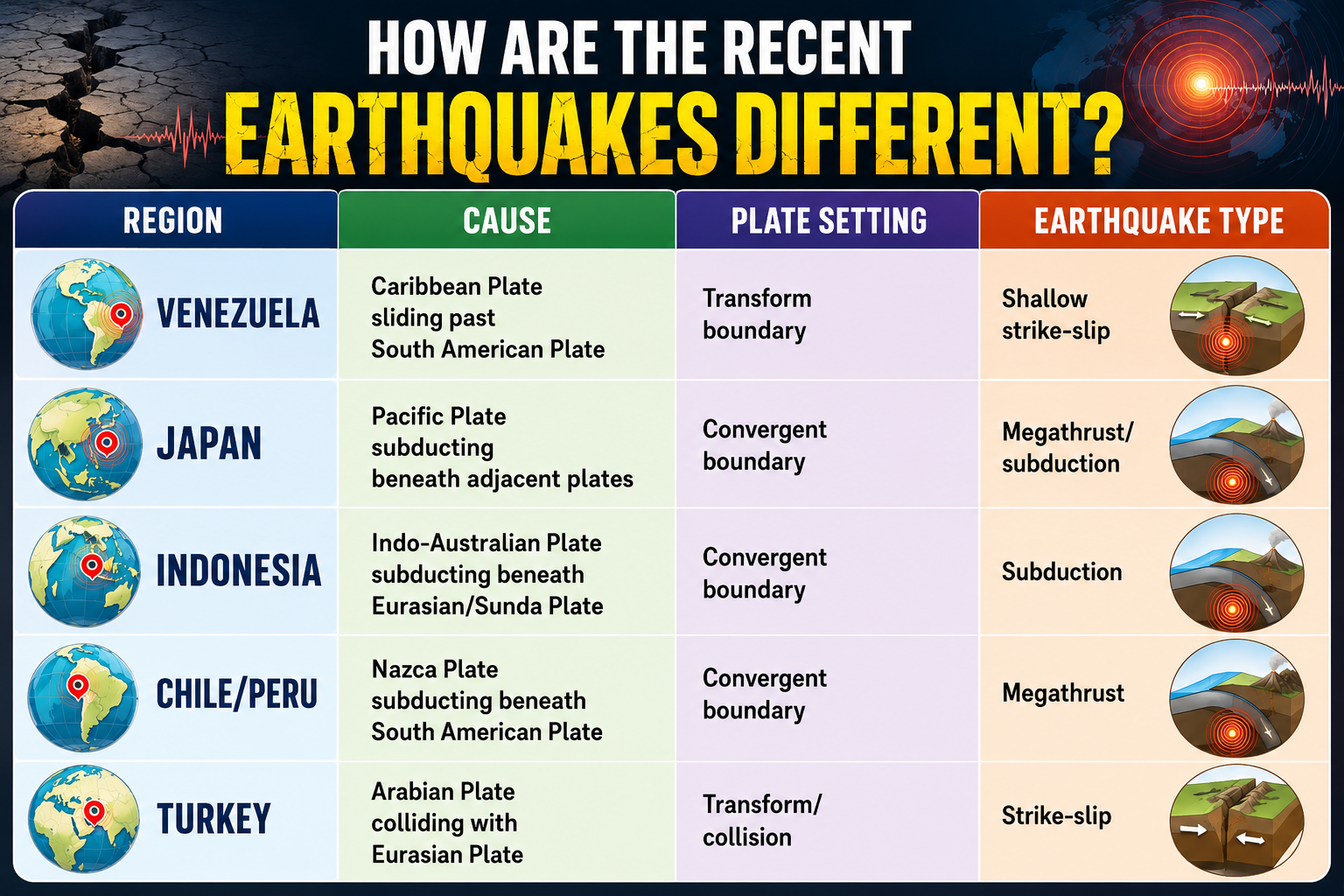
1. Venezuela lies on an active plate boundary
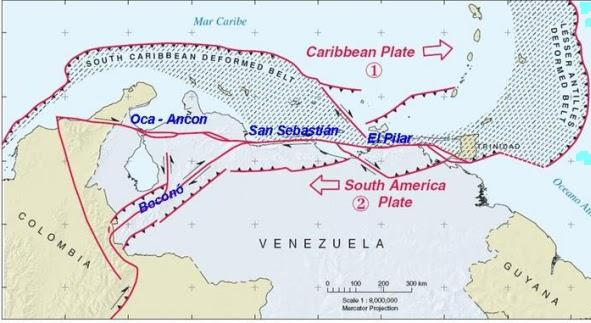
Northern Venezuela is situated at the boundary between the Caribbean Plate and the South American Plate.
-
The Caribbean Plate moves eastward relative to the South American Plate.
-
The relative motion is about 2 cm per year.
-
Although this movement is slow, enormous stress accumulates over decades or centuries.
2. Stress accumulated along major faults
The plate motion is accommodated by several large strike-slip faults, including:
-
Boconó Fault
-
San Sebastián Fault
-
El Pilar Fault
These faults remained locked for a long period, allowing elastic strain to build up. When the rocks could no longer withstand the stress, the fault ruptured suddenly, releasing vast amounts of seismic energy.
3. It was a shallow strike-slip earthquake
The 2026 earthquake was a shallow-focus strike-slip earthquake.
-
Shallow depth (around 10–20 km) means seismic waves had little distance to lose energy before reaching the surface.
-
Strike-slip motion involves horizontal movement of blocks of crust rather than one plate diving beneath another.
Shallow earthquakes generally produce much stronger ground shaking and greater damage.
4. A rare "seismic doublet"
One remarkable feature was that the event was a seismic doublet.
-
A Magnitude 7.2 earthquake occurred first.
-
Just 39 seconds later, a Magnitude 7.5 earthquake struck nearby.
Scientists believe the first rupture transferred stress to an adjacent fault segment, triggering the second earthquake almost immediately. This is uncommon but has been observed in a few major earthquakes worldwide
Simultaneous Earthquakes Around the World:
However, around the same time—within a few hours of the tremors in Venezuela — earthquakes also struck California (USA) and Japan. With earthquakes hitting three continents in such quick succession, a discussion has arisen regarding whether there is any connection between them.
Is there a relation?
Generally, no. Most earthquakes occur independently because each is caused by local tectonic stress along different plate boundaries or faults.
However, there are two important exceptions:
-
Same plate boundary or nearby fault system: One earthquake can trigger another through stress transfer (as happened in Venezuela's seismic doublet).
-
Remote dynamic triggering: Very large earthquakes (usually M8.5+) can sometimes trigger small earthquakes thousands of kilometres away by sending seismic waves through the Earth. This is rare and was not the case with the recent Venezuela earthquake.
How Google Warned Users Before the Quake?
Remarkably, many Android users in the affected region received a Google Earthquake Alert on their phones seconds before the strong shaking began, giving them valuable time to take protective action.
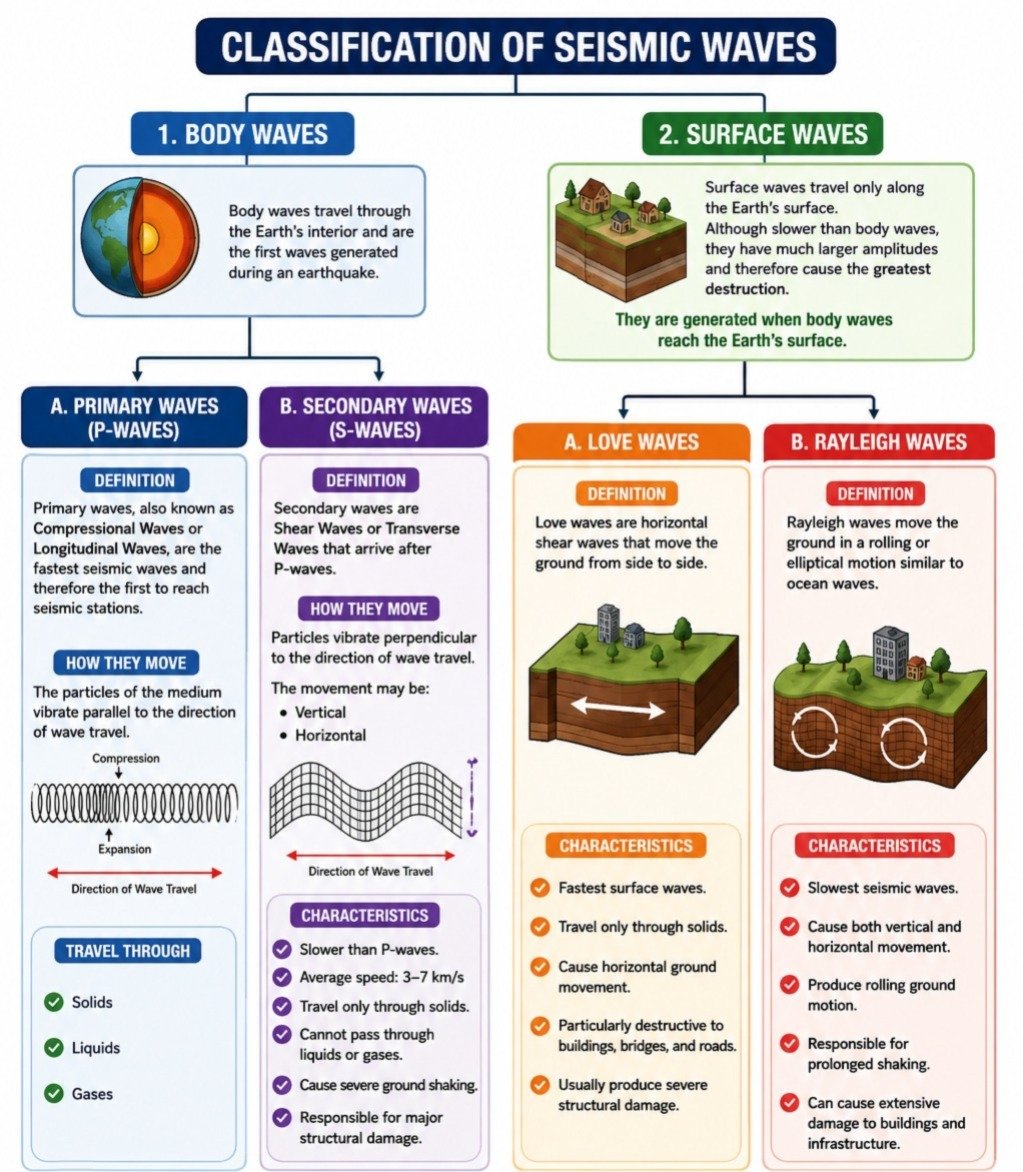
This is possible because earthquakes generate different types of seismic waves that travel at different speeds.
1. Primary Waves (P-Waves)
-
These are the first waves released during an earthquake.
-
They travel very fast—about 6 km per second.
-
They usually cause little damage.
2. Secondary Waves (S-Waves)
-
These travel more slowly—around 3 km per second.
-
They are much more destructive and cause the strong shaking that damages buildings and infrastructure.
Since P-waves travel faster than S-waves, there is a brief time gap between them. Google uses this gap to send early warnings.
How Does Google's Android Earthquake Alert System Work?
The system relies on the accelerometers built into millions of Android smartphones.
Step-by-Step Process
-
When an earthquake begins, nearby Android phones detect the fast-moving P-waves through their sensors.
-
These phones automatically send anonymous vibration data to Google's servers.
-
Google's algorithms quickly analyze the incoming data to confirm that an earthquake is occurring.
-
The system estimates the earthquake's location, magnitude, and the areas likely to be affected.
-
Android users who are farther away—but still in the earthquake's path—receive an alert before the slower, destructive S-waves arrive.
This warning may provide a few seconds to several tens of seconds of advance notice, depending on the user's distance from the epicenter.
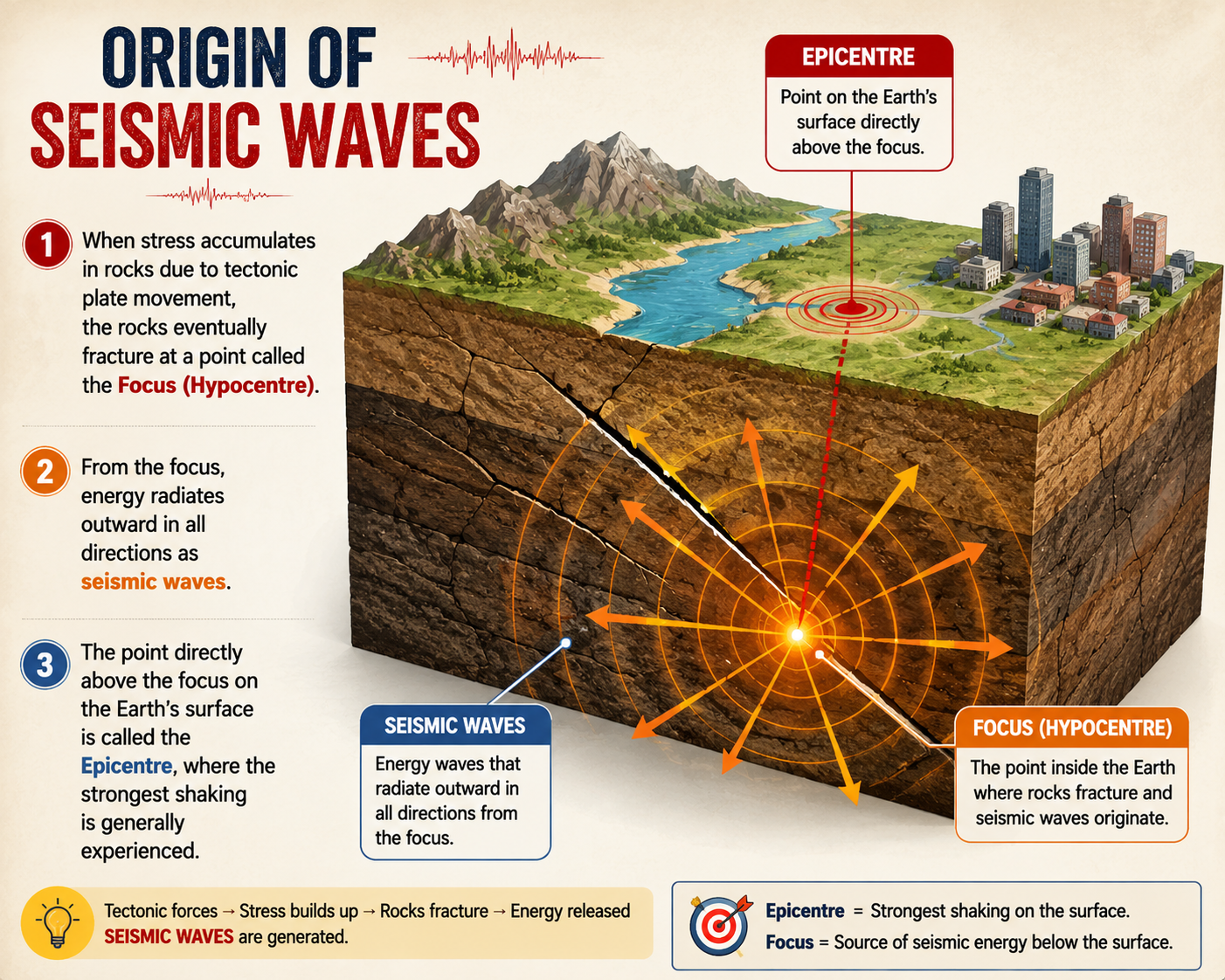
What is an Earthquake?
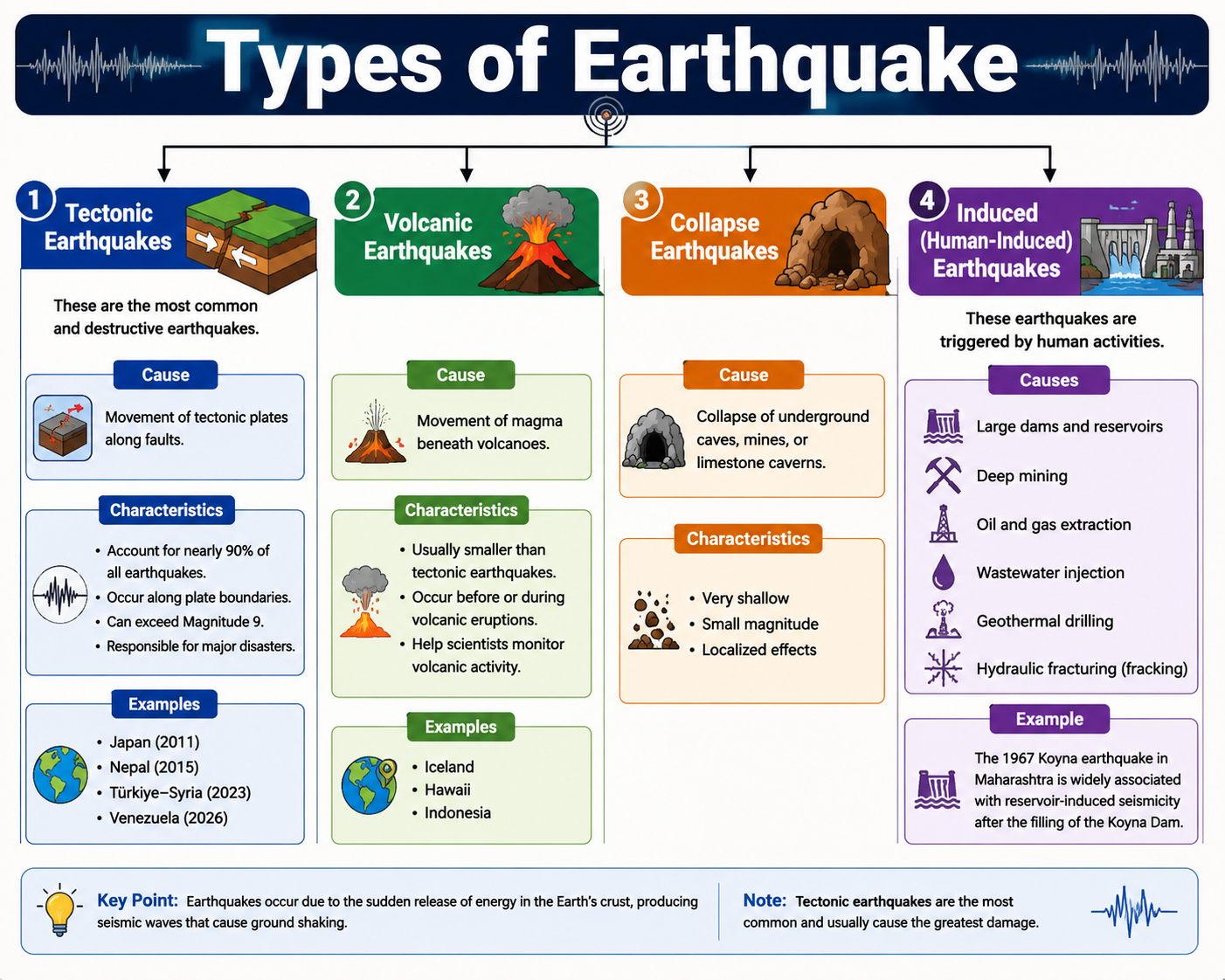
An earthquake is the sudden shaking of the Earth's surface caused by the rapid release of stored energy within the Earth's crust. This energy travels through the Earth in the form of seismic waves, producing ground shaking that may last from a few seconds to several minutes
Earthquakes occur mainly due to the movement of tectonic plates, but they may also result from volcanic activity, collapse of underground cavities, or human activities.
What are Seismic Waves?
Seismic waves are waves of energy released when rocks suddenly break or slip along a fault during an earthquake. These waves travel through the Earth's interior and along its surface, causing ground shaking. They also provide valuable information about the Earth's internal structure.
Origin of Seismic Waves
Prelims Questions:
1. Consider the following statements:
-
P-Waves can travel through solids, liquids and gases.
-
S-Waves can travel through solids and liquids.
-
Surface waves travel only along the Earth's surface.
Which of the statements given above are correct?
(a) 1 only
(b) 1 and 3 only
(c) 2 and 3 only
(d) 1, 2 and 3
Answer: (b)
2. Arrange the following seismic waves in the correct order of arrival after an earthquake:
-
Rayleigh Wave
-
S-Wave
-
Love Wave
-
P-Wave
Select the correct answer using the code below:
(a) 4 – 2 – 3 – 1
(b) 2 – 4 – 1 – 3
(c) 4 – 3 – 2 – 1
(d) 2 – 3 – 4 – 1
Answer: (a)