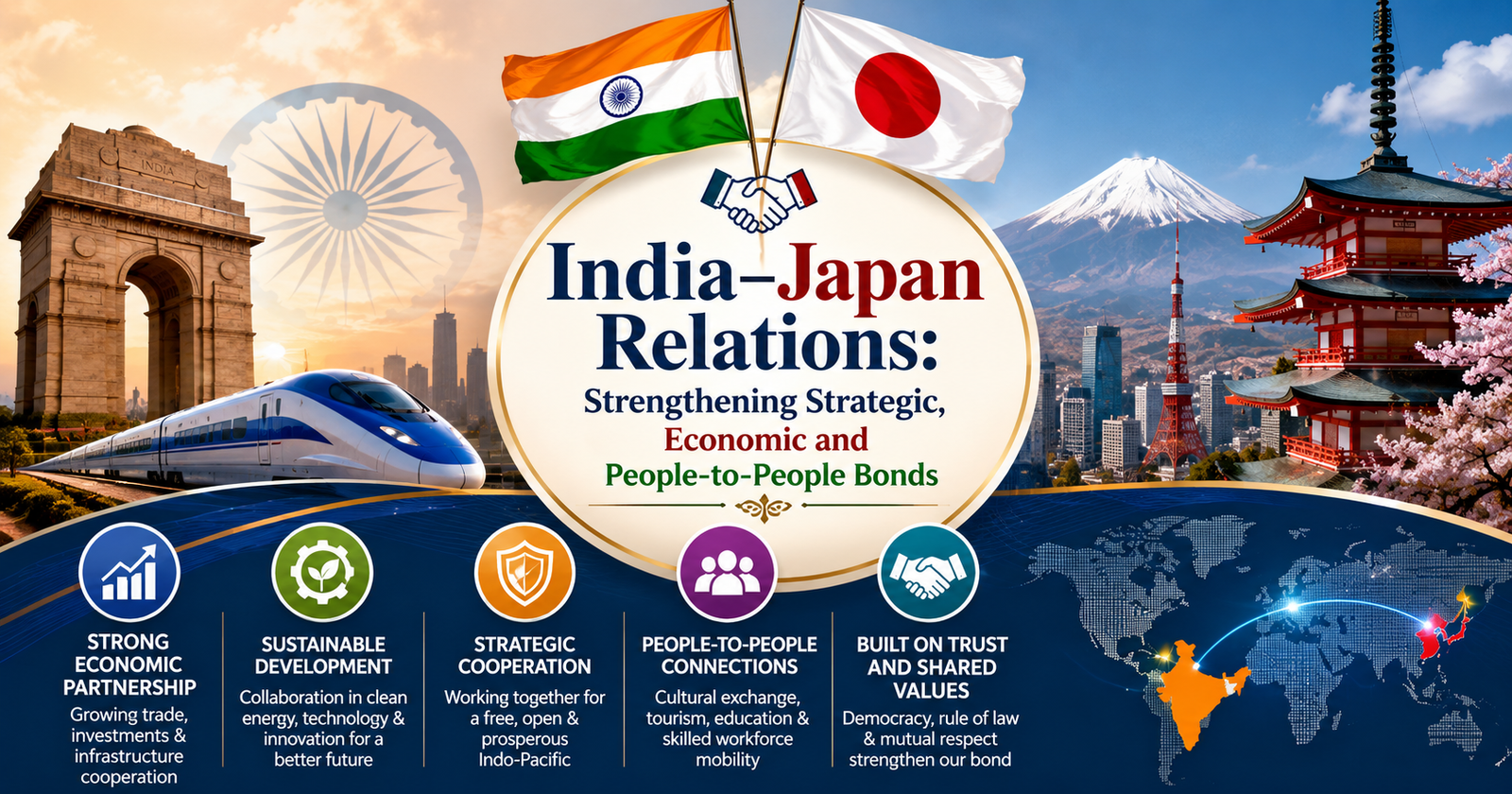
Explore the evolving India–Japan partnership covering strategic cooperation, trade, investments, infrastructure, tourism, skilled workforce mobility, and future opportunities shaping the Indo-Pacific region.
Syllabus Areas:
GS II - International Relations
GS III - S & T
India and Japan today share one of the most trusted and strategically significant partnerships in the Indo-Pacific region. Built on democratic values, mutual respect, economic cooperation, and shared strategic interests, the relationship has evolved from traditional diplomatic engagement into a Special Strategic and Global Partnership.
The growing cooperation is visible across trade, investment, infrastructure development, technology, tourism, skilled workforce mobility, and people-to-people exchanges. Japan's recent decision to recruit 50,000 skilled workers from Haryana over the next five years further reflects the deepening collaboration between the two countries.
With cumulative Japanese investments exceeding US$43 billion since 2000 and increasing collaboration in sectors such as manufacturing, semiconductors, digital technologies, clean energy, and infrastructure, India-Japan ties are becoming a major pillar of stability and economic growth in Asia.
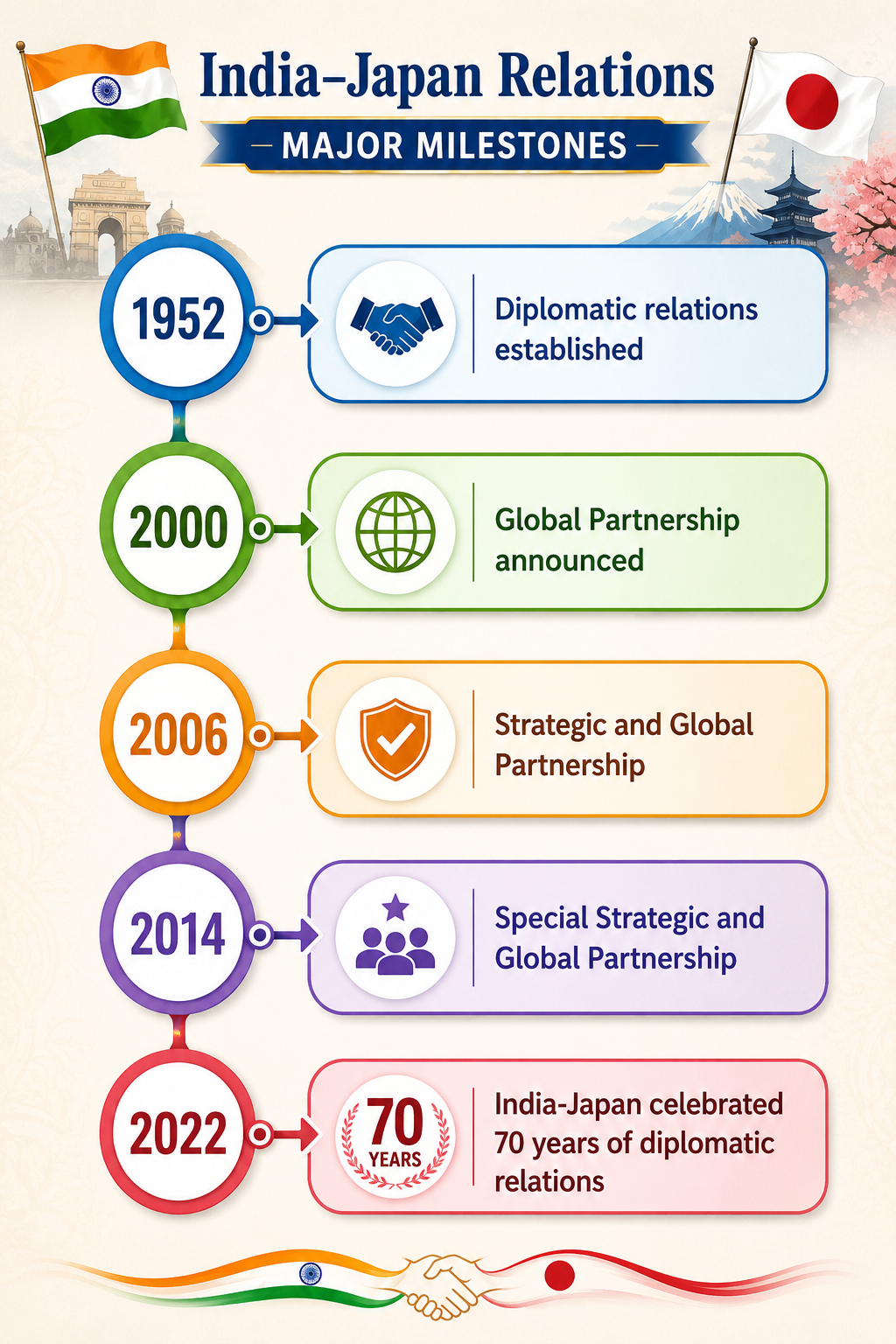
Evolution of India–Japan Relations
India and Japan established diplomatic relations in 1952, shortly after the Second World War. Over the decades, the relationship has steadily expanded.
Today, cooperation extends beyond bilateral interests to regional and global issues including:
-
Free and Open Indo-Pacific (FOIP)
-
Maritime security
-
Supply chain resilience
-
Climate change
-
Digital transformation
-
Emerging technologies
-
Defence cooperation
Skilled Workforce Partnership
One of the latest developments is Japan's decision to recruit 50,000 skilled workers from Haryana over the next five years.
This initiative addresses two major needs simultaneously:
For Japan
-
Aging population
-
Shrinking workforce
-
Labour shortages in manufacturing, healthcare and construction
For India
-
Employment opportunities
-
Higher income
-
International exposure
-
Skill development
-
Enhanced remittances
The agreement highlights growing confidence in India's skilled human resources.
Indian Community in Japan Continues to Grow
The Indian diaspora in Japan has expanded rapidly over the last few years.
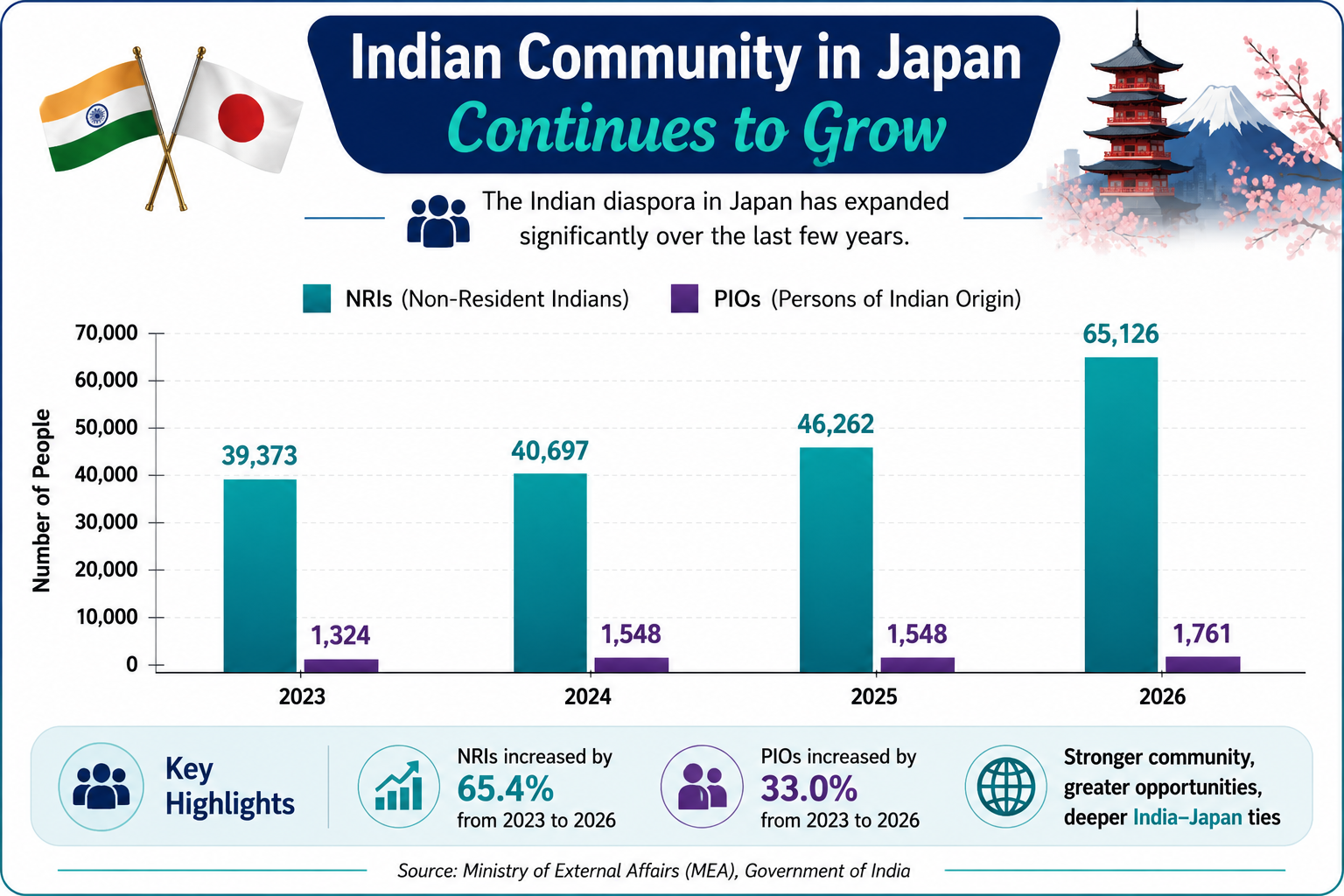
The sharp rise reflects:
-
Growing employment opportunities
-
Expansion of IT sector
-
Academic exchanges
-
Business investments
-
Skilled worker migration
A larger Indian community strengthens cultural understanding and business collaboration between the two countries.
Trade Relations: Growing but Imbalanced
India and Japan have steadily expanded bilateral trade.
However, India imports considerably more from Japan than it exports, resulting in a widening trade deficit.
Trend in Bilateral Trade
Indian Exports to Japan
Exports have shown gradual growth but remain modest.
Major exports include:
-
Petroleum products
-
Iron ore
-
Marine products
-
Chemicals
-
Textiles
-
Pharmaceuticals
-
Agricultural products
Imports from Japan
Imports have increased significantly.
Major imports include:
-
Machinery
-
Automobiles
-
Electronic equipment
-
Precision instruments
-
Industrial chemicals
-
Electrical machinery
Trade Deficit
India's trade deficit with Japan widened to approximately US$15.4 billion in 2025-26, indicating that imports continue to outpace exports.
Challenges
-
Limited diversification of Indian exports
-
High dependence on Japanese capital goods
-
Non-tariff barriers
-
Logistics costs
Opportunities
-
Electronics manufacturing
-
Semiconductors
-
Green technologies
-
Pharmaceuticals
-
Food processing
-
Digital economy
Japanese Official Development Assistance (ODA)
Japan has been India's largest bilateral development partner for decades.
Its Official Development Assistance (ODA) provides:
-
Long-term loans
-
Low interest rates
-
Infrastructure financing
-
Technology transfer
These funds support projects that significantly improve India's infrastructure.
Major ODA Projects
Delhi Metro: Japan International Cooperation Agency (JICA) financing transformed urban transportation.
Mumbai-Ahmedabad High-Speed Rail: India's first Bullet Train project.
Dedicated Freight Corridors: Enhancing logistics efficiency.
Metro Rail Projects
-
Chennai
-
Bengaluru
-
Ahmedabad
-
Kolkata
-
Delhi
Water Supply Projects
Urban development and sanitation.
Smart Cities
Support for sustainable urbanization.
Although new loan commitments have moderated in recent years, Japan continues to remain India's most trusted infrastructure financing partner.
Japanese Investment in India
Japan has emerged as one of India's largest foreign investors.
Cumulative Japanese FDI: US$43.28 billion (April 2000 – December 2024)
Global Ranking: Japan ranks as the 5th largest source of Foreign Direct Investment (FDI) into India.
Share: Approximately 6.02% of India's cumulative FDI.
Major Investment Sectors
-
Automobile manufacturing
-
Electronics
-
Industrial machinery
-
Renewable energy
-
Chemicals
-
Financial services
-
Logistics
-
Startups
-
Digital technologies
Bilateral Currency Swap Agreement
India and Japan maintain a US$75 billion Bilateral Currency Swap Agreement, valid until 2026.
Importance
-
Enhances financial stability
-
Supports foreign exchange liquidity
-
Reduces market volatility
-
Builds investor confidence
-
Strengthens macroeconomic cooperation
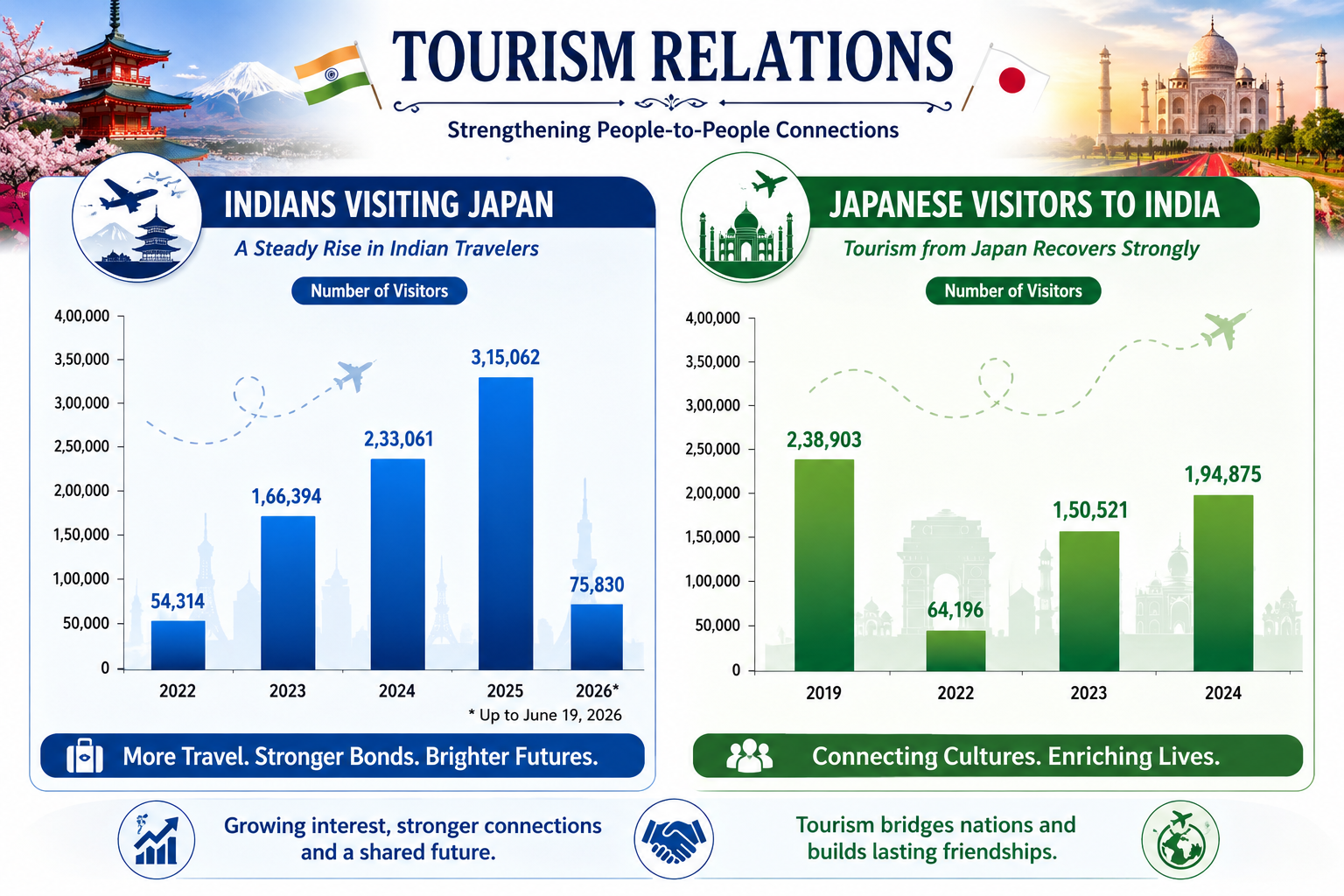
Tourism Relations
Tourism serves as an important pillar of people-to-people engagement.
Strategic Importance of India–Japan Relations
The partnership extends beyond economics.
-
Indo-Pacific Security: Both countries support Freedom of navigation, Rule-based international order, Maritime security, Peaceful resolution of disputes
-
Defence Cooperation: Joint military exercises include Dharma Guardian, JIMEX, Malabar Exercise (with the United States and Australia)
-
Supply Chain Resilience: India and Japan are working to reduce excessive dependence on single-country supply chains.
-
Semiconductor Cooperation: Joint initiatives focus on Chip manufacturing, Electronics ecosystem, Critical minerals, Advanced manufacturing
-
Clean Energy: Cooperation includes Green hydrogen, Renewable energy, Energy efficiency, Decarbonization technologies
Key Areas of Future Cooperation
-
Manufacturing: Expansion under the Make in India initiative.
-
Digital Economy: Artificial Intelligence, cybersecurity, fintech and digital infrastructure.
-
Healthcare: Medical technology and pharmaceutical collaboration.
-
Green Growth: Electric mobility and climate-friendly technologies.
-
Infrastructure: Industrial corridors, logistics parks and smart cities.
-
Education: Student exchanges, research partnerships and skill development.
Challenges in Bilateral Relations
Despite strong cooperation, certain issues remain.
-
Persistent trade imbalance
-
Slow progress in Free Trade Agreement utilisation
-
Limited awareness among SMEs
-
Supply chain disruptions
-
Global geopolitical uncertainties
-
Regional security concerns
Addressing these challenges will further strengthen bilateral cooperation.
Way Forward
To fully realise the potential of the partnership, India and Japan should focus on:
-
Expanding bilateral trade
-
Diversifying Indian exports
-
Enhancing semiconductor cooperation
-
Accelerating clean energy projects
-
Increasing educational exchanges
-
Promoting tourism
-
Deepening defence collaboration
-
Strengthening resilient supply chains
-
Facilitating greater mobility of skilled professionals
-
Encouraging innovation partnerships between startups
India–Japan relations have entered a transformative phase. From infrastructure financing and manufacturing investments to defence cooperation, tourism, skilled workforce mobility and digital technologies, the partnership has become multidimensional.
Japan's continued investments, infrastructure support through ODA, growing FDI, expanding Indian diaspora, increasing tourism, and enhanced strategic cooperation demonstrate the resilience of this relationship. While challenges such as the widening trade deficit remain, the enormous complementarities between the two economies present vast opportunities for future growth.
As Asia's two major democracies and leading Indo-Pacific partners, India and Japan are well-positioned to build stronger economic integration, promote regional stability, and contribute to a secure, prosperous and rules-based international order. The trajectory of their partnership suggests that the coming decade will witness even deeper collaboration, making India–Japan relations one of the defining strategic partnerships of the 21st century.