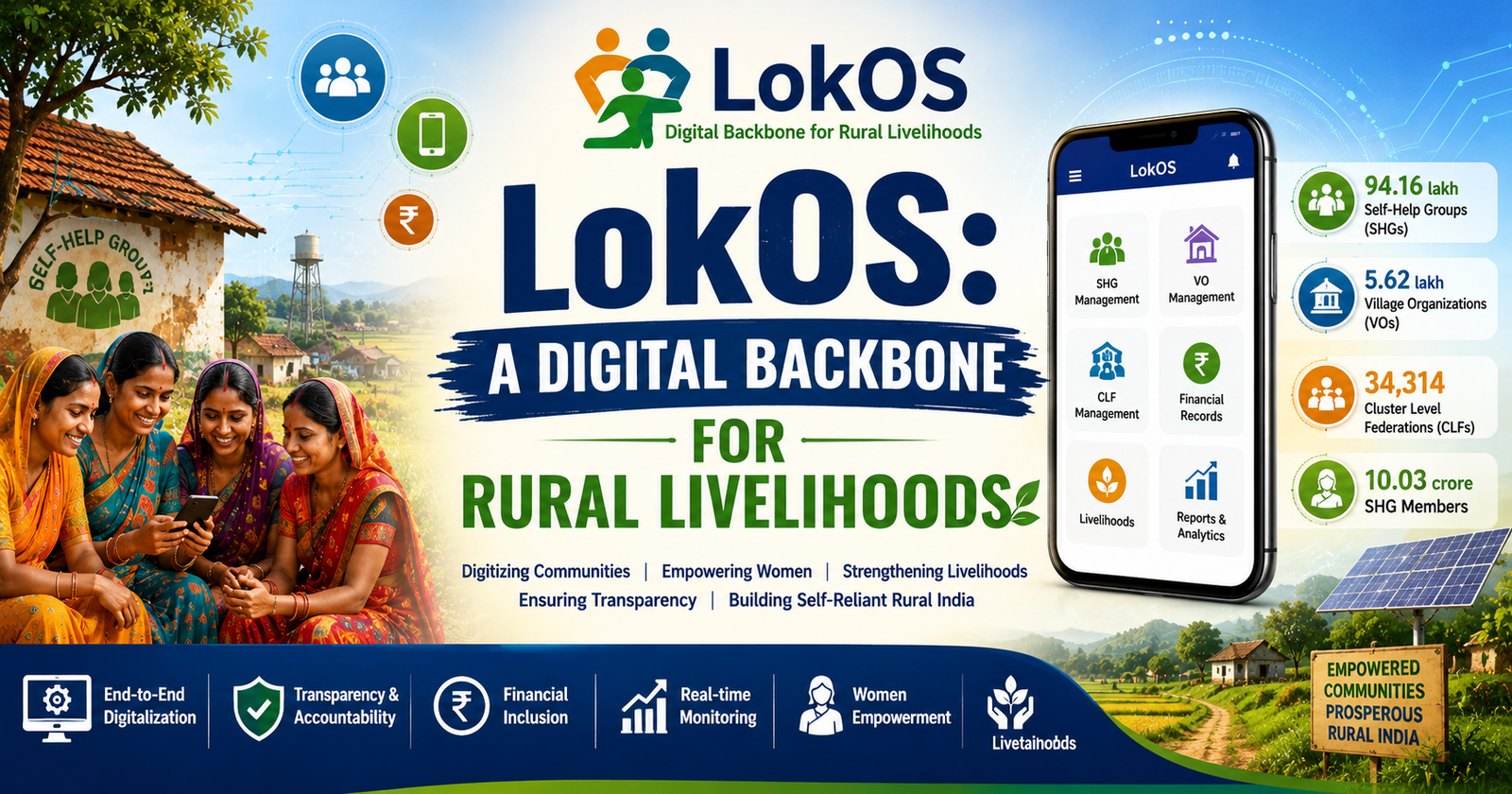
Discover how LokOS, under DAY-NRLM, is revolutionizing rural governance through digital transformation, empowering Self-Help Groups, promoting financial inclusion, transparency, and sustainable livelihoods across India.
Syllabus Areas:
GS II - Governance
GS III - Technology
LokOS (Lok = People, OS = Operating System) is a comprehensive web and mobile-based digital platform developed under the Deendayal Antyodaya Yojana – National Rural Livelihoods Mission (DAY-NRLM). It enables end-to-end digitization of Self-Help Groups (SHGs) and their federations, improving governance, transparency, financial inclusion, and rural livelihoods across India.
What is LokOS?
LokOS (Lok = People, OS = Operating System) is a web and mobile-based digital platform developed under the Deendayal Antyodaya Yojana – National Rural Livelihoods Mission (DAY-NRLM).
It aims to provide end-to-end digitization of Self-Help Groups (SHGs), their federations, and Community-Based Organizations (CBOs). The platform strengthens transparency, financial inclusion, governance, accountability, and livelihood planning across rural India.
Why LokOS Matters?
LokOS represents one of India's largest rural digital governance initiatives. By integrating financial management, enterprise development, community institution monitoring, and beneficiary tracking on a single platform, it enhances transparency, accountability, and efficiency under DAY-NRLM while accelerating women's empowerment and sustainable rural livelihoods.
About DAY-NRLM
The Deendayal Antyodaya Yojana – National Rural Livelihoods Mission (DAY-NRLM) is the flagship poverty alleviation programme of the Government of India.
Objectives
-
Promote self-employment
-
Generate skilled employment
-
Strengthen women's Self-Help Groups
-
Improve financial inclusion
-
Create sustainable rural livelihoods
LokOS acts as the digital backbone of this mission.
Objectives of LokOS
LokOS has been designed to:
-
Digitize SHGs and Community-Based Organizations
-
Maintain digital member profiles
-
Track savings, loans and repayments
-
Improve financial transparency
-
Enable real-time monitoring
-
Reduce manual paperwork
-
Improve governance and operational efficiency
-
Support convergence with government welfare schemes
-
Promote digital financial management
Digital Features of LokOS
1. End-to-End Digital Management
-
Registers SHGs
-
Registers Village Organizations (VOs)
-
Registers Cluster Level Federations (CLFs)
-
Maintains complete member records
2. Unique Digital IDs
LokOS generates Aadhaar-linked IDs, Bank-linked Digital IDs. This ensures authentic identification of community institutions and members.
3. Digital Financial Records
The platform records Savings, Loans, Repayments, Internal lending, Other financial transactions. This improves financial transparency and audit readiness.
4. Livelihood Profiling
Captures information on Occupation, Livelihood activities, Income sources, Government scheme linkage. This supports better livelihood planning.
5. Role-Based Administration
Different levels receive different access Village level, Block level, District level, State level, National level. This enables efficient approvals, monitoring and reporting.
6. Real-Time Analytics
Provides Dashboards, Instant reports, Performance tracking, Decision-support tools. This enables evidence-based policymaking.
Web and Mobile Applications
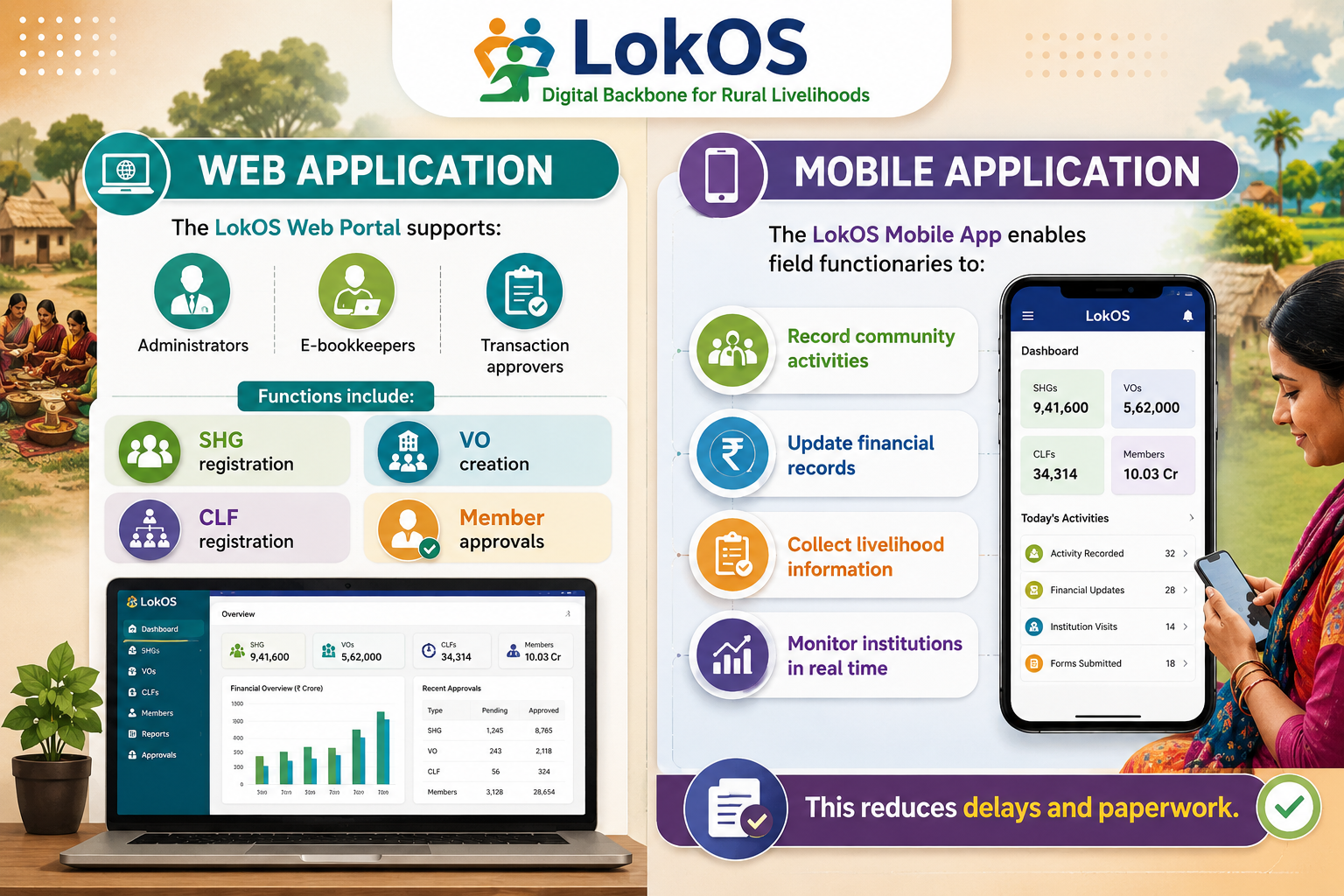
SHE-LEAPS Platform
LokOS also hosts SHE-LEAPS (Self-Help Entrepreneur–Livelihoods and Enterprise Application for Prosperity and Sustainability).
Purpose
Supports women entrepreneurs by providing:
-
Enterprise creation
-
Business management
-
Performance tracking
-
Enterprise monitoring
It covers both:
-
Farm enterprises
-
Non-farm enterprises
The platform helps build resilient rural entrepreneurship
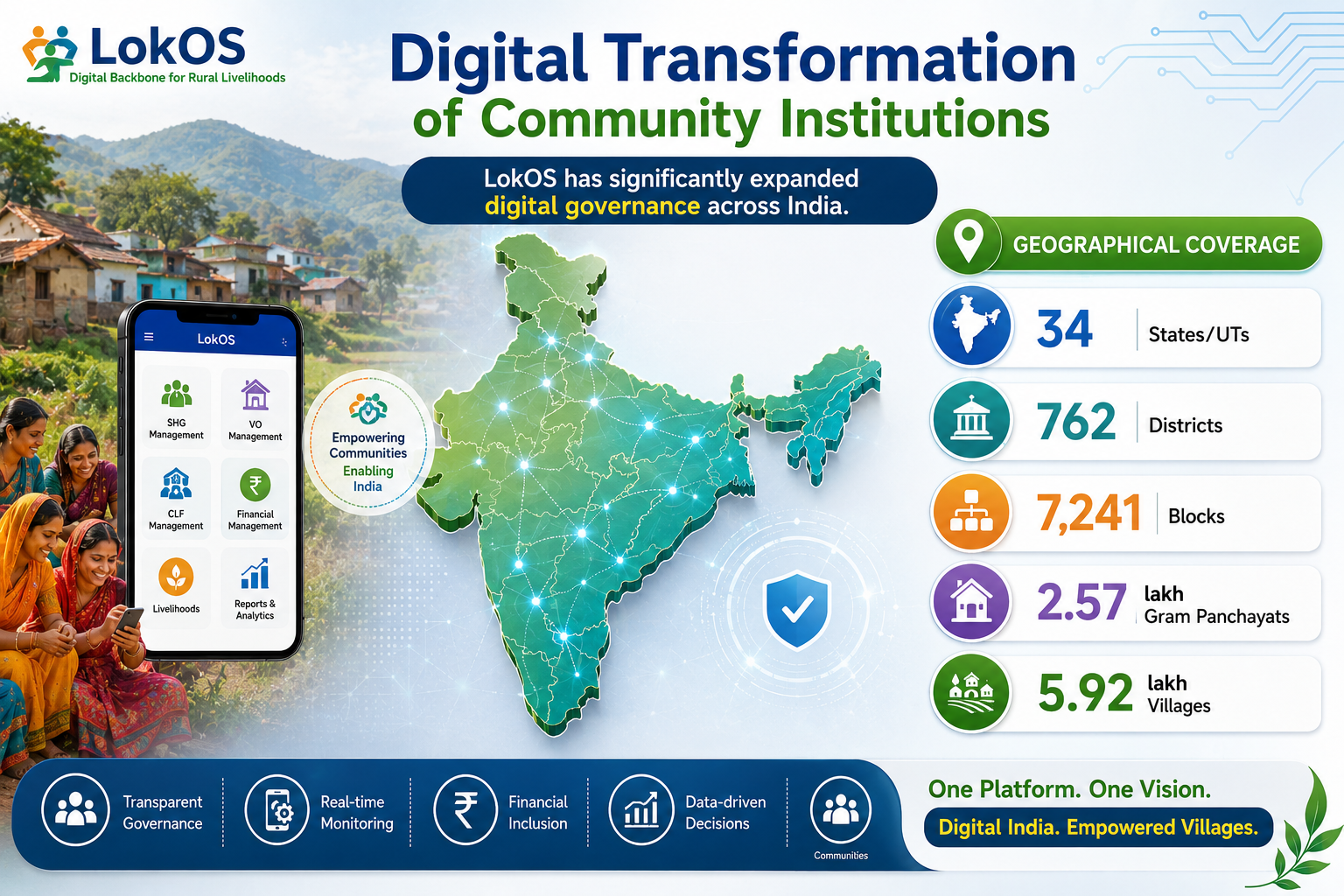
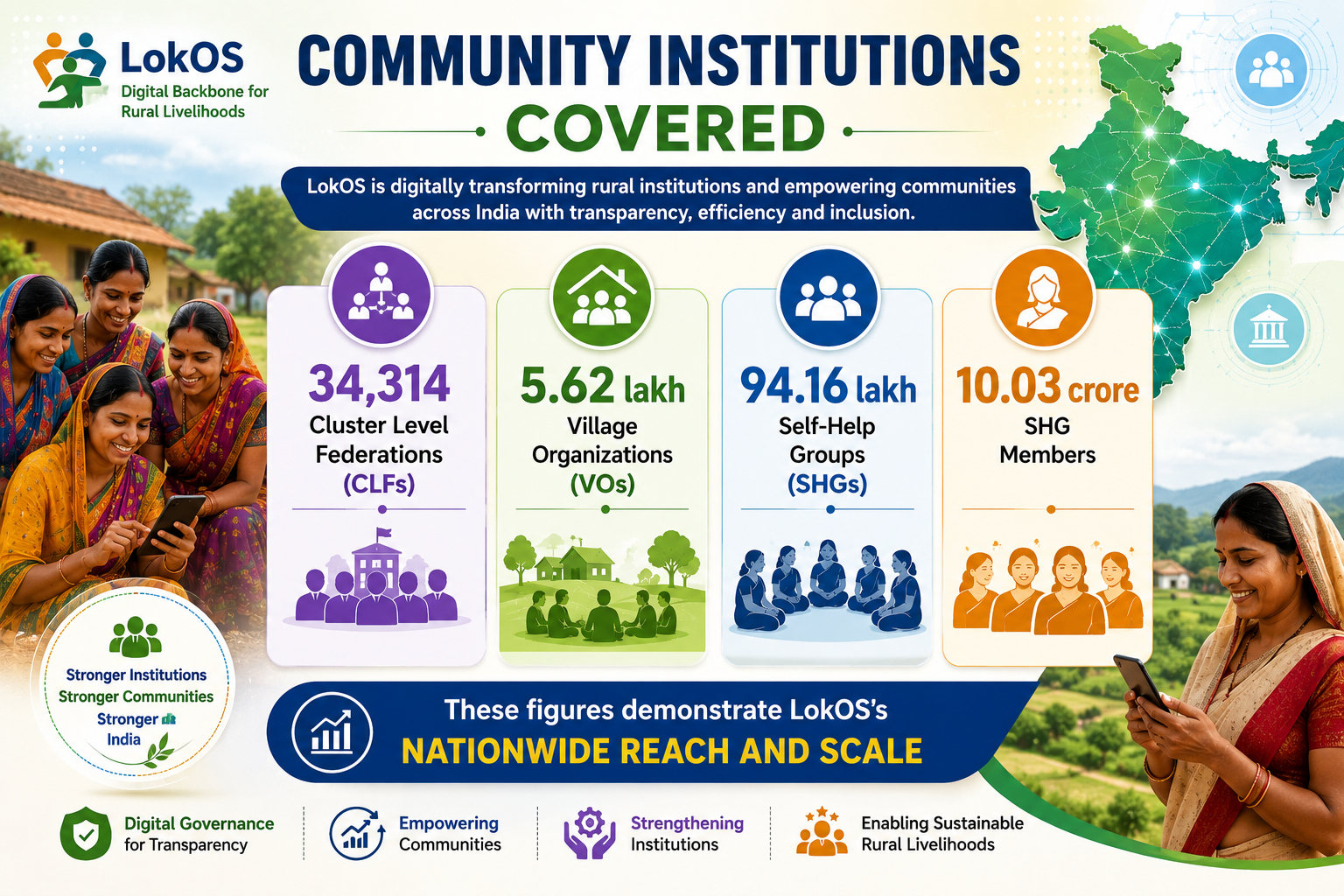
Digital Transformation of Community Institutions
LokOS has significantly expanded digital governance across India
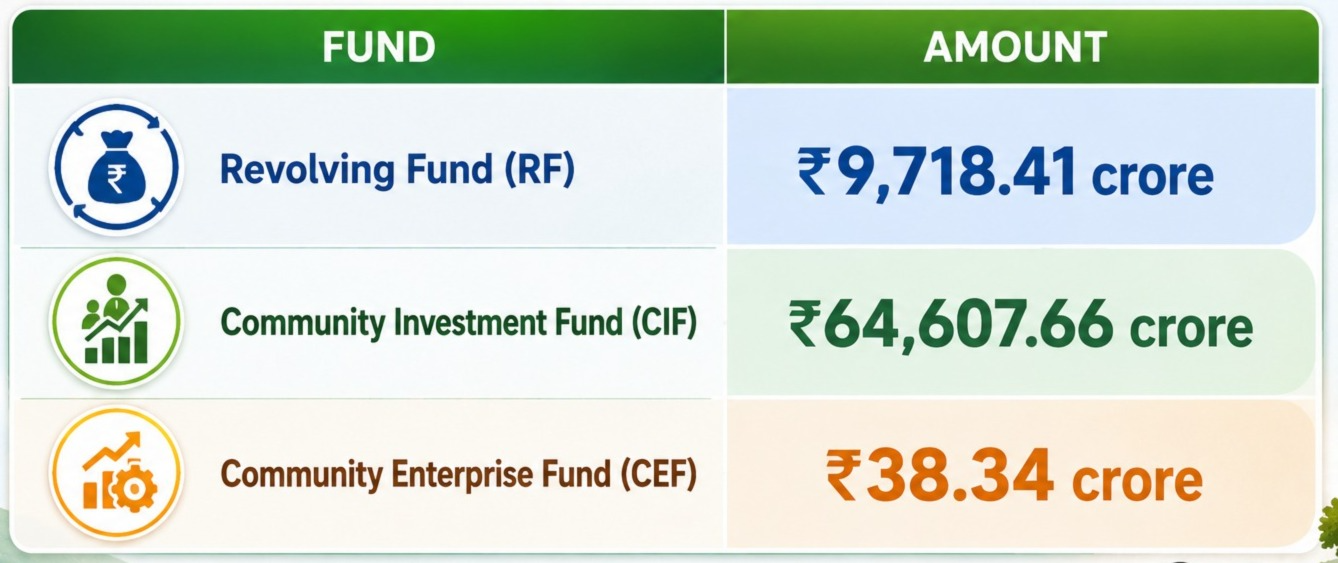
Financial Support Tracked Through LokOS
The platform digitally tracks major financial assistance provided under DAY-NRLM.
LokOS and Lakhpati Didi Initiative
LokOS supports the Lakhpati Didi Mission by enabling:
-
Beneficiary identification
-
Digital monitoring
-
Progress tracking
-
Outreach management
Current ecosystem includes:
-
6,611 Master Trainers
-
4.09 lakh Community Resource Persons (CRPs)
-
3.87 crore Potential Lakhpati Didis (PLDs)
The platform also maintains:
-
18.50 crore Digital Aajeevika Registers (DARs)
These digital records strengthen livelihood planning and programme implementation.
Importance of LokOS
LokOS contributes to:
-
Digital governance
-
Financial inclusion
-
Women's economic empowerment
-
Rural entrepreneurship
-
Transparent fund utilization
-
Real-time monitoring
-
Better policy implementation
-
Data-driven administration
-
Stronger Self-Help Group ecosystem
It serves as a digital backbone for India's rural development architecture.
LokOS is transforming rural governance through end-to-end digitalization, strengthening transparency, financial inclusion, and women's empowerment while enabling efficient implementation of DAY-NRLM and building sustainable, self-reliant rural communities across India.
Prelims Questions:
Q1. Consider the following statements regarding LokOS:
-
It is a digital platform developed under the Deendayal Antyodaya Yojana–National Rural Livelihoods Mission (DAY-NRLM).
-
It provides end-to-end digitization of Self-Help Groups (SHGs) and Community-Based Organizations (CBOs).
-
It has been developed by the Ministry of Electronics and Information Technology.
Which of the statements given above is/are correct?
A. 1 and 2 only
B. 2 and 3 only
C. 1 and 3 only
D. 1, 2 and 3
Answer: A
Explanation: LokOS is implemented under DAY-NRLM by the Ministry of Rural Development, not MeitY.
Q2. Which one of the following initiatives is directly supported through the LokOS platform by enabling beneficiary tracking and digital monitoring?
A. PM-KISAN
B. Lakhpati Didi Initiative
C. PM Gati Shakti
D. National Livestock Mission
Answer: B
Q3. With reference to the institutions covered under LokOS, consider the following:
-
Self-Help Groups (SHGs)
-
Village Organizations (VOs)
-
Cluster Level Federations (CLFs)
-
Farmer Producer Organizations (FPOs)
Which of the above are covered under LokOS?
A. 1 and 2 only
B. 1, 2 and 3 only
C. 2, 3 and 4 only
D. 1, 2, 3 and 4
Answer: B
Explanation: LokOS digitally manages SHGs, Village Organizations (VOs), Cluster Level Federations (CLFs) and their members. Farmer Producer Organizations (FPOs) are not listed as community institutions under the platform.