Learn about the Modified UDAN Scheme 2026, its objectives, features, funding, achievements, benefits, and impact on strengthening regional aviation and connectivity of India
Syllabus Areas:
GS III - Economy
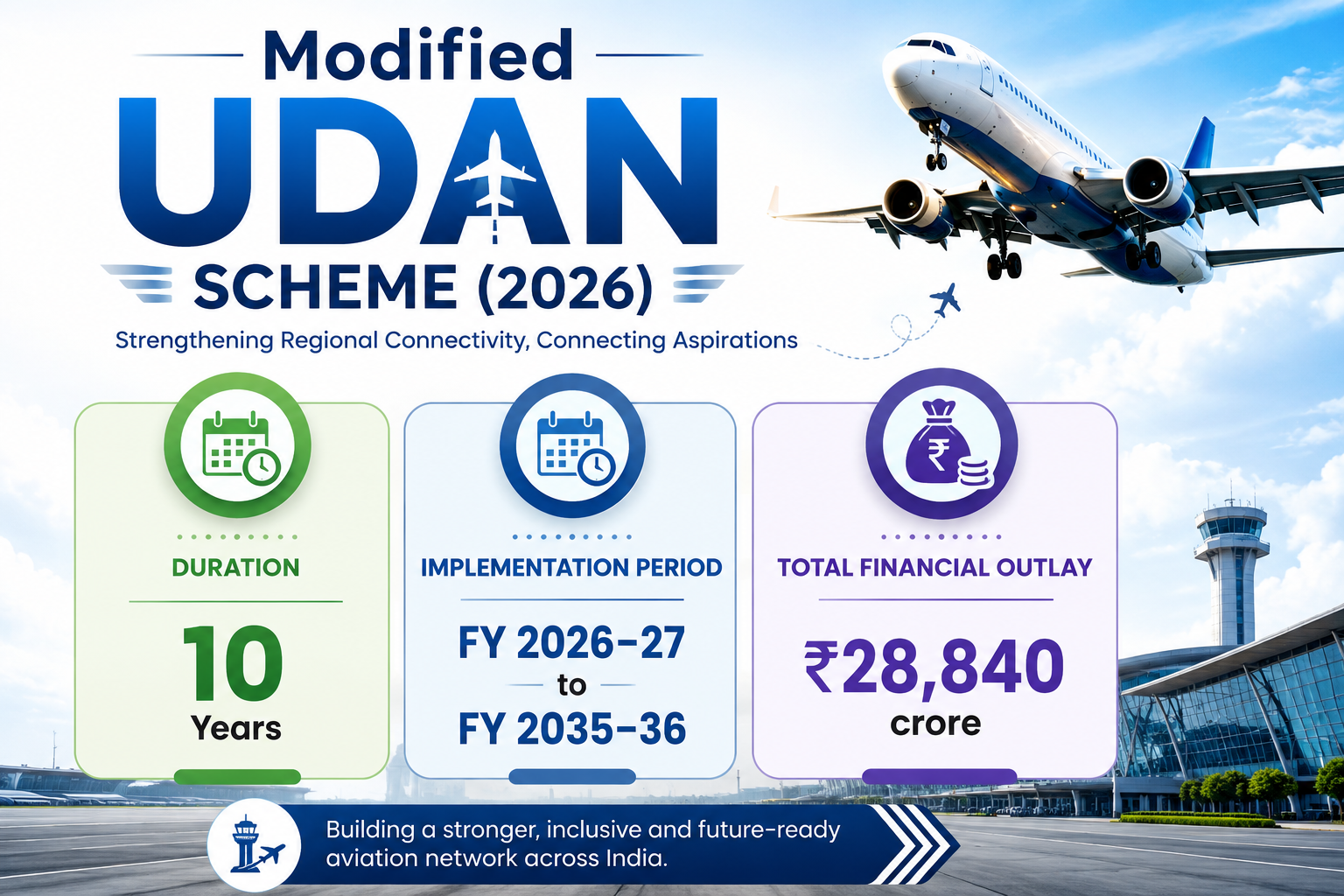
The Union Cabinet has approved the Modified UDAN (Ude Desh ka Aam Nagrik) Scheme to strengthen regional air connectivity across India. The revamped scheme will be implemented for 10 years (FY 2026–27 to FY 2035–36) with a total outlay of ₹28,840 crore.
What is UDAN?
-
UDAN (Ude Desh ka Aam Nagrik) is the Regional Connectivity Scheme (RCS) launched by the Ministry of Civil Aviation (MoCA) in October 2016.
-
It aims to make air travel affordable, accessible, and widespread, particularly in underserved and unserved regions.
-
The scheme promotes balanced regional development by connecting smaller towns with major cities.
-
India is currently the third-largest domestic aviation market globally.
-
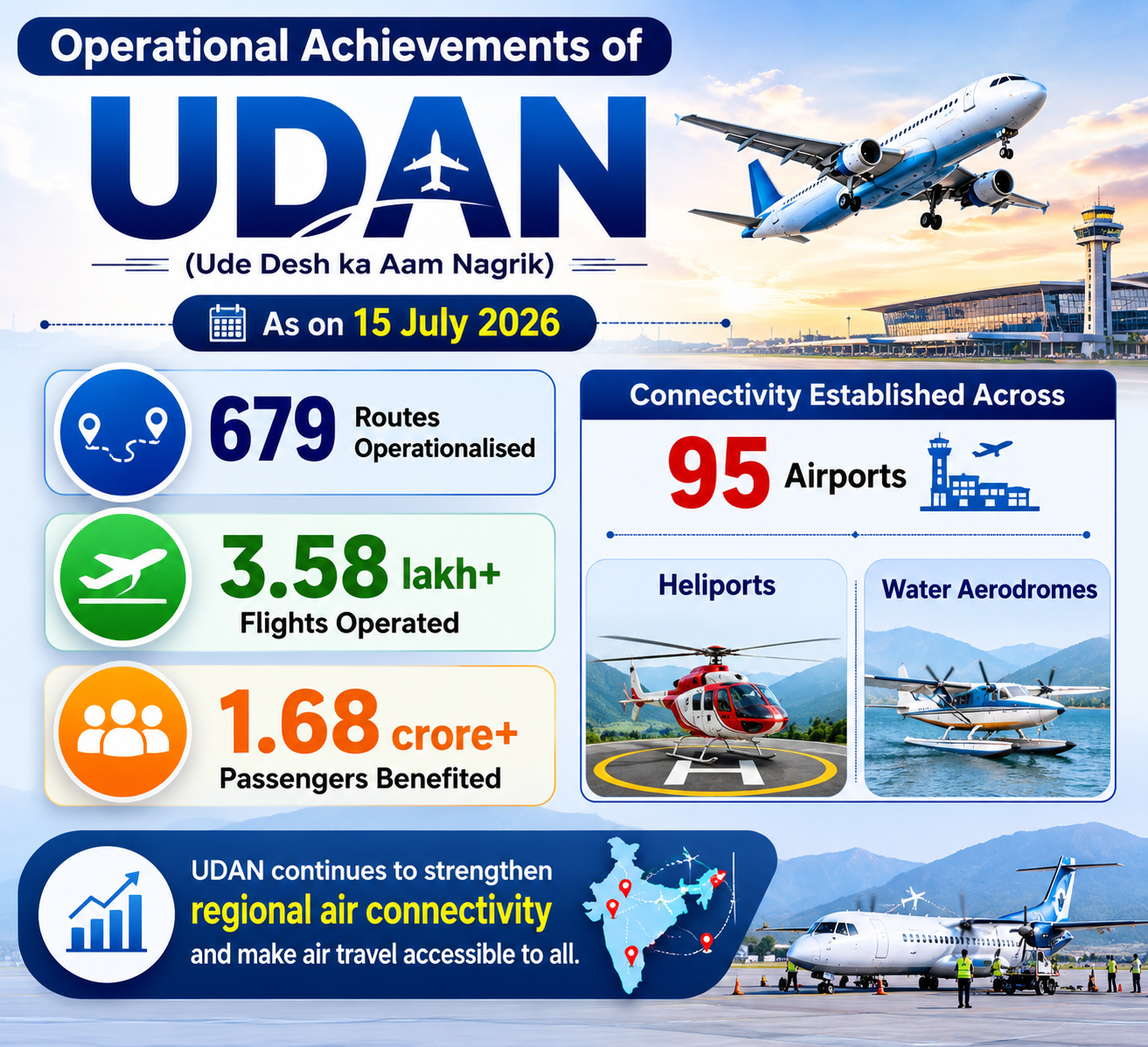
The number of operational airports has increased from 74 (2014) to 165 (as of 15 July 2026).
Objectives of Modified UDAN Scheme:
-
Expand airport infrastructure.
-
Improve operational support for regional airports.
-
Strengthen last-mile air connectivity.
-
Enhance airline viability.
-
Promote indigenous aviation capabilities.
-
Improve connectivity in remote, hilly and island regions.
Major Components of the Modified UDAN Scheme
1. Development of Aerodromes
-
Development of 100 airports from existing unserved airstrips.
-
Integrate remote regions into the national transportation network.
-
Improve passenger and cargo movement.
-
Promote regional economic development.
-
Allocation: ₹12,159 crore over 8 years.
What are Aerodromes?
A defined area on land or water intended to be used wholly or partly for the arrival, departure, and surface movement of aircraft.
Types of Aerodromes
-
Airport
-
Largest type of aerodrome.
-
Has runways, terminals, air traffic control, security, cargo facilities, etc.
-
Example: Rajiv Gandhi International Airport, Hyderabad.
-
Airstrip
-
A simple runway with minimal facilities.
-
Used in remote areas or for small aircraft.
-
Heliport
-
Designed exclusively for helicopters.
-
Water Aerodrome (Seaplane Base)
-
Aircraft take off and land on water.
-
Used by seaplanes.
Why does the UDAN Scheme use the word "Aerodrome"?
The Modified UDAN Scheme aims to improve connectivity in remote areas. Therefore, it includes all types of aviation facilities, not just airports.
Under the scheme:
-
100 airports will be developed.
-
200 modern heliports will be constructed.
-
Existing water aerodromes will also be supported where needed.
Thus, the term aerodrome is used because it covers airports, airstrips, heliports, and water aerodromes.
2. Operation & Maintenance (O&M) Support
To ensure sustainability of regional airports:
-
O&M support for 3 years.
-
Maximum assistance:
-
₹3.06 crore/year per airport
-
₹0.90 crore/year per heliport or water aerodrome
-
Expected to support 441 aerodromes.
-
Allocation: ₹2,577 crore.
3. Viability Gap Funding (VGF)
What is Viability Gap Funding (VGF)?
Viability Gap Funding (VGF) is a financial support (subsidy) provided by the Government to airlines operating on regional routes that are not commercially profitable in the initial years.
The objective is to ensure that air services continue until passenger demand increases and the routes become financially self-sustaining.
Features
-
Total Allocation:
-
₹10,043 crore
-
Funding support available for up to 5 years.
-
Exclusive route rights limited to 3 years.
-
Gradual reduction (tapering) of support to encourage commercial sustainability.
4. Promoting Atmanirbhar Bharat
The scheme supports indigenous aviation manufacturing by providing:
-
2 HAL Dhruv helicopters for Pawan Hans
-
2 HAL Dornier aircraft for Alliance Air
Purpose:
-
Strengthen domestic aviation capability.
-
Improve connectivity in remote terrains.
-
Promote indigenous aircraft manufacturing.
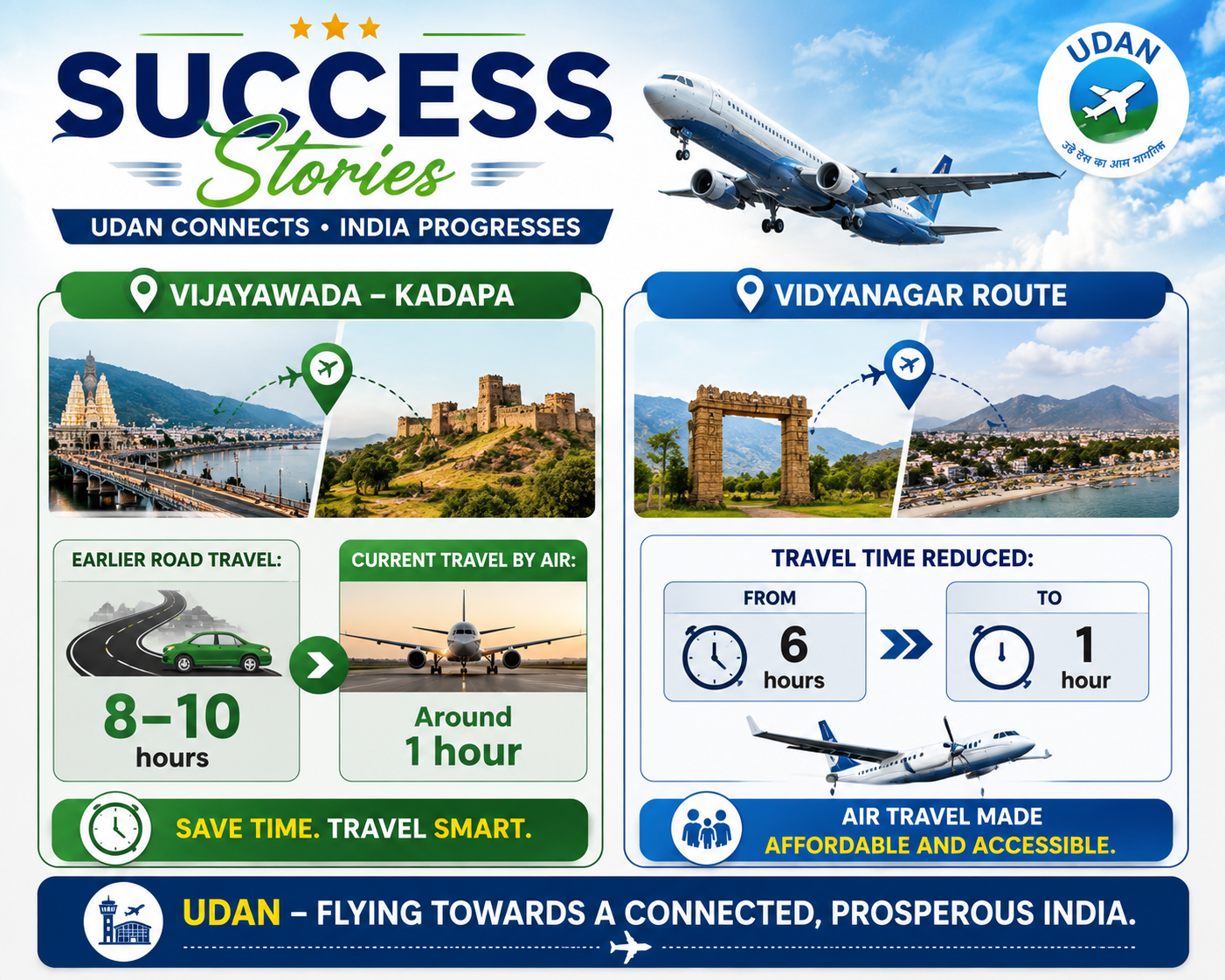
Impact of UDAN
The scheme has significantly improved connectivity across India by:
-
Connecting remote, hilly and island regions.
-
Promoting regional tourism.
-
Supporting local economic growth.
-
Improving healthcare accessibility.
-
Facilitating emergency services.
-
Strengthening links between smaller towns and metropolitan cities.
Passenger-Centric Initiatives
To improve passenger experience, UDAN has introduced:
-
UDAN Yatri Cafés offering affordable food.
-
Flybrary facilities providing:
-
Free books
-
Free Wi-Fi
-
Improved passenger amenities at regional airports.
Funding Mechanism of the UDAN Scheme
What is the Funding Mechanism?
The UDAN Scheme requires financial support because many regional air routes are not commercially profitable, especially during the initial years. Instead of depending entirely on government budget allocations, India introduced a first-of-its-kind Regional Connectivity Scheme (RCS) Levy mechanism to finance the scheme.
How does the RCS Levy Mechanism Work?
Under this mechanism, a small levy (fee) is collected from selected domestic flight operators on profitable routes.
-
The money collected is deposited into the Regional Connectivity Fund (RCF).
-
This fund is then used to provide Viability Gap Funding (VGF) to airlines operating flights on regional and underserved routes.
-
Thus, profitable routes indirectly help support air connectivity in remote and less-developed regions.
Key Features
1. Funded through a Small Levy on Selected Domestic Flights
-
Airlines operating on major, profitable routes contribute a small levy.
-
This levy is not collected from all flights but only from selected domestic services.
-
The collected amount finances regional air connectivity.
2. Supports Regional Connectivity
-
The Regional Connectivity Fund provides financial assistance to airlines operating in underserved and remote areas.
-
It helps make air travel affordable while ensuring the sustainability of regional routes.
3. Airport-Level Coordination
The Government coordinates with various agencies to ensure smooth implementation by:
-
Developing airport infrastructure.
-
Improving operational efficiency.
-
Facilitating regulatory clearances.
-
Supporting airport management and regional aviation services.
4. Operational Concessions to Reduce Airline Costs
To encourage airlines to operate on regional routes, the Government provides several concessions such as:
-
Reduced airport charges.
-
Lower navigation and landing fees.
-
Concessions on security and firefighting services.
-
Support for airport operations and maintenance.
-
Other regulatory and operational incentives.
These measures reduce operating costs and improve the financial viability of regional flights.
Significance of Modified UDAN
-
Enhances affordable regional air connectivity.
-
Promotes balanced regional development.
-
Strengthens last-mile connectivity.
-
Boosts tourism and trade.
-
Generates employment opportunities.
-
Improves disaster response and emergency medical access.
-
Supports the vision of Atmanirbhar Bharat.
-
Contributes to building a modern, inclusive and resilient aviation ecosystem.
The Modified UDAN Scheme strengthens India's regional aviation ecosystem by expanding air connectivity, developing infrastructure, supporting airlines, and promoting affordable travel. It enhances economic growth, tourism, healthcare access, and last-mile connectivity while advancing an inclusive, sustainable, and self-reliant aviation sector.