The BRICS New Development Bank emerged as an alternative source of development finance, seeking to reduce dependence on traditional Western-led financial institutions.
Syllabus areas
GS paper II - International Relations
GS paper - III - Economy
When India hosts the 18th BRICS summit at New Delhi in September 12–13, 2026, under the banner of "Humanity First", the occasion will be draped in a familiar promise: that the bloc is building an alternative to the western-dominated global financial order. A new bank to rival the World Bank. A reverse fund to free countries from the International Monetary Fund. A path away from the dominance of US dollar.
The New Development Bank (NDB)
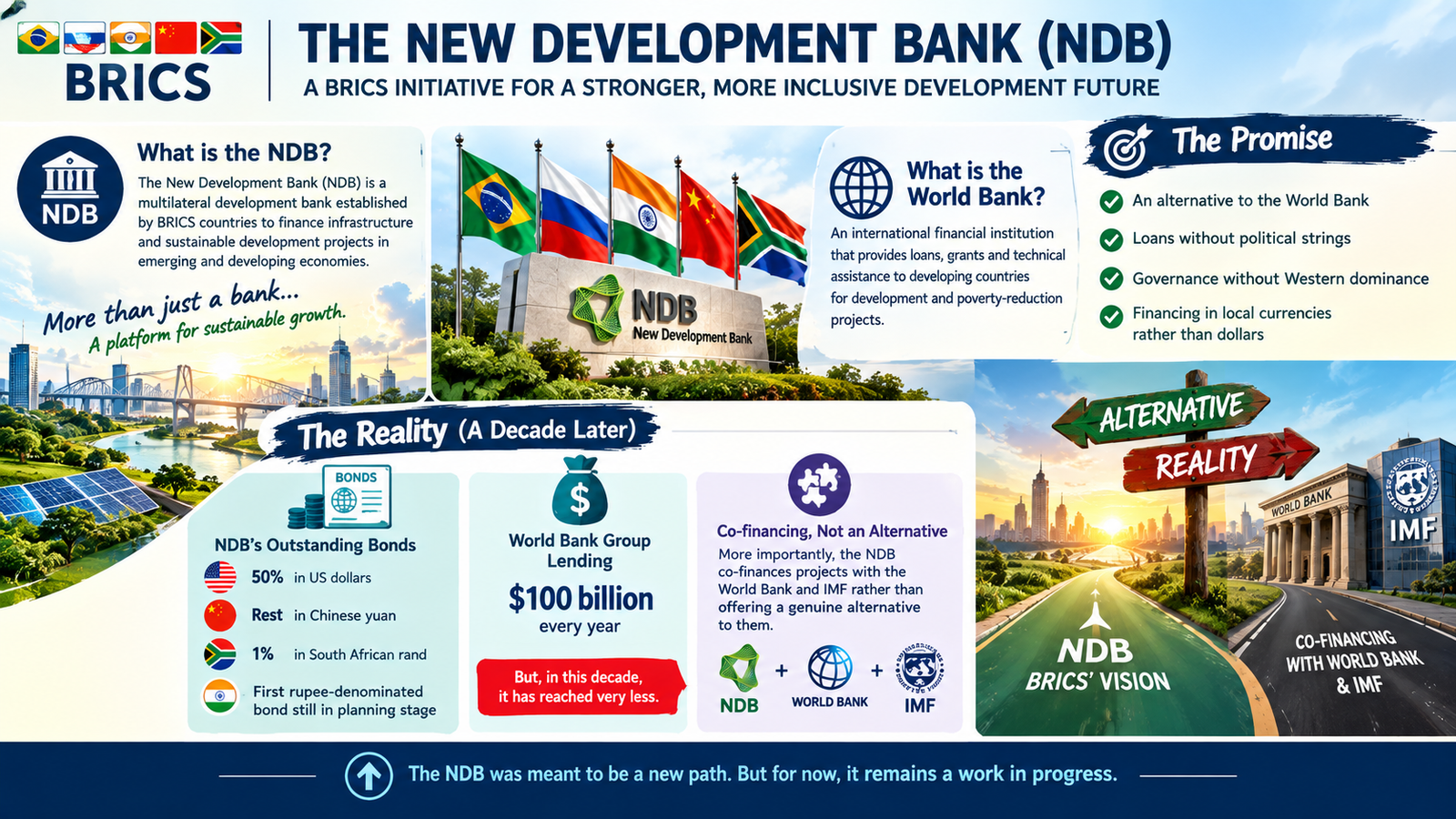
The New Development Bank (NDB), launched in 2015, was BRICS's flagship creation. It was supposed to offer developing countries an alternative to the World Bank: loans without the political strings, governance without Western dominance, financing in local currencies rather than dollars.
NDB – New Development Bank: A multilateral development bank established by BRICS countries to finance infrastructure and sustainable development projects in emerging and developing economies.
World Bank: An international financial institution that provides loans, grants and technical assistance to developing countries for development and poverty-reduction projects.
A decade later, half of the NDB's outstanding bonds are denominated in US dollars, with Chinese yuan the rest. South African rand accounts only one percent. The NDB's first rupee-denominated bond was still in planning stage.
The World Bank Group commits $100 billion every year.
But, in this decade, reached very less.
More importantly, NDB co-finances projects with World Bank and IMF rather than offering genuine alternative to them.
Contingent Reserve Arrangement (CRA)
Alongside NDB, the BRICS countries established Contingent Reserve Arrangement (CRA) in 2015: a $100 billion pool of foreign exchange reserves meant to help member countries weather financial crises without turning to IMF.
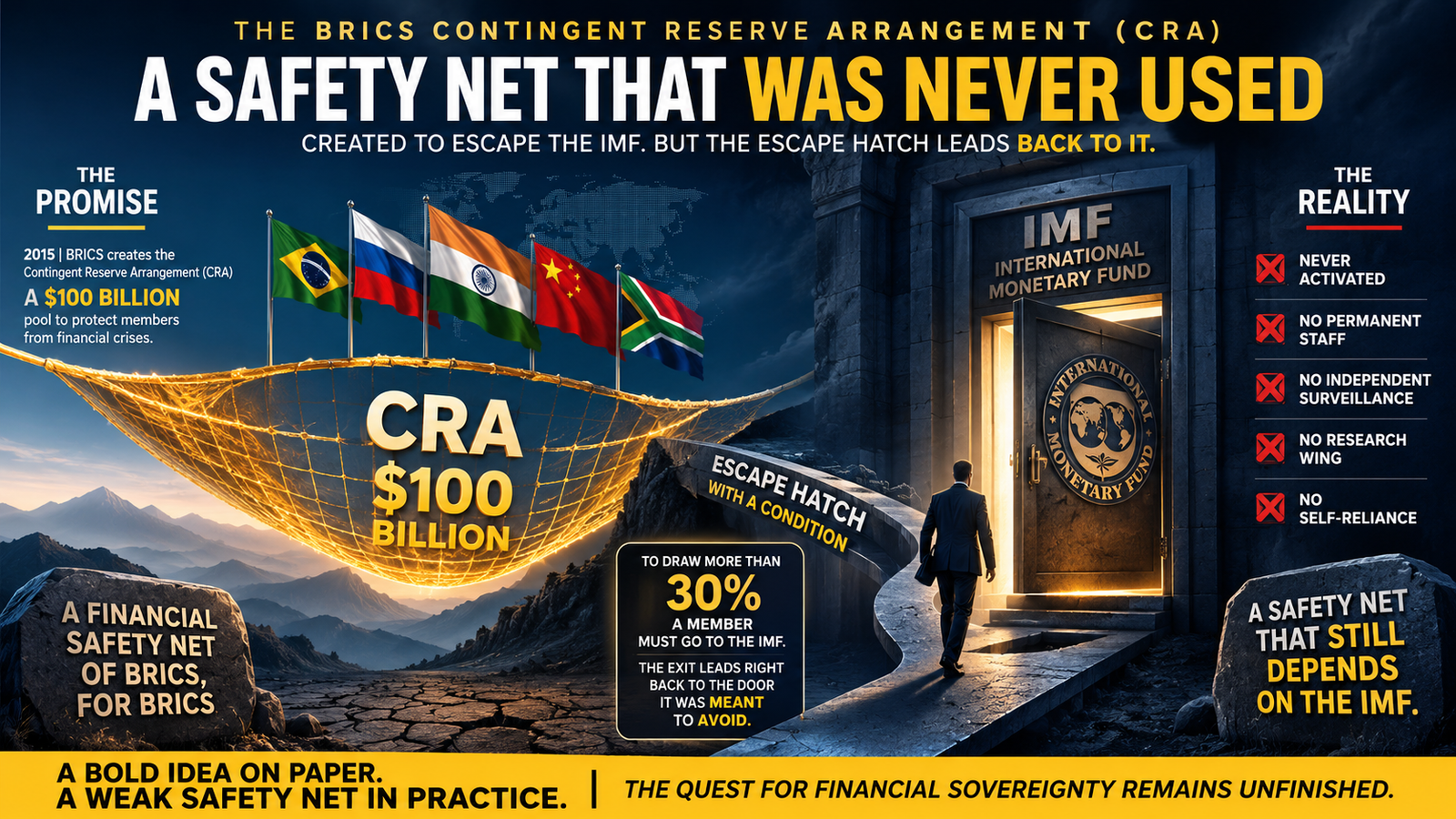
CRA – Contingent Reserve Arrangement: A BRICS financial safety-net mechanism created in 2015, with a committed pool of foreign exchange reserves intended to provide liquidity support to member countries facing balance-of-payments or short-term external financing pressures.
IMF – International Monetary Fund: A global financial institution that promotes international monetary and financial stability and provides financial assistance to countries facing balance-of-payments problems.
But, CRA has never been activated. Not once in a decade. Why?
1. Any member country that wants to draw more than 30% of its allotted share must first enter to IMF. That is, the escape hatch leads to IMF again which was supposed to escape.
2. CRA has no permanent staff.
3. No independent surveillance capacity.
4. No research wing.
5. No self-reliance.
De-dollarisation
6. Not yet de-dollarisation. For example, the 126-point declaration issued at Rio Summit in July 2025 – the bloc's most comprehensive statement to date – does not contain the word de-dollarisation even once.
De-dollarisation: The process of reducing dependence on the US dollar in international trade, investment, financial transactions and foreign-exchange reserves, often through greater use of national or alternative currencies.
7. India opposes any move toward common BRICS currency.
South Africa considers the idea too risky.
China prefers gradual internationalisation of yuan.
8. When US President Trump threatened 10% tariff surcharge the bloc was silent.
The answer is simple. The USA holds 16.49% of IMF voting rights.
Any major decision requires 85% supermajority.
Therefore no BRICS country fight against USA.