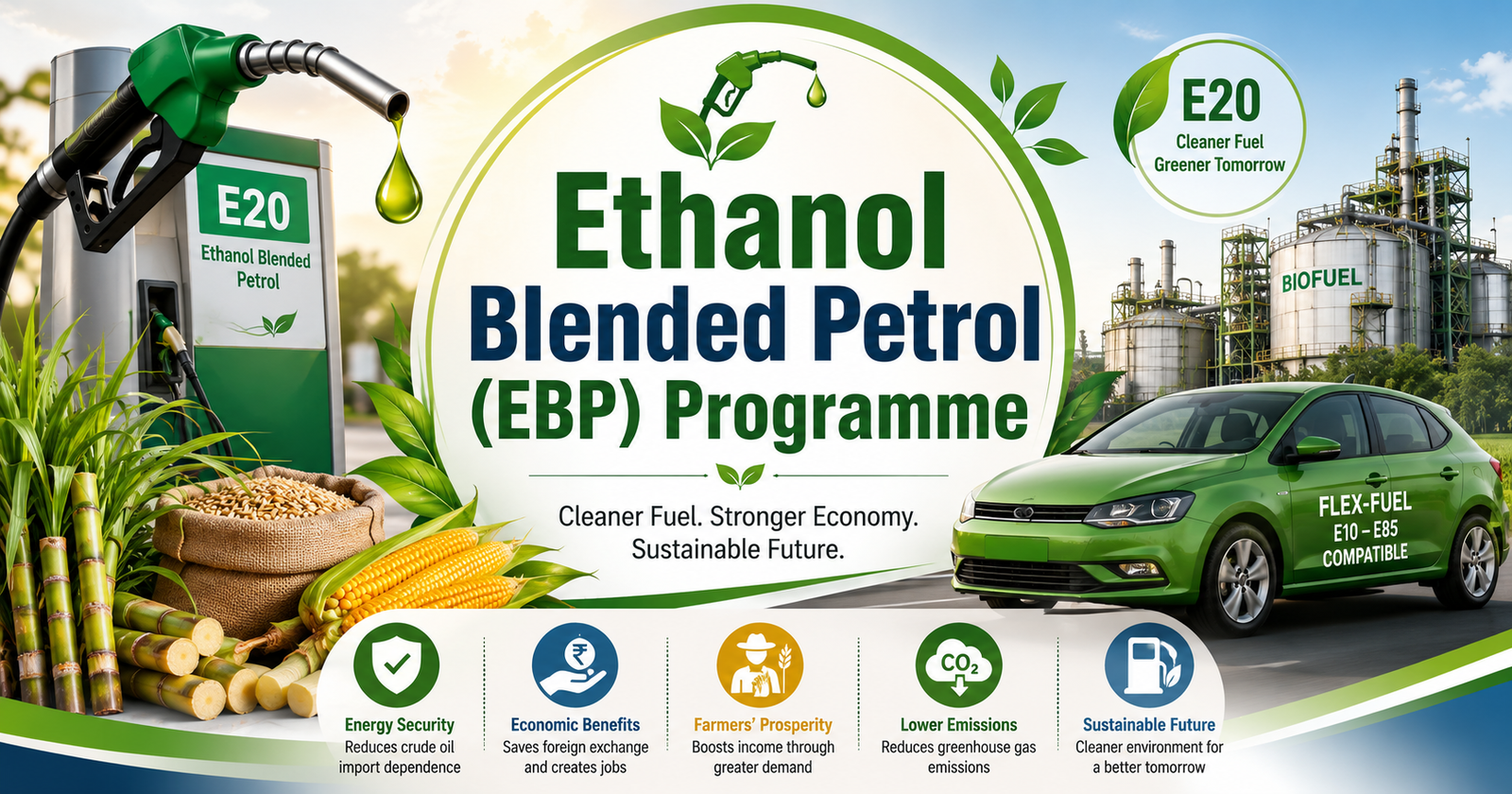
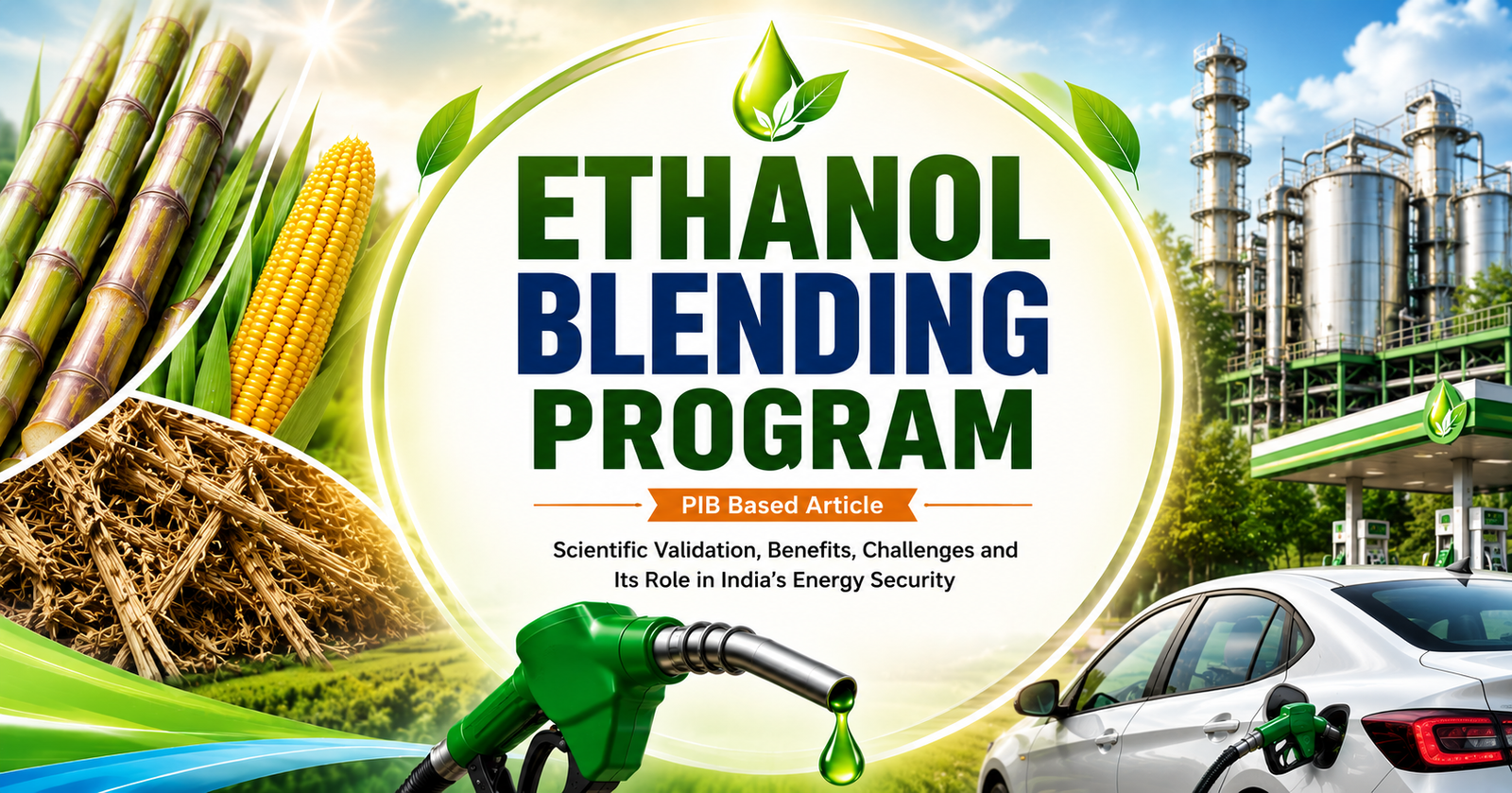
Explore Ethanol Blended Petrol Programme, its major achievements, global adoption, benefits, myths versus facts, flex-fuel vehicles, and its role in energy security and sustainability.
Syllabus Areas:
GS III - S&T and Environment
The Ethanol Blended Petrol (EBP) Programme is one of India's flagship initiatives to reduce dependence on imported crude oil, promote renewable fuels, increase farmers' income, and reduce greenhouse gas emissions. Ethanol is blended with petrol to create cleaner and more sustainable transport fuel.
The programme has become a key pillar of India's Energy Transition, Biofuel Strategy, and Net Zero commitments.
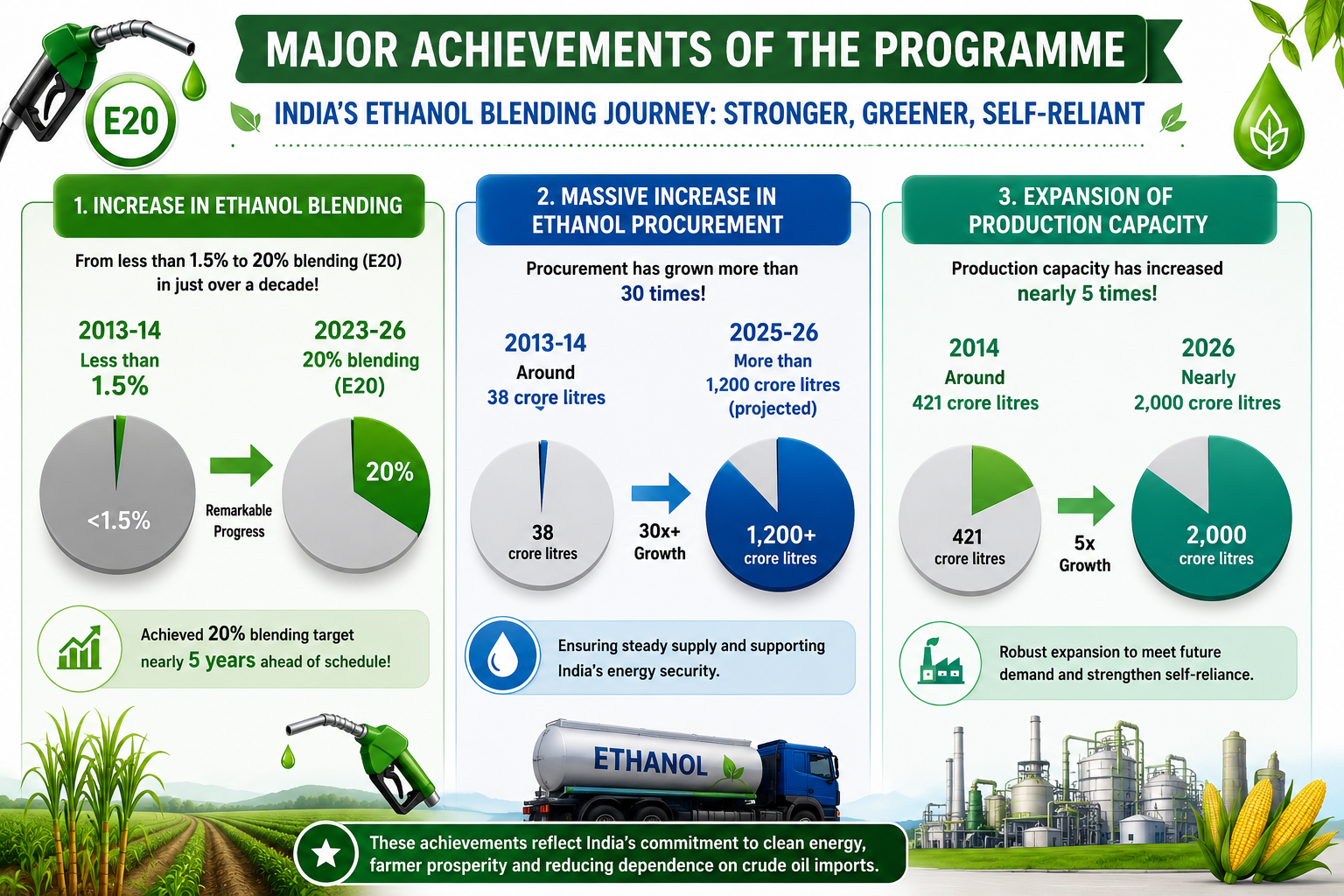
Major Achievements of the Programme
India has witnessed remarkable progress in ethanol blending over the last decade.
Increase in Ethanol Blending
-
2013-14: Less than 1.5%
-
2025-26: 20% blending (E20)
India achieved the 20% blending target nearly five years ahead of schedule, making it one of the fastest-growing ethanol blending programmes globally.
Massive Increase in Ethanol Procurement
-
2013-14: Around 38 crore litres
-
2025-26: More than 1,200 crore litres (projected)
This reflects the rapid expansion of ethanol production and supply infrastructure.
Expansion of Production Capacity
Production capacity increased nearly five times.
-
2014: Around 421 crore litres
-
2026: Nearly 2,000 crore litres
This expansion has enabled India to meet growing fuel demand while reducing import dependence.
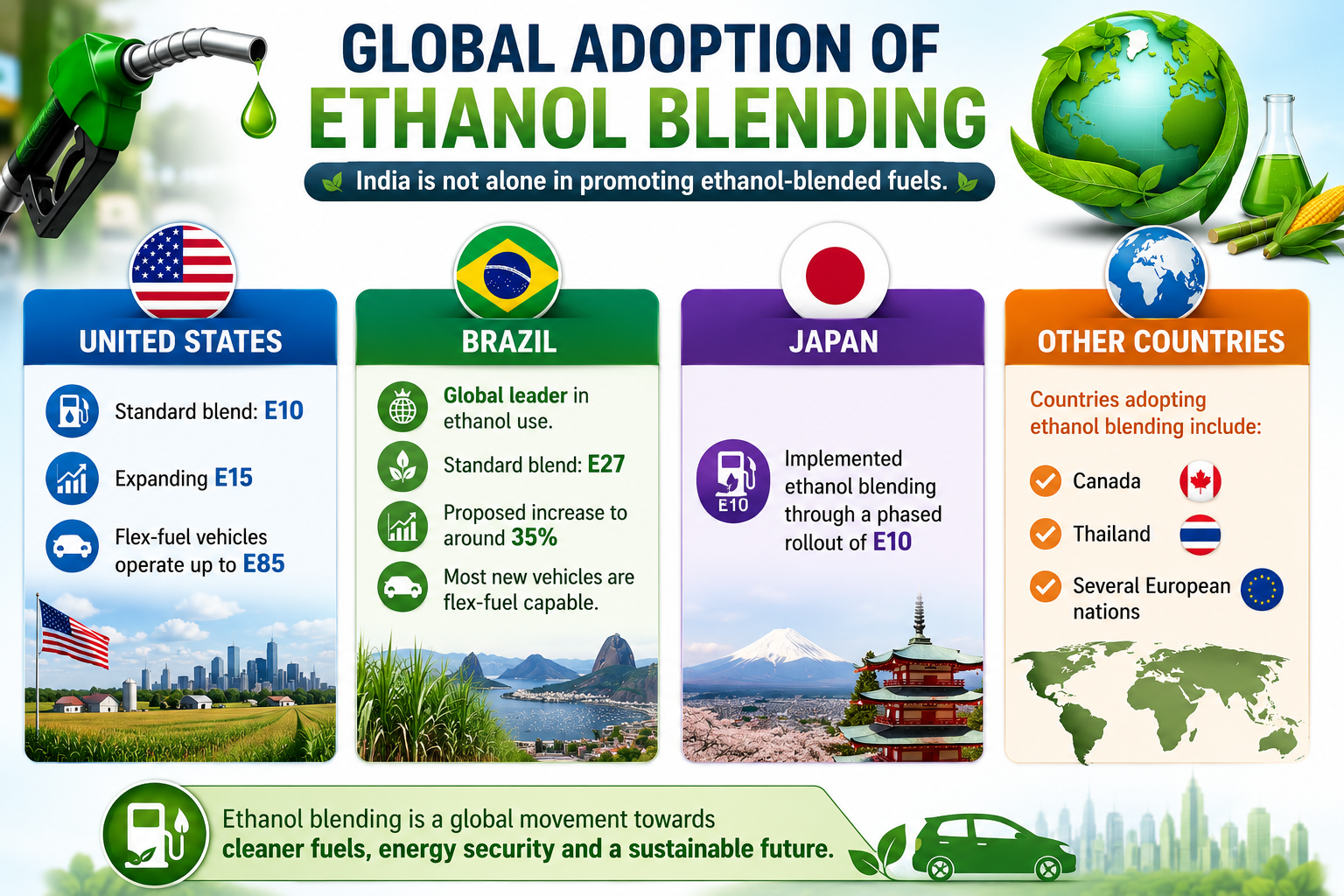
Contribution to India's Energy Security
India imports nearly 88.5% of its crude oil requirements, making it highly vulnerable to global oil price fluctuations and supply disruptions.
Ethanol blending helps India by:
-
Replacing imported petroleum with domestically produced biofuel.
-
Reducing exposure to international oil market volatility.
-
Improving long-term energy security.
-
Promoting self-reliance (Atmanirbhar Bharat).
Ethanol is mainly produced from Sugarcane, Maize, Surplus rice
These are domestically available feedstocks.
Economic Benefits
Since the Ethanol Supply Year (ESY) 2014-15, the programme has delivered significant economic gains.
-
Foreign Exchange Savings: India has saved more than ₹1.90 lakh crore through reduced crude oil imports.
-
Crude Oil Substitution: Over 310 lakh metric tonnes of crude oil have been substituted through ethanol blending.
-
Additional Income for Farmers: Farmers have earned over ₹1.60 lakh crore through increased demand for agricultural feedstocks used in ethanol production.
This has diversified farm income and strengthened rural economies.
Environmental Benefits
-
The EBP Programme contributes significantly to climate change mitigation.
-
Carbon Emission Reduction: The programme has reduced approximately 930 lakh metric tonnes of CO₂ emissions.
-
Other environmental benefits include:
-
Cleaner combustion
-
Reduced vehicular pollution
-
Lower greenhouse gas emissions
-
Promotion of renewable fuels
What are Flex-Fuel Vehicles (FFVs)?
Flex-Fuel Vehicles (FFVs) are vehicles specially designed to run on petrol, ethanol, or any mixture of both in varying proportions without requiring any manual adjustment by the driver.
The vehicle's engine automatically detects the ethanol content in the fuel and adjusts fuel injection and ignition timing for optimal performance.
Significance for India
The Ethanol Blended Petrol Programme has emerged as a transformational policy initiative that supports multiple national priorities simultaneously.
It contributes to:
-
Energy security
-
Import substitution
-
Climate change mitigation
-
Rural income enhancement
-
Renewable energy promotion
-
Atmanirbhar Bharat
-
Sustainable transportation
With continued expansion of production capacity, technological improvements, and wider vehicle compatibility, ethanol blending is expected to remain a key component of India's clean energy transition and long-term fuel security strategy.
Prelims Questions:
1. With reference to Flex-Fuel Vehicles (FFVs), consider the following statements:
-
Flex-fuel vehicles can run on petrol, ethanol, or any blend of the two.
-
Flex-fuel vehicles automatically detect the ethanol content in the fuel and adjust engine performance.
-
All petrol vehicles manufactured in India are flex-fuel vehicles.
Which of the statements given above is/are correct?
A. 1 and 2 only
B. 2 and 3 only
C. 1 and 3 only
D. 1, 2 and 3
Answer: A
2. Consider the following statements regarding Fourth Generation (4G) biofuels:
-
They involve genetically engineered microorganisms.
-
Carbon Capture and Storage (CCS) is often integrated into the production process.
-
They are commercially deployed on a large scale worldwide.
Which of the statements given above is/are correct?
A. 1 only
B. 1 and 2 only
C. 2 and 3 only
D. 1, 2 and 3
Answer: B
Explanation
4G biofuels are still largely in the research and demonstration stage.
3. Consider the following statements:
-
Second Generation ethanol reduces the problem of food-versus-fuel competition.
-
Second Generation ethanol utilizes agricultural waste that might otherwise be burnt.
Which of the above statements is/are correct?
A. 1 only
B. 2 only
C. Both 1 and 2
D. Neither 1 nor 2
Answer: C