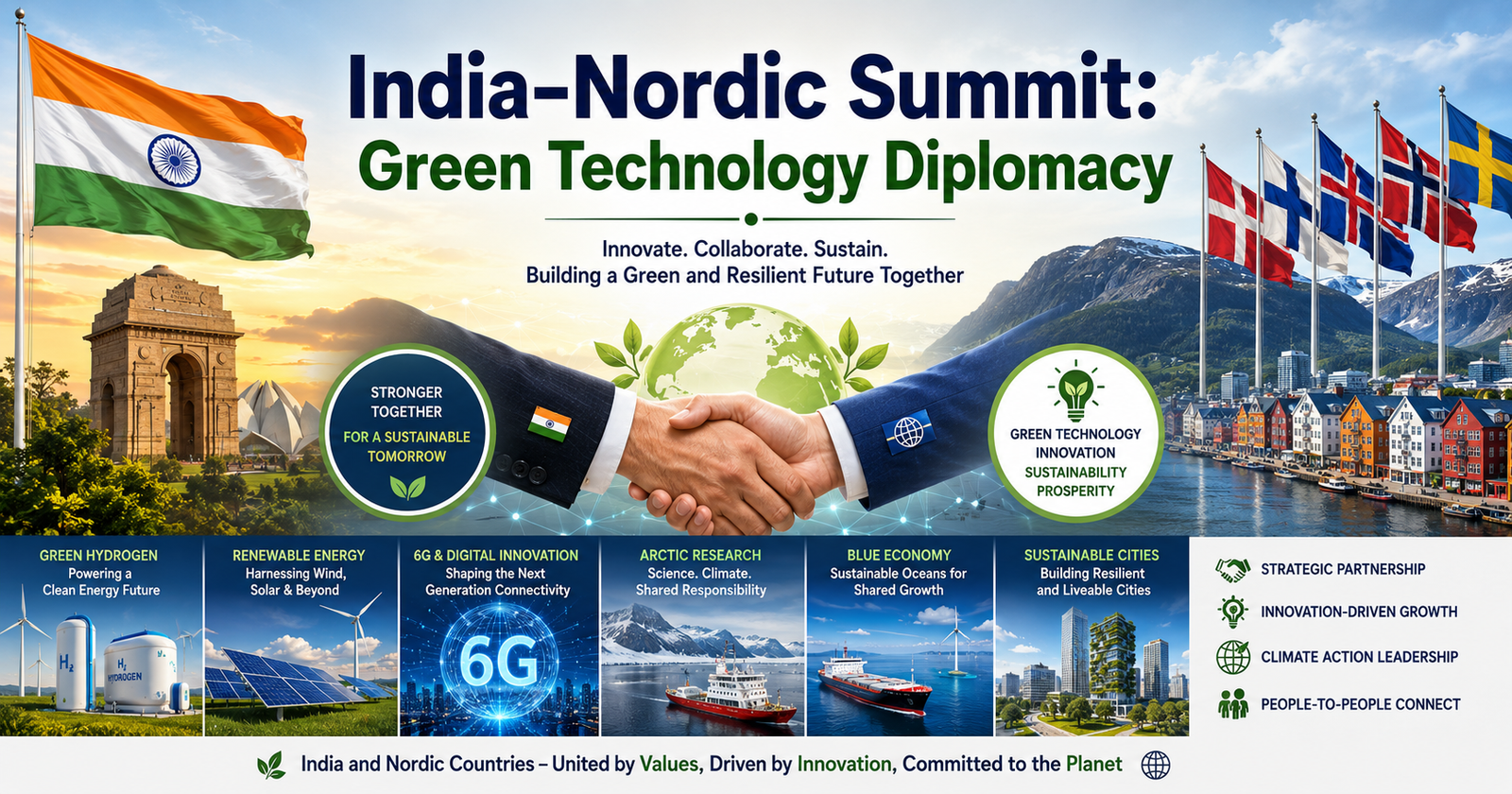
Explore key outcomes of the India–Nordic Summit focused on green technology, renewable energy, 6G innovation, Arctic cooperation, and blue economy partnerships shaping sustainable growth and future-focused global diplomacy.
Syllabus Areas:GS II - International Relations |
The recent India–Nordic Summit has emerged as an important development in India’s foreign policy, technological cooperation, and climate diplomacy. The summit focused on strengthening collaboration between India and the Nordic countries in sectors such as green technology, renewable energy, digital innovation, Arctic research, maritime economy, sustainability, and advanced telecommunications like 6G.
The Nordic countries — Denmark, Finland, Iceland, Norway, and Sweden — are globally known for their innovation-driven economies, environmental sustainability, advanced infrastructure, and clean energy systems. India’s growing partnership with these countries reflects its long-term strategy to combine economic growth with technological advancement and sustainable development.
The summit also highlighted how modern diplomacy is increasingly shifting from traditional political alliances toward partnerships based on technology, climate action, and innovation.
Why the India–Nordic Partnership Is Important
The India–Nordic partnership is important because both sides possess complementary strengths that can support each other’s long-term strategic goals.
India offers:
-
a large and growing consumer market,
-
one of the world’s fastest-growing digital economies,
-
a strong startup ecosystem,
-
a skilled workforce,
-
and huge renewable energy potential.
The Nordic countries contribute:
-
advanced clean technologies,
-
expertise in sustainable urban planning,
-
leadership in renewable energy systems,
-
high investment in research and development,
-
and innovation-driven governance models.
This partnership creates opportunities for:
-
technology transfer,
-
joint research,
-
sustainable industrial growth,
-
clean energy investment,
-
and digital infrastructure expansion.
India sees Nordic countries not merely as trade partners but as strategic technology partners for the future economy.
Focus on Green Technology Cooperation
One of the central themes of the summit was cooperation in green technology.
As climate change becomes a major global challenge, countries are increasingly investing in technologies that reduce carbon emissions while supporting economic growth. Nordic countries are among the global leaders in sustainable technologies and environmental governance.
During the summit, discussions focused on:
-
renewable energy expansion,
-
sustainable transportation,
-
electric mobility,
-
carbon-neutral industrial systems,
-
waste management technologies,
-
and energy-efficient infrastructure.
India is currently pursuing ambitious climate goals, including:
-
achieving net-zero emissions by 2070,
-
expanding renewable energy capacity,
-
reducing carbon intensity,
-
and promoting sustainable development.
The Nordic partnership can help India access advanced technologies required for this transition.
For example:
-
Denmark has expertise in wind energy,
-
Norway leads in electric mobility,
-
Sweden is known for sustainable industrial systems,
-
and Finland has advanced clean-tech innovation capabilities.
These partnerships can help India modernize industries while balancing development and environmental protection.
Green Hydrogen and Renewable Energy
-
Green hydrogen emerged as a major area of discussion during the summit.
-
Green hydrogen is produced using renewable energy sources like solar and wind power instead of fossil fuels. Unlike conventional hydrogen production methods, green hydrogen produces minimal carbon emissions and is therefore considered a future clean fuel.
-
India has already launched the National Green Hydrogen Mission to position itself as a global hub for green hydrogen production and exports.
-
The Nordic countries possess strong expertise in hydrogen storage systems, offshore wind energy, clean industrial fuel systems, and renewable-powered energy grids.
-
India can benefit from Nordic experience in scaling green hydrogen infrastructure.
-
This is particularly important because sectors like Steel, Shipping, heavy transport, and fertilizers
-
cannot be fully decarbonized using electricity alone. Green hydrogen offers a possible long-term solution for these industries.
-
The partnership can therefore strengthen India’s energy security, climate commitments, and industrial competitiveness.
Cooperation in 6G Technology
-
Another major outcome of the summit was cooperation in 6G technology research and innovation.
-
Although many countries are still implementing 5G systems, advanced economies have already started preparing for sixth-generation communication technology.
-
6G technology is expected to provide ultra-fast internet speeds, support artificial intelligence integration, enable advanced automation, improve smart manufacturing, and strengthen Internet of Things (IoT) applications.
-
Nordic countries, especially Finland and Sweden, are global leaders in telecommunications research.
-
Companies from these countries have historically played major roles in the development of mobile communication systems.
-
India’s cooperation with Nordic countries in this sector is strategically important because future economic and geopolitical influence will increasingly depend on technological leadership.
-
The summit emphasized joint innovation, research collaboration, startup partnerships, and digital ecosystem development.
-
India wants to ensure that it does not remain merely a technology consumer but becomes an active participant in developing future technologies.
Strategic Importance of Digital Partnerships
-
India’s digital economy is expanding rapidly through digital payments, E-governance, online services, artificial intelligence,and startup-driven innovation.
-
The Nordic countries are known for highly digitized societies with strong cybersecurity systems and innovation-friendly governance.
-
During the summit, discussions focused on cybersecurity cooperation, digital public infrastructure, AI-based governance, semiconductor ecosystems, and startup collaborations.
-
Such partnerships support India’s broader initiatives like Digital India, Startup India, Make in India, and Atmanirbhar Bharat.
-
The partnership is therefore not limited to trade alone but extends into long-term technological transformation.
Arctic Cooperation and Strategic Significance
-
Arctic cooperation emerged as another important theme during the summit.
-
The Arctic region is becoming increasingly important because climate change is rapidly melting polar ice. This is opening new maritime routes, access to natural resources, and geopolitical competition among major powers.
-
Nordic countries possess deep expertise in Arctic governance, climate science, and polar research.
-
Although India is geographically distant from the Arctic, the region directly affects India’s climate systems.
-
Changes in Arctic ice influence global weather patterns, ocean circulation, and monsoon behavior.
-
India already has an Arctic Policy and maintains research operations through the Himadri research station in Svalbard, Norway.
-
During the summit, India emphasized the importance of scientific cooperation, environmental monitoring, climate research, and sustainable Arctic governance.
-
This reflects India’s growing role in global environmental diplomacy.
Blue Economy Partnership
-
The summit also focused on strengthening cooperation in the blue economy.
-
The blue economy refers to the sustainable use of ocean resources for economic growth, livelihood generation, marine conservation, and maritime development.
-
India has a coastline of more than 7,500 kilometers and major strategic interests in the Indian Ocean region.
-
The Nordic countries possess expertise in sustainable fisheries, marine technologies, offshore renewable energy, shipping innovation, and ocean resource management.
-
India aims to improve port infrastructure, coastal economic zones, marine exports, fisheries development, and maritime logistics.
-
Cooperation in the blue economy can therefore strengthen both sustainability and economic growth.
Climate Diplomacy and India’s Global Position
-
The summit also demonstrated India’s increasing role in climate diplomacy.
-
Modern diplomacy is no longer limited to military or political alliances alone. Countries now build partnerships around clean technology, resilient supply chains, Innovation, sustainability,and digital infrastructure.
-
India is attempting to position itself as a responsible emerging power, a climate-conscious economy, and a technology-driven nation.
-
By partnering with technologically advanced countries like the Nordic nations, India aims to strengthen its global influence while supporting sustainable development goals.
Challenges in the Partnership
-
Technology Costs: Advanced green technologies are often expensive and may require large-scale investment.
-
Regulatory Differences: Differences in industrial standards and environmental regulations may slow implementation.
-
Geopolitical Competition: Technology partnerships increasingly intersect with global strategic competition involving the US, China, and Europe.
-
India must therefore maintain strategic autonomy while expanding cooperation.
The India–Nordic Summit reflects the changing nature of global diplomacy where technology, sustainability, climate action, and innovation are becoming central pillars of international relations.
The partnership is strategically important because it supports India’s ambitions in renewable energy, green hydrogen, digital transformation, Arctic research, maritime development, and advanced technology ecosystems.
As the global economy increasingly shifts toward clean energy and knowledge-driven growth, partnerships like these will play a major role in shaping future geopolitical and economic power structures.
For India, the summit is not merely a diplomatic event but part of a broader long-term strategy to emerge as a sustainable, technologically advanced, and globally influential power.