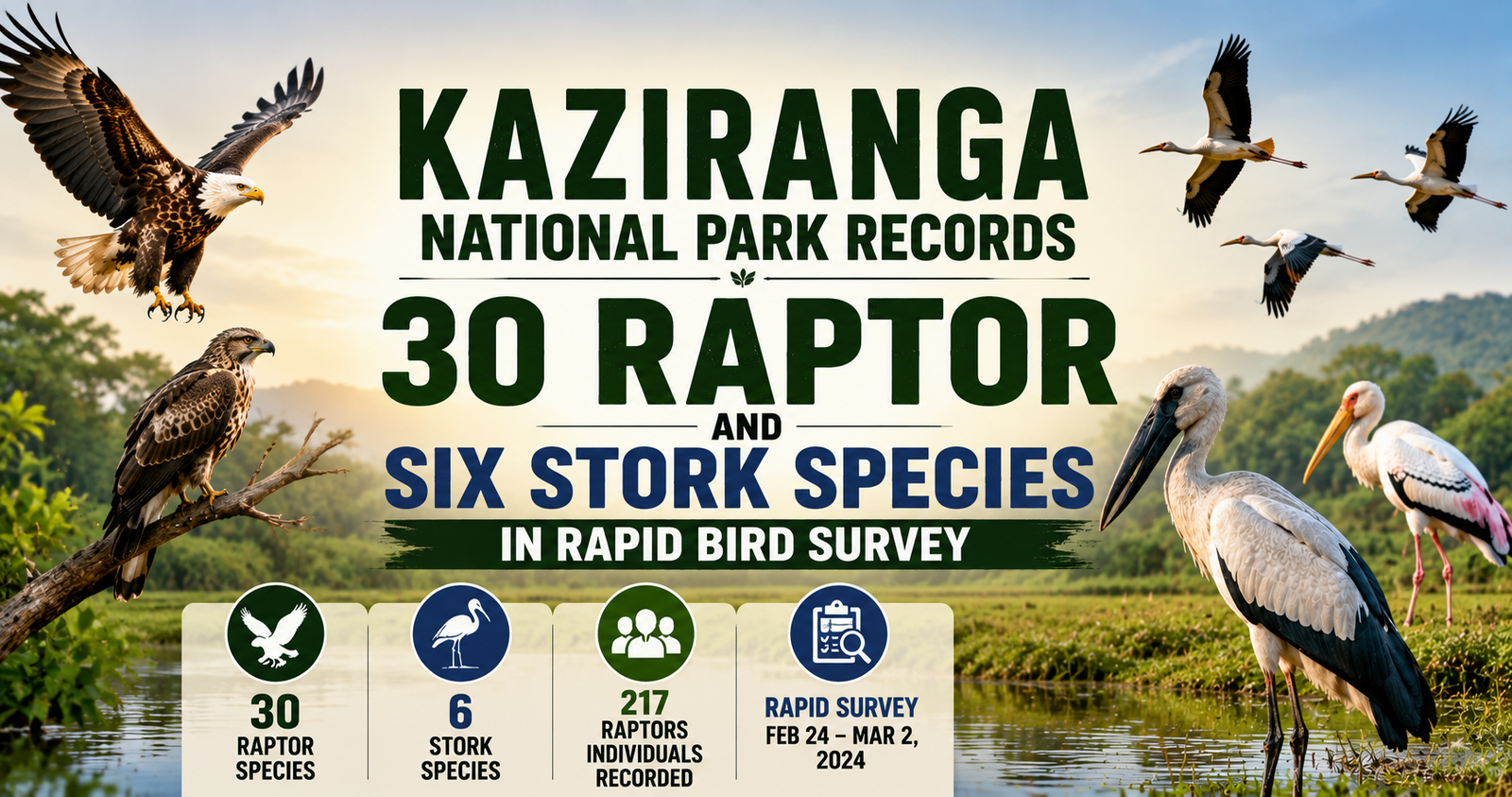
Kaziranga’s rapid bird survey recorded 30 raptor species and six stork species, highlighting Assam’s rich wetland biodiversity and reinforcing the park’s importance as a critical habitat for threatened and migratory birds.
Syllabus Areas:GS III - Environment and Ecology |
A rapid bird survey conducted in and around Kaziranga National Park has documented an impressive diversity of raptors and storks, highlighting the ecological importance of Assam’s wetlands and forest landscapes for bird conservation.
Key Findings of the Survey
a. Extensive Survey Conducted Across Kaziranga Landscape
The survey was carried out over a 10-member team between the last week of February and March 2. It was released on June 5 ahead of World Environment Day. Researchers from Gauhati University collaborated with the Kaziranga Tiger Reserve authorities for the study.
b. Significant Diversity of Raptors Recorded
Researchers documented 217 individual raptors belonging to 30 different species. Raptors are birds of prey that include eagles, hawks, vultures, falcons, and buzzards. Their presence indicates a healthy ecosystem because these birds occupy the top levels of the food chain.
c. Six Species of Storks Were Identified
The survey also recorded 266 individual storks belonging to six species. Storks depend heavily on wetlands and floodplain ecosystems, making them useful indicators of habitat quality.
Raptors (Birds of Prey)Raptors are birds that hunt and feed on other animals. They have:
Examples of Raptors:
Why are they important?Raptors control populations of rodents, reptiles, fish, and other animals. Since they are at the top of the food chain, they indicate ecosystem health. Examples from Kaziranga survey:
StorksStorks are large, long-legged wading birds mostly found near wetlands, rivers, marshes, and floodplains. They generally feed on:
They have:
Examples of Storks:
Why are they important?Storks are indicators of healthy wetlands because they depend on clean water bodies and abundant aquatic life. |
Survey Covered Multiple Administrative Zones
The raptor–stork study covered Kaziranga’s three administrative zones:
-
Eastern Assam Wildlife Division
-
Biswanath Wildlife Division
-
Nagaon Wildlife Division
This broad coverage helped researchers understand bird distribution across the larger Kaziranga landscape.
Important Species Observed
a. Asian Openbill Was the Most Abundant Stork
Among the stork species recorded, the Asian Openbill (Anastomus oscitans) emerged as the most abundant species, with 92 individuals recorded.
b. Lesser Adjutant Stork Remains a Conservation Highlight
The Lesser Adjutant Stork (Leptoptilos dubius) was identified as the rarest among the stork species, with only three individuals recorded. This species is globally threatened and requires focused conservation attention.
c. Himalayan Griffon Was the Most Frequently Seen Raptor
Among birds of prey, the Himalayan Griffon (Gyps himalayensis) was the most commonly sighted species, with 69 individuals recorded.
d. Rare Raptors Were Also Spotted
Researchers reported individual sightings of rare raptors such as:
-
Bonelli’s Eagle
-
White-tailed Eagle
These rare sightings demonstrate the ecological richness of the Kaziranga landscape.
e. Presence of Pallas’s Fish Eagle is Significant
Kaziranga also serves as an important habitat for the Pallas’s Fish Eagle (Haliaeetus leucoryphus), a globally threatened bird species. A previous survey by the Wildlife Institute of India in January 2020 recorded 15 active nests, making Kaziranga one of the most important breeding sites for this species globally.
Ecological Importance of Kaziranga for Birds
a. Assam’s Wetlands and Foothills Create Ideal Bird Habitats
Kaziranga’s ecological richness comes from:
-
Extensive wetlands and floodplains
-
Grasslands and riverine ecosystems
-
Proximity to Himalayan foothills
-
Abundant prey availability
These factors create ideal habitats for both migratory and resident bird species.
b. Critical Habitat for Raptors
India hosts around 112 species of diurnal and nocturnal raptors, and the Kaziranga landscape provides habitat for nearly 50 species, underlining its importance for raptor conservation.
c. Global Importance for Stork Conservation
India has around 20 stork species found across tropical and subtropical regions, and Assam supports a large share of these populations because of its wetland-rich environment.
Why Raptors and Storks Matter
Raptors as Ecological Indicators
Raptors are often called indicator species because their population trends reflect ecosystem health. A decline in raptor numbers may indicate habitat destruction, pollution, or food chain disruptions.
Storks Depend on Healthy Wetlands
Storks rely heavily on wetlands for feeding and nesting. Their survival is closely linked with water availability, fish populations, and habitat quality.
|
Indicator species are organisms whose presence, absence, abundance, or health status gives information about the condition of an ecosystem. They act like “biological signals” that help scientists understand whether an environment is healthy or under stress. In Simple TermsIndicator species = Species that indicate the health of an ecosystem |
The survey reinforces Kaziranga’s status not only as a famous habitat for rhinos and tigers but also as one of India’s most important landscapes for bird diversity. The presence of rare and threatened birds highlights the need for continued habitat conservation, wetland protection, and scientific monitoring.
Prelims Questions:1. Which among the following are commonly used as bioindicators?
Select the correct answer: A) 1 and 2 only Answer: C 2. Which of the following characteristics are generally associated with storks?
Select the correct answer using the code below: A) 1 and 2 only Answer: B Explanation: Hooked beaks are characteristic of raptors, not storks. 3. Wetlands are ecologically important because they:
Select the correct answer: A) 1 and 2 only Answer: D Explanation: Wetlands provide multiple ecosystem services. |