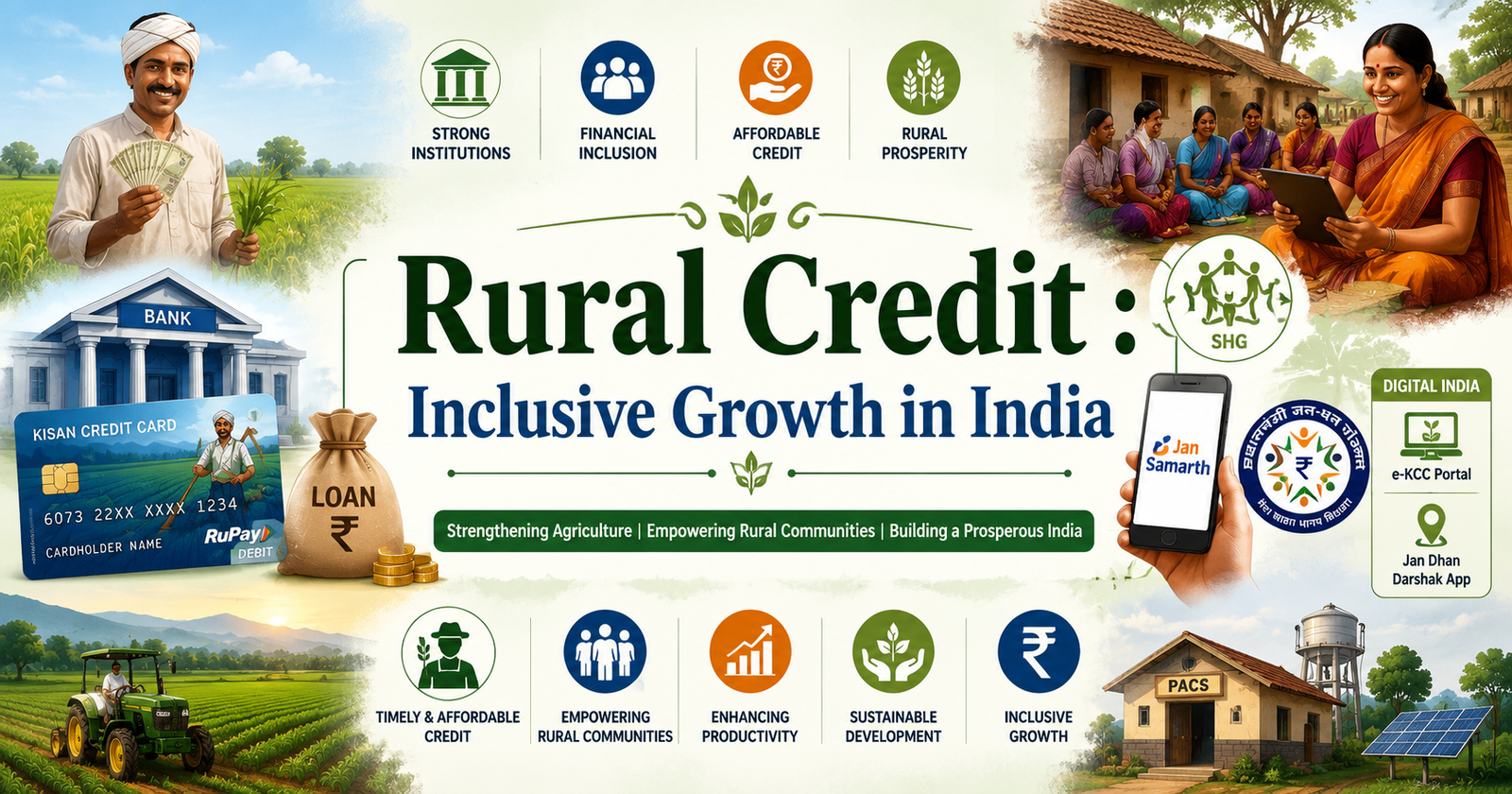
Explore rural credit system of India, institutional framework, major schemes, policy reforms, financial inclusion initiatives, and their role in promoting agricultural growth and inclusive rural development.
Syllabus Areas:
GS III - Economy
India's rural credit system forms the backbone of agricultural and rural development by ensuring timely and affordable financial access.
What is the Rural Credit System?
The Rural Credit System refers to the organized network of financial institutions, policies, and credit delivery mechanisms that provide timely, adequate, and affordable financial assistance to rural households, particularly farmers, agricultural labourers, rural entrepreneurs, and allied sectors. Its primary objective is to support agricultural production, promote rural livelihoods, reduce dependence on informal moneylenders, and foster inclusive rural development.
Types of Credit Provided
The rural credit system caters to different financial needs:
1. Short-Term Credit (up to 15 months)
Used for:
-
Purchase of seeds, fertilizers, pesticides
-
Payment of wages
-
Irrigation expenses
-
Crop cultivation
Example: Kisan Credit Card (KCC) loans.
2. Medium-Term Credit (15 months to 5 years)
Used for:
-
Purchase of tractors and farm machinery
-
Dairy and poultry units
-
Horticulture development
-
Land improvement
3. Long-Term Credit (Above 5 years)
Used for:
-
Irrigation projects
-
Farm mechanization
-
Plantation crops
-
Rural infrastructure
-
Warehouses and cold storage

Evolution of Rural Credit System
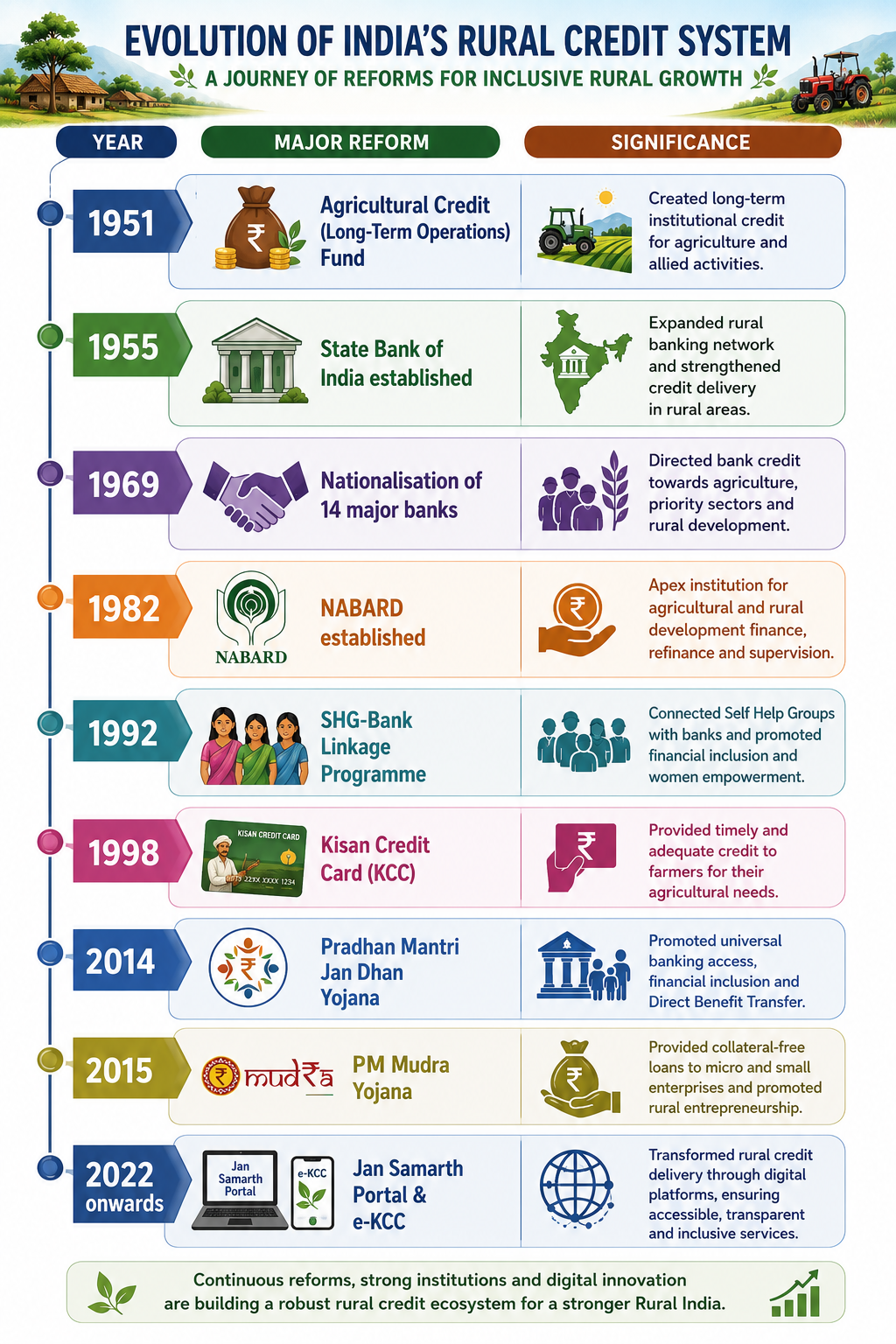
In the post-Independence period, the Government and the Reserve Bank of India (RBI) undertook key initiatives to strengthen institutional credit.
1955: Establishment of the State Bank of India (SBI) and the National Agricultural Credit (Long-Term Operations) Fund to strengthen rural banking.
1969: Nationalisation of 14 major commercial banks, expanding institutional credit to agriculture and priority sectors.
1982: Establishment of NABARD, the apex institution for agricultural and rural development finance.
1992: Launch of the Self-Help Group (SHG)-Bank Linkage Programme to improve rural access to formal credit.
1998: Introduction of the Kisan Credit Card (KCC) Scheme for timely and affordable farm credit.
2014: Launch of Pradhan Mantri Jan Dhan Yojana (PMJDY), strengthening financial inclusion through the JAM Trinity.
2015: Launch of the Pradhan Mantri MUDRA Yojana (PMMY) to provide collateral-free loans to micro and small enterprises.
2022 onwards: Introduction of digital initiatives such as the Jan Samarth Portal and e-KCC, making rural credit more accessible, transparent, and technology-driven.