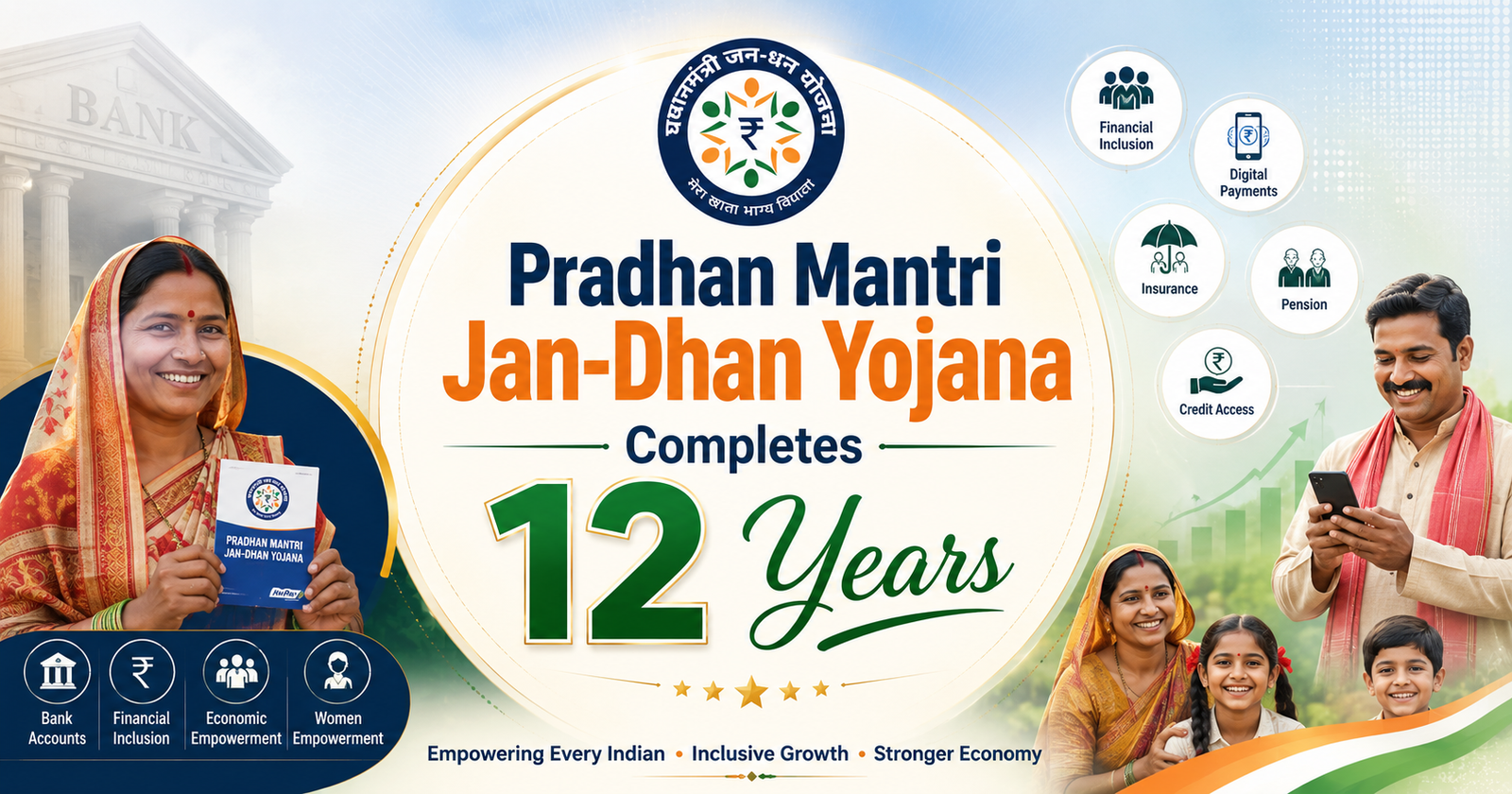
PMJDY has transformed financial inclusion by expanding banking access, strengthening women and rural empowerment, enabling digital payments, and supporting direct benefit transfers for greater economic self-reliance.
Syllabus Areas:
GS III - Economy
The Pradhan Mantri Jan-Dhan Yojana (PMJDY) has completed 12 years, marking a significant journey in India's efforts towards financial inclusion.
Union Minister for Women and Child Development Smt. Annpurna Devi described the scheme's journey as one that has moved “from financial inclusion to economic empowerment.”
What is PMJDY?
Pradhan Mantri Jan-Dhan Yojana (PMJDY) was launched on 28 August 2014 by the Government of India. Pradhan Mantri Jan-Dhan Yojana is a financial inclusion initiative of the Government of India aimed at providing access to formal banking and financial services, particularly to underserved sections of society, thereby promoting financial security, inclusive growth and economic empowerment.
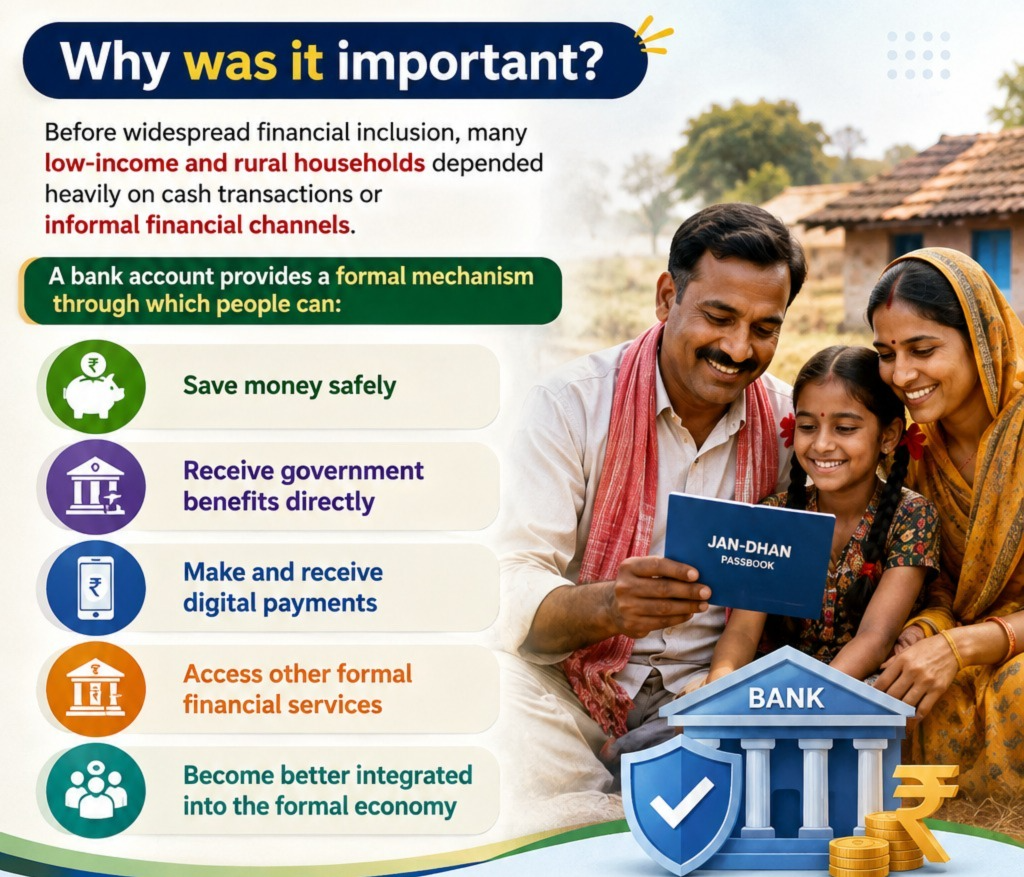
More than 59 crore Jan-Dhan accounts opened
A major achievement highlighted in the press release is the opening of more than 59 crore Jan-Dhan accounts.
These accounts have connected millions of citizens with the formal banking system and have contributed to building a foundation for greater financial self-reliance.
Women are major beneficiaries
Women account holders constitute a substantial share of the Jan-Dhan accounts.
-
56% of Jan-Dhan accounts belong to women.
This highlights the important role of PMJDY in bringing women into the formal financial system and strengthening their access to banking services.
Strong rural and small-town penetration
The scheme has also achieved significant outreach beyond major urban centres.
-
78% of Jan-Dhan accounts are in villages and small towns.
This demonstrates the scheme's focus on extending formal banking access to rural populations and people living in smaller settlements.
Deposits cross ₹3.1 lakh crore
The deposits held in Jan-Dhan accounts have crossed ₹3.1 lakh crore.
This indicates the growing participation of account holders in the formal banking ecosystem and reflects the scale of financial resources brought into formal accounts through the scheme.
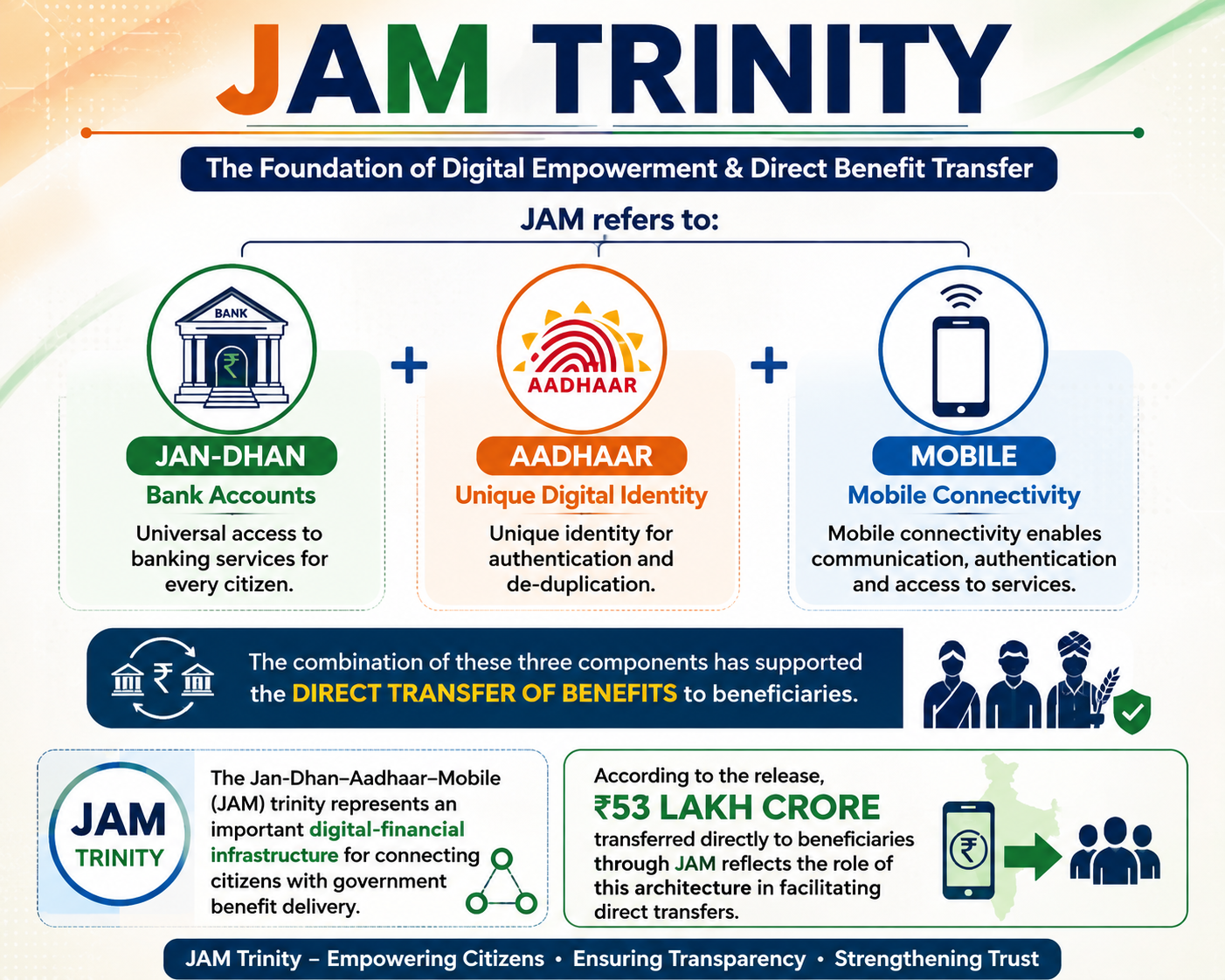
Direct Benefit Transfer (DBT)
Direct Benefit Transfer (DBT) is a Government of India mechanism through which government subsidies, welfare benefits, and financial assistance are transferred directly into beneficiaries’ bank accounts, reducing intermediaries and leakages.
Example:
A farmer eligible for a government income-support scheme receives the money directly in their bank account rather than through a middleman.
Focus on women and rural families
The Union Minister specifically highlighted the role of PMJDY in connecting citizens, particularly women and rural families, with the formal banking system.
The broader significance is therefore not merely the creation of bank accounts, but the expansion of access to formal financial services among sections of the population that have traditionally faced greater barriers to banking access.
Financial inclusion as a foundation for dignity and security
The press release characterises the Jan-Dhan journey as more than simply opening bank accounts. It describes the scheme as a transformative journey of dignity, security and empowerment.
It presents financial inclusion as an instrument that can strengthen people's economic participation and financial security.
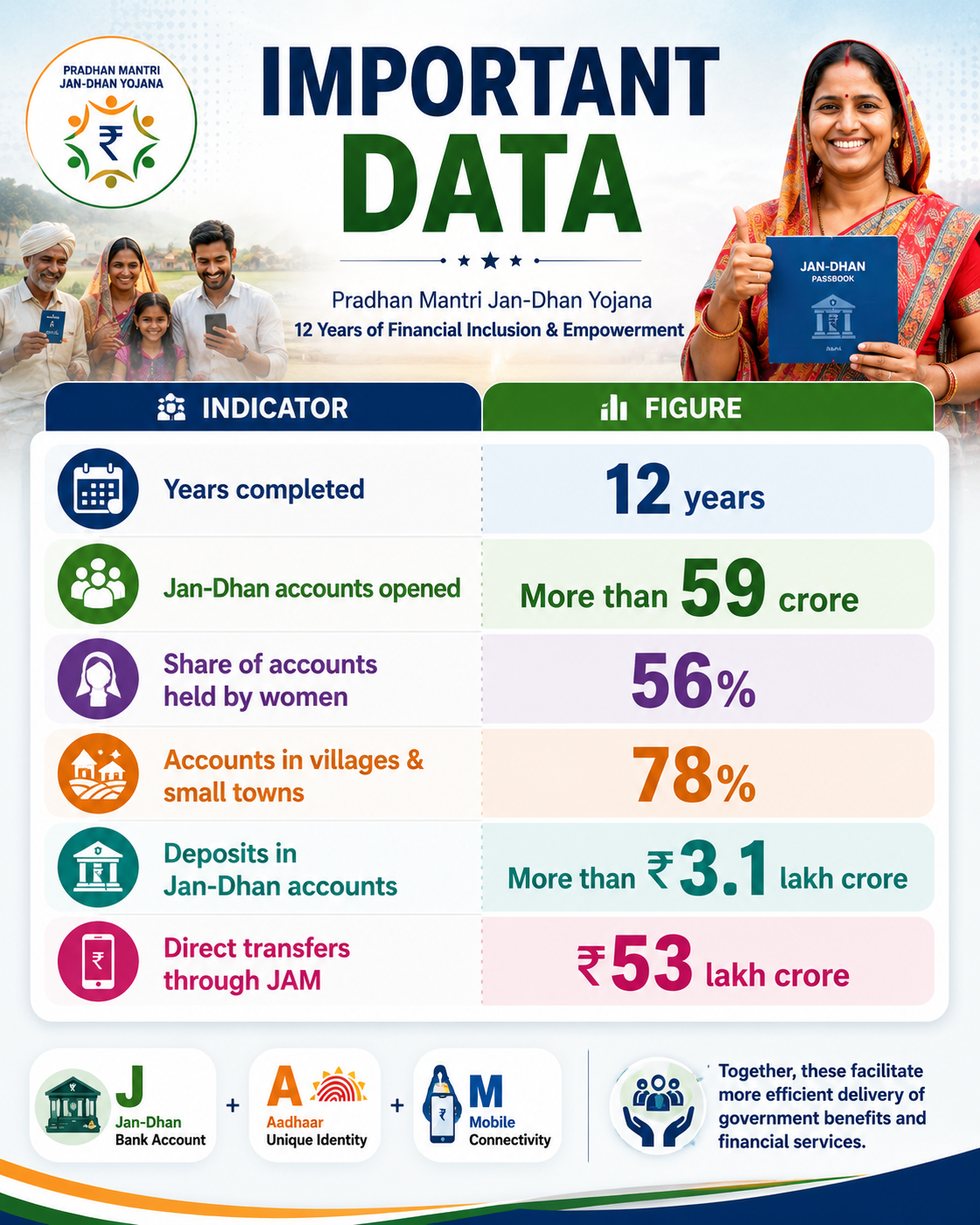
From financial inclusion to economic empowerment
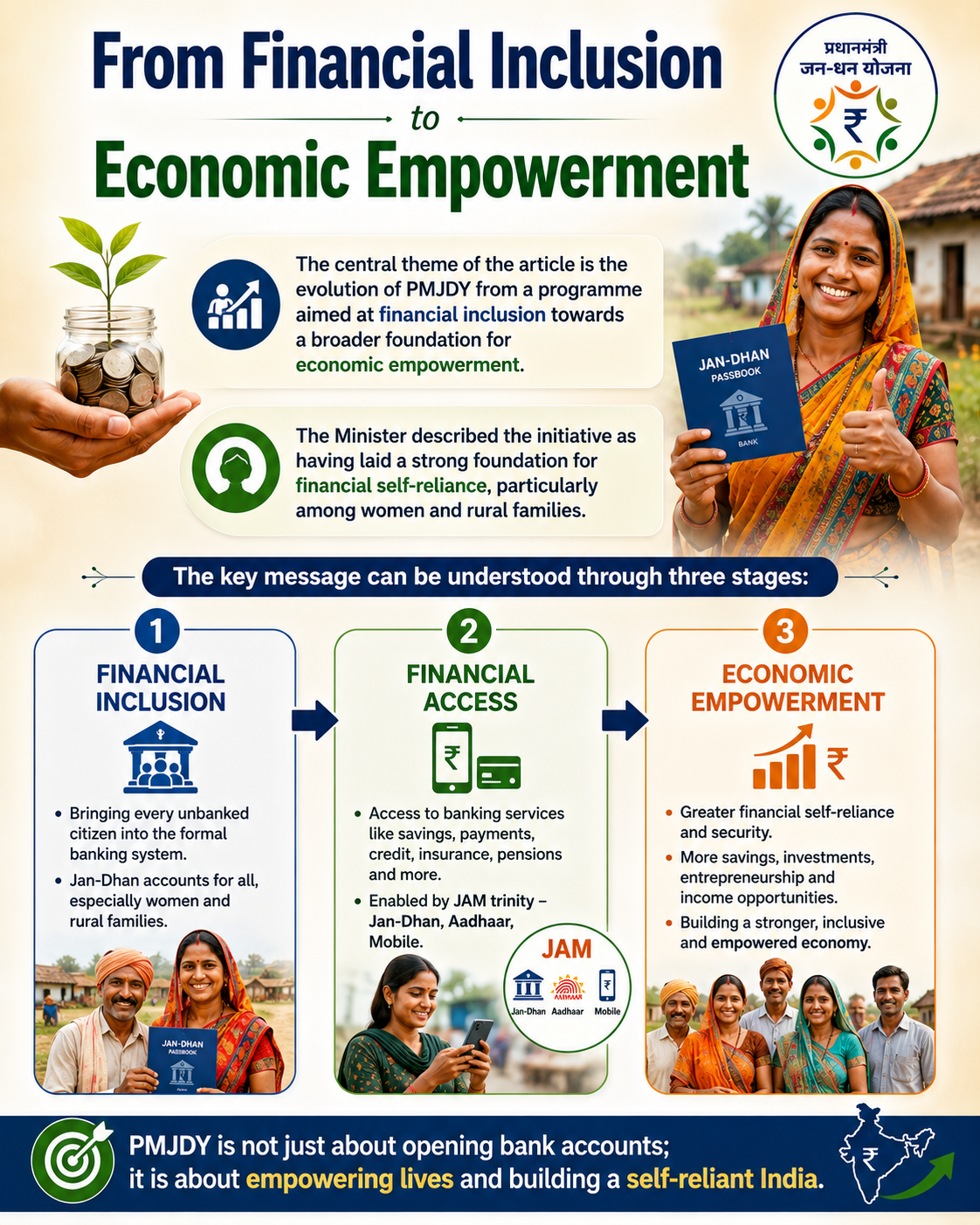
The central theme of the article is the evolution of PMJDY from a programme aimed at financial inclusion towards a broader foundation for economic empowerment.
The Minister described the initiative as having laid a strong foundation for financial self-reliance, particularly among women and rural families.
The key message can be understood through three stages:
Financial Inclusion → Financial Access → Economic Empowerment
Challenges of PMJDY:
-
Opening accounts does not guarantee financial inclusion, especially when beneficiaries rarely use them for savings, payments, credit, insurance, or pensions.
-
Limited financial literacy prevents many first-time banking users from understanding interest rates, insurance, credit, digital banking procedures, and fraud prevention.
-
Digital exclusion persists because poor connectivity, limited smartphone access, inadequate digital skills, and accessibility barriers restrict participation in digital finance.
-
Insufficient banking infrastructure in remote areas makes access difficult when beneficiaries lack nearby branches, ATMs, banking correspondents, or reliable connectivity.
-
Banking Correspondents face operational challenges, including availability, reliability, transaction costs, and sustainability, potentially weakening last-mile delivery of financial services effectively.
-
Greater digital financial participation can increase exposure to phishing, OTP fraud, identity theft, fake banking calls, and fraudulent digital transactions.
-
Aadhaar authentication failures, incorrect beneficiary details, or technical problems can disrupt access to benefits, highlighting the need for grievance mechanisms.
-
Having a bank account does not automatically ensure affordable institutional credit, insurance, pensions, investments, or other essential formal financial services.
-
Women may possess Jan-Dhan accounts without achieving complete financial autonomy because social constraints, limited literacy, and restricted digital access persist.
-
Effective Direct Benefit Transfer requires accurate beneficiary identification, correct account linkage, successful transactions, and beneficiaries' ability to access transferred funds.
Way Forward:
-
Financial Literacy: Expand targeted awareness programmes to improve understanding of savings, credit, insurance, pensions, and digital banking.
-
Last-Mile Infrastructure: Strengthen banking correspondents, micro-ATMs, ATMs, and internet connectivity in underserved rural regions.
-
Active Usage: Encourage regular savings, digital transactions, and meaningful use of financial products.
-
Digital Inclusion: Provide affordable smartphones, reliable internet, vernacular interfaces, and digital-literacy training.
-
Cybersecurity: Strengthen fraud prevention, transaction monitoring, consumer awareness, and grievance redressal.
-
Institutional Credit: Improve access to affordable credit, insurance, pensions, and investments.
-
Women’s Empowerment: Promote women’s financial independence, literacy, entrepreneurship, and account usage.
-
Efficient DBT: Ensure reliable Aadhaar-linking, authentication, and transaction systems.
-
Inclusive Banking: Simplify procedures and provide multilingual, assisted services.
-
Outcome-Based Approach: Measure inclusion through usage, savings, credit, security, and empowerment.
PMJDY has transformed financial inclusion by bringing millions into the formal banking system. The next phase must move beyond account opening towards active usage, digital inclusion, financial security and empowerment, ensuring that every beneficiary gains sustainable economic opportunities and resilience.