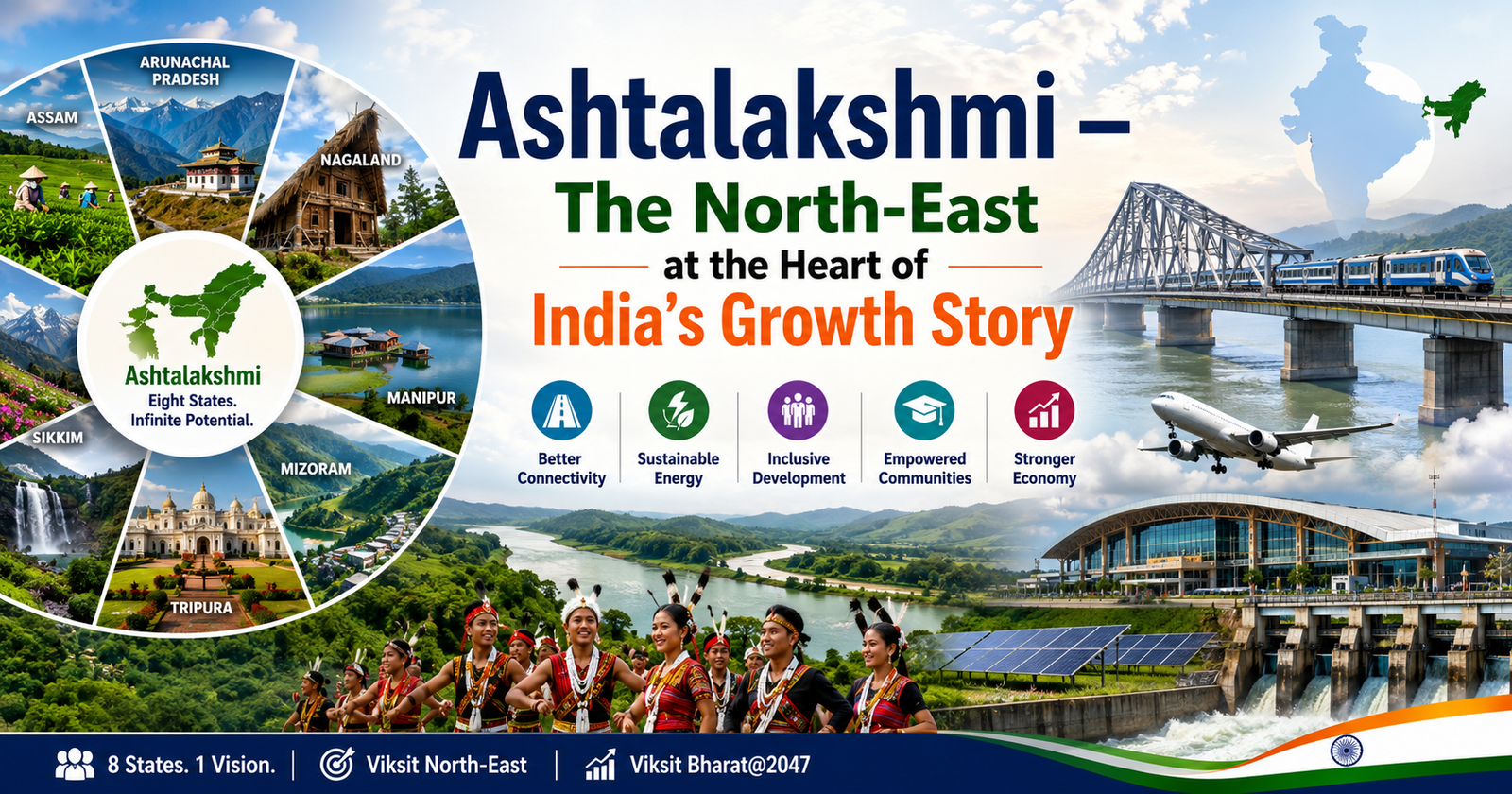
The Press Information Bureau (PIB) released a detailed backgrounder titled "Ashtalakshmi – The North-East at the Heart of India's Growth Story". The report highlights the transformative development of the North-Eastern Region ov
Syllabus Areas:GS II - Governance GS III - Economy and Development |
The North-Eastern Region (NER), comprising Assam, Arunachal Pradesh, Manipur, Meghalaya, Mizoram, Nagaland, Tripura, and Sikkim, is collectively known as "Ashtalakshmi." Over the last decade, the region has undergone a remarkable transformation driven by sustained policy support, improved connectivity, infrastructure expansion, and inclusive welfare measures. The North-East is increasingly becoming a strategic pillar of India's economic growth, regional integration, and Act East Policy.
1. Dedicated Policy Push for the North-East
The development of the North-East has been supported through a targeted policy framework led by the Ministry of Development of North Eastern Region (MDoNER).
-
A total of 3,746 projects have been sanctioned under various schemes.
-
2,730 projects have already been completed.
-
Completed projects represent investments exceeding ₹27,963 crore.
-
Major schemes include PM-DevINE, NESIDS, NEC Schemes, and Special Development Packages.
PM-DevINE Scheme
The Prime Minister's Development Initiative for North East Region (PM-DevINE) is a 100% centrally funded scheme with an outlay of ₹6,600 crore from 2022-23 to 2025-26. It focuses on infrastructure, livelihood generation, social development, and addressing critical developmental gaps.
2. Act East Policy and Strategic Importance
The Act East Policy has placed the North-East at the centre of India's engagement with Southeast Asia.
-
The policy promotes connectivity, trade, cultural exchanges, and border infrastructure.
-
The North-East is being transformed from a frontier region into India's gateway to ASEAN.
-
Cross-border connectivity projects are strengthening regional integration and economic opportunities.
Key Projects
-
India–Myanmar–Thailand Trilateral Highway will connect Moreh in Manipur to Thailand through Myanmar.
-
Kaladan Multi-Modal Transit Transport Project will improve connectivity between the North-East and Myanmar while reducing logistics costs.
3. Connectivity Revolution in the North-East
Road Connectivity
Road infrastructure has expanded significantly over the last decade.
-
National Highway length increased from 10,905 km in 2014 to 16,207 km in 2025.
-
Under Bharatmala Pariyojana, more than 2,100 km of roads have been awarded and over 1,800 km completed.
-
Under PMGSY, around 50,850 km of rural roads have been constructed, improving access to markets, healthcare, and education.
Rail Connectivity
Rail infrastructure has witnessed unprecedented expansion.
-
Railway budget allocation increased from ₹2,122 crore (2009-14) to ₹11,486 crore (2026-27).
-
Railway track commissioning increased from 333 km to over 1,900 km.
-
Arunachal Pradesh, Meghalaya, Nagaland, Tripura, and Mizoram achieved 100% railway electrification.
Important Rail Projects
-
Introduction of the Vande Bharat Express between Guwahati and New Jalpaiguri.
-
Around 60 railway stations are being redeveloped under the Amrit Bharat Station Scheme.
Air Connectivity
Air transport has greatly improved accessibility.
-
The UDAN Scheme facilitated the development of 8 new airports.
-
Around 90 regional routes have been operationalized.
-
The number of airports increased from 9 in 2014 to 17 in 2026.
Inland Waterways
The Brahmaputra and Barak river systems are being developed as major transport corridors.
-
National Waterway-2 on the Brahmaputra connects the North-East with mainland India and Bangladesh.
-
The number of National Waterways increased from 1 in 2014 to 20 in 2024.
Digital Connectivity
Digital infrastructure has expanded rapidly.
-
6,355 Gram Panchayats have become service-ready for broadband services.
-
3,718 mobile towers have been commissioned covering 5,366 villages.
4. Major Infrastructure Projects
-
Bogibeel Bridge (Assam): India's longest combined rail-cum-road bridge across the Brahmaputra, improving connectivity between Dibrugarh and Dhemaji districts.
-
Dhola-Sadiya Bridge (Bhupen Hazarika Setu): The country's longest road bridge connecting Assam and Arunachal Pradesh while enhancing strategic mobility.
-
Noney Bridge (Manipur): Expected to become the world's tallest railway pier bridge with a height of 141 metres.
-
Sela Tunnel (Arunachal Pradesh): Provides all-weather connectivity to Tawang and strengthens border infrastructure and defence preparedness.
-
Energy Security and Green Growth: The North-East is emerging as an important centre for India's clean energy transition.
5. Hydropower Development
Dibang Multipurpose Hydropower Project
-
Capacity: 2,880 MW
-
Located in Arunachal Pradesh.
-
Expected to become the tallest dam structure in India.
-
Supports power generation and flood control.
Subansiri Lower Hydroelectric Project
-
Capacity: 2,000 MW
-
India's largest run-of-the-river hydropower project.
North-East Gas Grid
-
Around 1,656 km pipeline network is under development.
-
Will connect all eight North-Eastern states to the national gas grid.
-
Includes Asia's longest hydrocarbon river-crossing pipeline beneath the Brahmaputra.
Solar and Green Hydrogen
-
A 20 MW solar park has been commissioned in Mizoram.
-
A 25 MW Green Hydrogen Plant is being developed in Assam.
-
Renewable energy initiatives are supporting sustainable development.
6. Water, Sanitation and Urban Transformation
Jal Jeevan Mission
The mission aims to provide tap water connections to all rural households.
-
Arunachal Pradesh and Mizoram achieved 100% tap water coverage.
-
JJM 2.0 has been extended until 2028 with enhanced financial support.
Swachh Bharat Mission
-
All North-Eastern states have attained ODF status.
-
Around 57 lakh household toilets have been constructed.
-
The focus has shifted towards ODF Plus villages and scientific waste management.
7. Healthcare Infrastructure
Healthcare access has expanded significantly across the region.
-
AIIMS Guwahati has become the region's premier tertiary healthcare institution.
-
12 medical colleges have been approved.
-
More than 2.43 crore Ayushman Bharat cards have been issued.
-
Over 8,200 Health and Wellness Centres provide primary healthcare services.
-
Telemedicine services are operational across all eight states.
8. Education and Skill Development
Education infrastructure has improved substantially.
-
The region has 79 universities, 1,001 colleges, and 110 ITIs.
-
Nearly 48 Eklavya Model Residential Schools have been established in tribal areas.
-
Higher education enrolment increased from 9.36 lakh to 12.02 lakh students.
-
622 Atal Tinkering Labs promote innovation and scientific learning.
9. Housing and Electrification
PMAY-Gramin
-
More than 28 lakh rural houses have been completed.
-
Beneficiaries also receive access to toilets, electricity, LPG, and tap water.
PMAY-Urban
-
Around 3.24 lakh urban houses have been completed for economically weaker sections and low-income groups.
Universal Electrification
-
All eight North-Eastern states have achieved 100% household electrification under the Saubhagya Scheme.
10. Agriculture and Allied Sector Development
The North-East possesses immense potential in agriculture, fisheries, livestock, horticulture, bamboo cultivation, and organic farming.
Fisheries Sector
-
Inland fish production increased from 4.03 lakh tonnes (2014-15) to 6.78 lakh tonnes (2024-25).
-
Assam contributes more than 70% of regional fish production.
Dairy and Livestock
-
The first IVF laboratory in the region was established in Guwahati under Rashtriya Gokul Mission.
-
Milk production increased from 1,293.5 thousand tonnes to 1,739.9 thousand tonnes.
-
Egg production also witnessed substantial growth.
Agarwood Economy
-
Nearly 90% of India's agarwood trees are located in the North-East.
-
Agarwood exports have expanded significantly, creating new livelihood opportunities.
11. Farmer Welfare and Agricultural Support
PM-KISAN
-
Around 26.98 lakh farmers are registered under PM-KISAN.
-
More than 10.08 lakh women farmers received support under the 19th instalment.
National Mission on Edible Oils
-
Funding increased from approximately ₹170 crore to nearly ₹475 crore between 2021-22 and 2024-25.
-
The mission promotes oilseed cultivation and reduces import dependence.
PM-KUSUM
-
Supports solar-powered agricultural infrastructure.
-
Around ₹58.2 crore has been released for North-Eastern states under the scheme.
The North-East has transformed from a geographically isolated frontier region into a strategically important growth hub. Through sustained investments in connectivity, energy, social infrastructure, healthcare, education, housing, and agriculture, the region has emerged as a critical component of India's Act East Policy and Viksit Bharat vision. The Ashtalakshmi model demonstrates how focused policy support and inclusive development can unlock the vast economic and strategic potential of a region.